Tag: 21st century literature

A Fan, Some Pans and Back Again: Ian McEwan’s What We Can Know

The first Ian McEwan novel that I’ve read in two decades . . . . . . and what did I think of it?  Well, you’ll just have to scroll down to find out!  Fear not, Gentle Readers,  I’ve inserted lots of subheadings to make it easy for you to skip the boring bits ….

I.   Preliminary Remarks: What’s Not Been Happening With the Blog 

I’ve been so inactive with my blog last year, and so very disinclined to write posts, that I’ve seriously considered giving the enterprise a merciful death.  After all, it’s sooooo much easier to leave comments on other bloggers’ well thought out opinions than to write my own posts!  Although I’m all about the easy solution, however, I do find that I’ve been a little dissatisfied since I’ve stopped posting, particularly when I’ve just finished a marvelous book (I read several last year), or I read one of your posts on a book I’ve previously read and loved, or read and hated, or even merely thought about reading.  I have the strong but supremely irrational feeling that, if I’ve even thought about it, it’s my book!  At such times, my adrenaline flows, ideas rush in and I find myself thinking, “I really should have written about that!”  It’s not that I think my insights are particularly insightful; I simply have more fun when I share my opinions on what I’ve read.  After all, the excitement of discovering new books and the joy of sharing our discoveries is really why most of us blog, innit?  I’ve also found that writing, and the organizing and analysis that it demands, always helps me to understand better whatever I’ve just read and, equally important, to appreciate what a particular writer is (or is not) trying to accomplish.  Posting also serves a very practical domestic function in the Janakay household, as it gives a welcome break to poor Mr. J., who’d otherwise have to listen to my yammering about books that he, a committed reader of serious non-fiction, has absolutely no interest in reading!  All in all, I do think I’ll pay a bit more attention to the blog in 2026 (my first New Year’s resolution perhaps?), although I doubt that I’ll ever be one of your methodical “post on a schedule” types.

And what better time to start than now?  My last post occurred in January, 2025; a nice piece of symmetry, don’t you think, for my next one to occur almost precisely a year later?  A pair of symbolic bookends, so to speak, with absolutely nothing blog-wise occurring in-between.  Last year was a mixed year for my reading, which began quite slowly (hard to concentrate given the dreadful political events in the U.S. and with a mild case of PTSD brought on by surviving two major hurricanes in one month).  After the first few months of 2025, however, I eventually recovered my bookish mojo and went on to have a fairly satisfying year.  Along with some bookless spaces here and there and a few duds over the months (I had a higher percentage than usual of abandoned books last year) my 2025 list eventually included several memorable novels, ranging from very good (e.g. Pamela Hansford Johnson’s Helena Trilogy); to wonderful (Desai’s Sonya and Sunny & Ęca de Queirós’ The Maias) to really, really fabulous (Leopoldo Alas’ La Regenta — thanks again, Silvia, for suggesting this project!).  As with the past, I also read several things for sheer distraction and fun.  I didn’t alas, make it to Lottie Hazell’s Piglet but I’d definitely recommend Harriet Lane’s Other People’s Problems, a wonderfully nasty tale of envy & revenge and a most welcome distraction during that dreary afternoon in Chicago’s Midway when my plane was late.

II.   A Fan and a Pan: How I Fell In and Out of Love

So why go now with McEwan, a writer I’ve actively avoided for two decades or more, when I’ve read so many other wonderful books this year?  Practicality, as always, carries considerable weight in these types of decisions.  Because What We Can Know (WWCK) is my most recent “big” book, its impact is fresher than that of the complex novels I read earlier in the year, making it easier (remember — I’m all about the short cuts) to yammer on about.  Equally important, I wanted to test my reaction at returning to an old love.  For you see, Gentle Readers, back in the early days of “Ian Macabre” I was one of this writer’s biggest fans.  Although my memory of The Cement Garden (1978) is now a bit hazy, I still retain fond recollections of The Comfort of Strangers (1981), and, to a lesser extent, of Black Dogs (1992); Enduring Love (1997); and Amsterdam (1998).

But then, towering above even these very interesting gems, came Atonement (2001), my very, very favorite McEwan novel and one of my most memorable books from that era of my life.  What a transcendent few days I spent, reading that masterpiece!  However did it not win the Booker that year?  Atonement was one of my early experiences with meta fiction, which was exhilarating in itself.  This, combined with lyrical writing, a clever plot and great characters (I still haven’t forgiven that nasty little Briony) made it one of those transcendent reading experiences that so seldom comes one’s way (I am not embarrassed to say, dear Readers, that one of Atonement’s plot twists reduced me literally to tears).  In addition to all this surface shine, Atonement raised some very provoking questions regarding time, memory and artistic morality:  when an artist transmutes his/her great sin into a beautiful work of art, has s/he atoned for their transgression or merely rationalized their moral failure?  (Readers, this is a question I’m still pondering in the odd moment or two, particularly when I’m listening to Wagner.)  I was already a confirmed admirer prior to Atonement; with its publication I became a worshiper at the Shrine of McEwan!

My adulation lasted until 2005 and the publication of Saturday, when I concluded that my literary god had feet of clay.  With advance apologies to any fan of the novel, I really, really hated Saturday.  I was baffled by its glowing reviews from critics and prize committees (it made the Booker short list & won the James Tait Black Memorial Prize for fiction, etc), as I wholeheartedly agreed with John Banville’s opinion that Saturday was “ill-conceived,” smug and “a dismayingly bad book.”  (If its website is in a generous mood, you may read the entirety of Banville’s entertaining & highly critical review in the May 26, 2005 edition of the New York Times Book Review.)  Perhaps it was class consciousness (although we both favor the same recording of the Goldberg Variations, Saturday’s privileged protagonist & I occupy opposite ends of the social spectrum) or perhaps an almost laughable plot twist (reciting “Dover Beach” repelled the thugs invading your homeReally?).  Perhaps it was simply the wrong book for me at the wrong time, but Saturday parted the ways for me and my hitherto beloved Ian Mc.  In the following years, I barely glanced at reviews of McEwan’s subsequent novels and wasn’t at all tempted to read any of them.

So what made me risk fifteen U.S. dollars (the current sales price on that platform we all love to hate) and two days of my time on WWCK?  True, the novel has received glowing reviews but then, so did Saturday.   WWCK’s plot, centering on a search for a lost literary work, seemed intriguing; almost enough to overshadow my cringing memory of Saturday’s smugly rarefied & privileged world.  WWCK’s futuristic setting was also a strong draw; I love sci-fi, especially when it nods towards dystopia.  Timing, as always, certainly helped, as I’d just finished a marvelous book right before Christmas (Margaret Kennedy’s Troy Chimneys, if you’re curious) and found myself in one of those awkward “whatever do I read now” holes that urgently demanded a new book.  At this crucial point, I stumbled upon yet another laudatory review (this one in the New York Times, where WWCK apparently gave the reviewer “so much pleasure” he  “laughed with delight” etc etc).   Reading this effusion with some skepticism, my eye caught the sentence that tipped the scales, i.e., WWCK is “the best thing McEwan has written in ages.”  Gentle Readers, it had been over twenty years since my disillusionment.  I decided to risk all (well, fifteen bucks and an afternoon) to give my former love another chance.

III.   Back Again: So What About The Novel Itself?

WWCK is a chameleon of a novel, deceptively simple in structure and surprisingly complex in content.  Opening in the 22nd century and extending back into our own times, at its simplest level WWCK is a literary mystery centered on the fate of the only extant copy of a legendary poem, “Corona for Vivien.”  Composed in 2014 by the great (fictional) poet Francis Blundy as a birthday present for his wife, the poem was subsequently lost in the climate disasters and political upheaval that destroyed the world as we know it.  In pursuing the mystery of the poem’s fate, McEwan’s protagonists encounter some very melodramatic events (murder! insanity! attempted kidnapping! betrayal! revenge!) and the reader gets to enjoy some very nicely done satire as McEwan skewers (among other things) academia, the literary world and current pop culture.  Lurking beneath the brio of the literary treasure hunt, however, are some very serious questions regarding the nature of history (as well as who gets to tell the story); the relationship between biographer and subject and the detritus (both physical & metaphorical) we of the present day are leaving for future generations.

I hope I’m not making WWCK sound overwhelming and pompous, because it’s nothing of the sort.  Although serious themes are definitely present, they are treated very lightly and can be happily ignored by readers who prefer focusing on a treasure hunt and a sci-fi setting rather than pondering the big questions.  Regardless of a reader’s chosen approach, WWCK is equally enjoyable; it’s tightly plotted, with complex and well-drawn characters and the prose is among McEwan’s best.  What can I say, Readers, except the obvious — I absolutely adored this novel!

I particularly enjoyed McEwan’s depiction of life in the 22nd century setting.  Like Margaret Atwood, McEwan has an definite knack for world building and is equally skillful in extrapolating from current trends to construct an all too plausible future.  While both writers concern themselves with environmental issues, Atwood IMO focuses more on scientific and social aspects (e.g., the MaddAddam Trilogy’s genetic engineering or The Handmaid’s Tale & Testament’s female repression) while McEwan concentrates more on the geopolitical.  WWCK’s world is a product in part of the Derangement, a late 20th century phenomenon in which society collectively acknowledged, but refused to address, the catastrophic effects of climate change.  In 2042, amidst rising sea levels and conflicts over dwindling resources (the mid-21st century is marked by several “climate wars” for instance), came the Inundation, a global flooding event triggered when a Russian hydrogen bomb aimed at the U.S. misfired over the Atlantic Ocean.  The resulting seventy meter waves (combined with record high sea levels) obliterated three-quarters of the Atlantic-facing population of North America, Europe and West Africa:

There were only a few hours of warning.  The survivors were those who trusted their governments sufficiently to act, had transport and were not trapped in traffic jams and knew the routes to higher ground.  * * * Lagos, London, Rotterdam, Hamburg and most of Paris did not emerge from under the counter-surges that raced up estuaries or from the savage storms that followed.  In revenge assaults, Russia lost St. Petersburg * * *   More than 200 million died.  Britain became an archipelago, its population halved (pages 105-106).

The world portrayed in WWCK, however, is far from the blood soaked, cannibalistic scenarios so common in today’s dystopian fiction (think Cormac McCarthy’s novel The Road or a movie like The Day).  Despite its best efforts to self-destruct, humanity not only survived but managed to preserve a sizable chunk of its cultural past.  The survivors and their descendants adapted surprisingly well to a world that was now without heavy metals, fossil fuels or much dry land.  Life is peaceful, with stable communities existing on the small archipelago islands that survived the Inundation and nature (albeit much diminished in species diversity) has begun to recover.  New technologies (such as retrieving metal from wrecked & drowned vehicles and making “protein bars” from bacteria & atmospheric carbon dioxide) have developed to replace those of our own time.  Major libraries and museums have been relocated to the highest of elevations and are relatively safe & reasonably accessible to those willing to travel by boat.  Take comfort in this fictional future, dear Readers with academic inclinations!  Universities and literature departments very much remain a feature of life, along with their associated & perennial problems of bureaucracy, inadequate funding and students who’d rather be elsewhere.

Just as quotidian life has changed, so also has geopolitical hegemony.  Global power has shifted from the West to Nigeria (Britain has been reduced to a string of small, isolated islands while the United States has devolved into warring territories ruled by rival warlords, much like its current situation).  A controlled and regulated AI plays an important role in ordinary life and, in a point that’s very important for plot purposes, the pre-Inundation internet with all its contents has been preserved and maintained by Nigerian scientists.  As Tom Metcalf, the novel’s protagonist who leads the quest to recover the lost “Corona for Vivien,” explains (p 58):

Everything that has ever flowed through the internet is now held centrally in New Lagos and has been well-catalogued.  Advances in quantum computing and mathematics have cracked open all that was once encrypted.  I’d like to shout down through a hole in the ceiling of time and advise the people of a hundred years ago:  if you want your secrets kept, whisper them into the ears of your dearest, most trusted friend.  Do not trust the keyboard and screen.  If you do, we’ll know everything.  

The idea of “robb[ing] the past of its privacy” (page 17) plays an important role in WWCK.  Aside from being a clever twist on the omniscient narrator (it’s the data bank that now knows everything and makes it available to a diligent researcher), it underscores one of the novel’s main themes, so amply demonstrated in Tom’s all-consuming quest to discover the fate of the lost poem, i.e., that one may possess a massive amount of data about an object (including a poem!) or person, without really knowing anything at all about either it or her.  Echoing McEwan’s previous great novel Atonement, WWCK is very much concerned with that liminal space between reality and fiction, between the objective “truth” the artist/writer observes and that which s/he invents.

WWCK begins in 2119 with Tom Metcalf, a literature professor at the University of the South Downs, traveling by boat to the Bodleian library, now located on a mountain peak in Wales.  Specializing in fiction from the 1990-2030 period, Tom is obsessed with the poet Francis Blundy, one of the major poets of his era (eclipsed only by Seamus Heaney) and his lost masterpiece “Corona for Vivien.”  (I’ll spare you the wiki click dear Readers, as well as most of the technical details.  It’s enough to know that a “corona” is a complex sequence of sonnets linked by their internal structure and exploring different aspects of the same theme.)  The poem, which exalted the beauty of nature and the mutual love between Blundy and his wife, was handwritten by Blundy on vellum and presented to Vivien at a dinner party in honor of her birthday in October 2014.  To mark the unique value of Vivien’s gift, Blundy made no copies; the fate of the poem, in other words, lay entirely (and literally) in Vivien’s hands.  Although Blundy read the poem for the couple’s dinner guests, his reading was not recorded nor, surprisingly given the poet’s fame, was the work subsequently ever published.  As a result, “Corona for Vivien” is known to the 22nd century only through the imperfect memories of the Blundys’ dinner guests, whose emails, social media posts and memoirs suggest that the poem was the culminating masterpiece of Blundy’s career.  With the passing of the years, the dinner party (known as “the Second Immortal Dinner,” the first being an 1817 event attended by Wordsworth, Lamb & Keats) became legendary and the mystery and allure of the missing poem grew.  Because it so lovingly catalogued the glories of the natural world, it even became an anthem of the environmental movement, with many believing that the oil industry had bribed Blundy to suppress the poem’s publication.  “Like the play of light and shadow on Plato’s cave,” “Corona for Vivien” became for posterity the ideal for all poetry, “all the more beautiful for not being known.”  (page 107)

Aside from the dinner party itself, the first and longer portion of WWCK concerns Tom’s obsessive search for the poem, which, he is convinced, has been hidden by Vivien in some now inaccessible spot.  I won’t repeat the details of either Tom’s detective work or physical quest, conducted with the aid of Rose, his colleague and on-again, off-again lover.  I’m afraid you’ll have to read those for yourself, although I will say that both were quite entertaining.  Equally so, IMO, were the glimpses into the pair’s teaching grind (“In the two weeks allotted, almost half the kids had done some of the reading, well above the norm, though none had managed the full ninety-six pages” (page 154)).  Because it would be impossible to avoid spoilers, I’ve also decided not to discuss Part Two of the novel except to say that McEwan uses it to switch both narrator and time period.  This tricksy maneuver gives a whole different perspective on the Corona’s creation and meaning; equally important, it heightens many of the serious themes the novel evokes.

Given how much I enjoyed WWCC, do I regret my long boycott of McEwan’s work?  Not really, although I’m open to suggestions if any McEwan fan cares to offer a recommendation regarding the novels I’ve skipped.  While I’m not terribly eager to make up lost ground, I am actually considering a 2026 re-read of The Comfort of Strangers!

IV.  If You’ve Made It This Far, Here’s Your Visual Reward
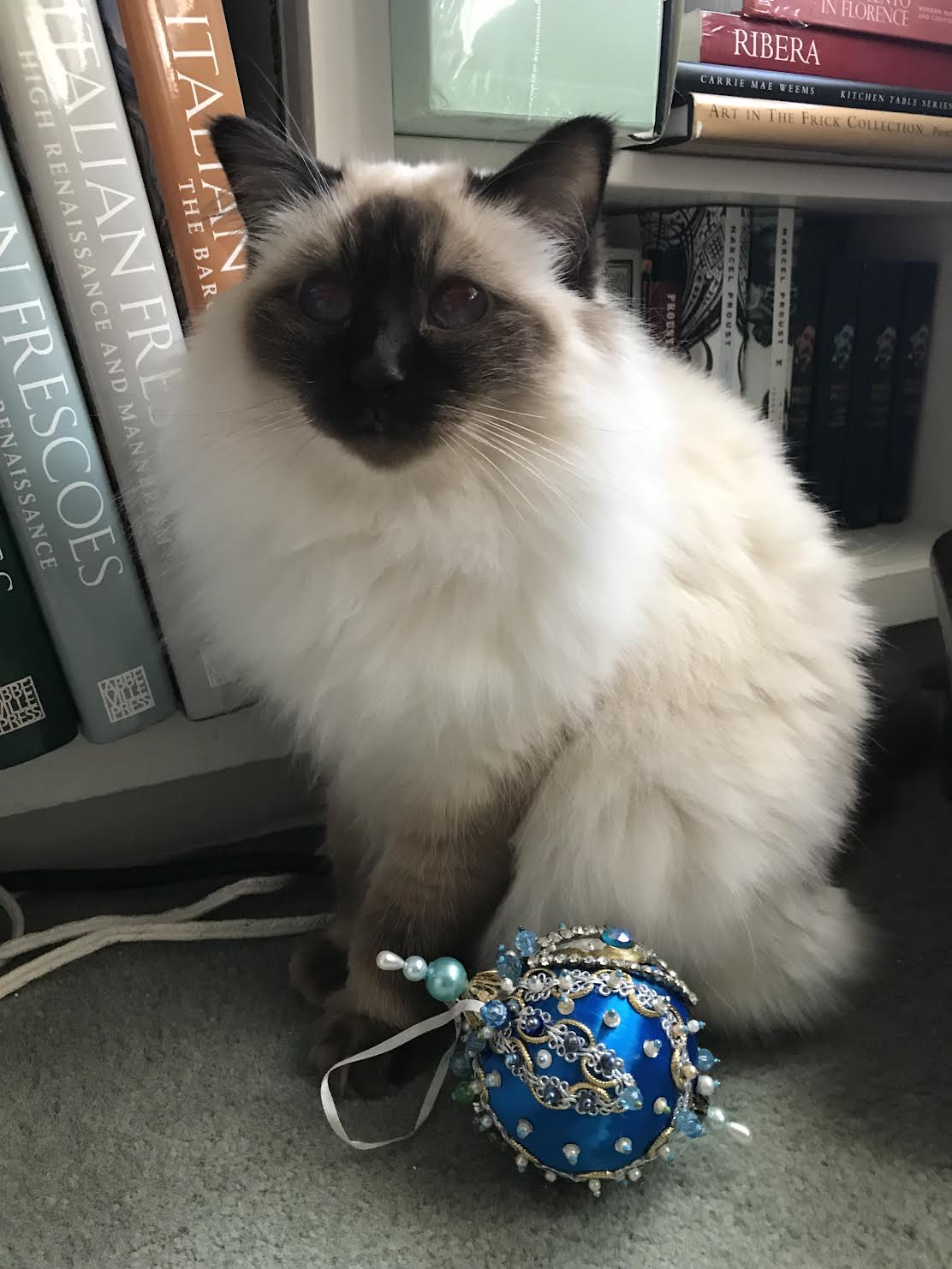
A little untimely, but I always think that it’s really the first full week of January that marks the end of the holidays, don’t you?  Formally christened “Katy,” that name was lost to her forever on her first visit to the Vet; he took one look & exclaimed “she doesn’t look like a cat at all!  She’s more like a little bear!”  Not exactly a “people cat,” Pooh-Bear prefers to spend her time solo in closets & under the coffee table.

My Second New Year’s resolution: get those books off the floor and onto some shelves!  Two of my feline overlords (the third is in the next photo), unfortunately, offer only supervisory assistance . . . .
Yeah!  She’s finally stopped yammering!  Nap is next (assuming she hasn’t already put you to sleep)!

Finishing Off Scandinavia & Murder With Maud

0-1
Have any of you yet met Maud?  Such a sweet old lady and perfectly safe . . . most of the time . . .

As my post’s heading indicates, I’m covering two topics today:  a brief recap of my Nordic reads for January (I did read a few other things but didn’t bother posting about them) and a series of murderously entertaining short stories featuring Maud, a most unusual protagonist.  I’ll be covering these in reverse order, so if you’re interested in one but not the other, you may want to skip.

As #NordicFinds month draws to a close, I find that I can’t quite leave Scandinavia without saying a word or two about Maud, an octogenarian resident of Gothenburg, Sweden.  If you like twisty tales laced with black humor and mayhem, well, she’s definitely worth checking out.  Because I actually read these books last fall (Up To No Good was a re-read to refresh my memory before indulging in Must Not be Crossed)  they aren’t eligible for my Reading Europe Challenge.  They do, however, fit nicely into the #NordicFinds and #ReadIndies months.  Although I read them last year, I couldn’t resist including them on the final lap of this year’s Scandi-journey, particularly as I haven’t previously reviewed them and they provide such a perfect finish for my idiosyncratic little survey of contemporary Scandinavian fiction.  Aside from their content, which provided me with some very happy reading hours, you can see that both books are handsome little volumes, with interesting artwork.  One has a brief but interesting afterword by the author, the other two recipes, one naughty and one nice, for gingerbread cookies.  A word to the wise — if you’re allergic to nuts, don’t eat any of Maud’s baked goods!

Both these little volumes (Marlaine Delargy tr.) are short story collections by the Swedish crime writer Helene Tursten, perhaps best known for her franchise detective Irene Huss, a detective inspector in Gothenburg’s Special Crimes Unit.  If you’re a fan of Irene Huss or Embla Nyström (the protagonist in another Tursten series) you’ll be pleased to learn that both make most entertaining appearances in a few of these stories (first and most notably in “The Antique Dealer’s Death” from Up To No Good).

The collection of stories featuring Maud was born when Tursten, facing a deadline for a Christmas story for one of Sweden’s largest publications, began to panic.  As she explains in her afterword to Up To No Good:

then, she came to me:  Maud.  She was 88 years old and looked like most old grannies.  But inside she was quite special.  Her age was a perfect disguise for a criminal!  Even . . . a murderer.  I wrote the first story, “An Elderly Lady Seeks Peace at Christmas,” in just three hours, and I enjoyed every minute of her company.  But let’s just say I would not like to have her for a neighbor or a relative!”

Although Tursten knows Maud best, I think she’s a little hard on her creation.  I’d feel perfectly safe living next door as long as I minded my own business, didn’t make too much noise (particularly at Christmas) and kept my animals under control.

Although the books are independent of each other and the stories are still quite enjoyable if you skip around (my usual method for reading a collection), you’ll get the most out of them by beginning with Up To No Good and reading the stories in the given order, as Tursten discloses Maud’s character and background in bits and pieces as the stories proceed.  This slow reveal is in fact a very clever and effective way of tying the collections together.  Maud’s habits are another connecting thread.  She loves to travel & has been “virtually all over the world” (Up To No Good, page 44); is an avid surfer of the net (she considers her laptop, which she ripped off from a Silver Surfers IT course, “indispensable”) and really, really likes to be left alone.  When Maud was eighteen her father died of a sudden heart attack and her once wealthy family discovered the money was gone.  Although Maud’s widowed mother was forced to sell the apartment building that was the sole remaining asset, a clause in the contract gave her and her two daughters the right to live rent free in the nicest set of rooms as long as they wished.  Seventy years later mother and sister are dead, the building is now an ultra fashionable address and Maud, to the frustration of the housing board (its lawsuit to dislodge her was unsuccessful), continues to enjoy her rent free life style.

Maud’s unusual living arrangement is at the center of the plot in  “An Elderly Lady Has Accommodations Problems,” the first of Up To No Good’s five stories.  Life has been peaceful for Maud until the advent of Jasmine Schimmerhof, celebrity child of famous parents (the subjects of Jasmine’s tell-all bestseller), a would-be sculptor and the latest new tenant in Maud’s building.  As Jasmine explains in her blog, Me, Jasmine:

I despise sovereignty and the patriarchy.  I have grown up under that kind of oppression, and I know how terrible it is.  I want to give the finger to all oppressors and tell them to go to hell.  In October, I will be putting on an exhibition at the Hell Gallery.  At the moment I am working on Phallus, Hanging.  It’s going to be a kick in the balls for all those bastard men!

When Jasmine begins a sustained campaign to woo Maud and win the seemingly senile old lady’s good will, Maud becomes suspicious and turns to the internet to discover that Jasmine is rather unwisely hinting on her blog that she may soon be moving into a much larger apartment that currently belongs to an elderly neighbor.  What’s that elderly lady to do, except protect her home?  I won’t say anything more, except to note that Maud helps the patriarchy to strike back in a most unusual way.  The book’s other four stories, in which Maud deals most efficiently with noisy neighbors, a thieving antique dealer and a gold-digging soft porn actress with designs on Maud’s former finance (Maud retains fond memories despite being jilted when her family went broke) are equally entertaining.  Who could imagine that murder could be so funny?

An Elderly Lady Must Not Be Crossed follows a similar format but is not quite more of the same.  Deciding that it’s best to clear out of Gothenburg for a bit after the antique dealer, Maud embarks on a luxury safari to South Africa, financed by the sale of a family heirloom or two.  Tursten skillfully uses the exotic setting to broaden the stories, and to deepen and soften Maud’s character as we learn more of her backstory.  Although I enjoyed Must Not Be Crossed and would definitely recommend it for an enjoyable afternoon of reading, I preferred Up To No Good.  I suspect it doesn’t speak well for my character that I prefer my murders undiluted by humanitarian impulses.

Midnight approaches here in Gulf Coast Florida and that’s enough of Maud.  As I noted above, these books are part of my Scandinavian journey, undertaken as part of Annabel’s #NordicFinds month.  They are also eligible for Lizzy & Kaggsy’s #ReadIndies month, as they are published by Soho Press, an independent publisher located in Manhattan.  Soho Crime specializes in atmospheric international fiction and has an impressive backlist of authors.

Nordic-Finds-Bannerread-indies-2

Proceeding to the second part of my post, I’d like to do a wrap-up of the books I read for #NordicFinds.

0-4
The four additional books I completed for #NordicFinds, one each from Denmark, Norway, Finland and Iceland.

In participating in the read-along, I tried very hard to push my boundaries by reading books that were, to varying degrees, outside my comfort zone either because of genre (memoirs, for example), style or subject.  As a result, I think my journey through Scandinavia was enlivened by books that were quite different from each other.  I also chose books written by authors from the countries where the books were set, rather than books by English speakers about the various countries, if that makes any sense.  By a happy coincidence, #NordicFinds overlapped with the beginning of the Reading Europe Challenge and #ReadIndies, so most of my books were twofers and a couple, oh happy day, qualified for all three events.  In addition to Tursten’s Elderly Lady collections, my choices included:

Tove Ditlevsen’s Copenhagen Trilogy, a beautifully written and intense set of memoirs by the noted Danish writer;

Dag Solstad’s Novel 11, Book 18, a piece of avant-garde fiction from Norway in which a very ordinary man experiences an existential crisis and decides that he, rather than chance, will control his fate;

Antti Tuomainen’s Dark As My Heart, where the king of Helsinki Noir tells the dark story of a decades long search for justice;

Oddny Eir’s Land of Love and Ruins, a genre-defying, autobiographical novel set in Iceland and mixing philosophy, eroticism, history, archaeology and bird watching.

And then, of course, there’s the one that got (temporarily) away:

0-3
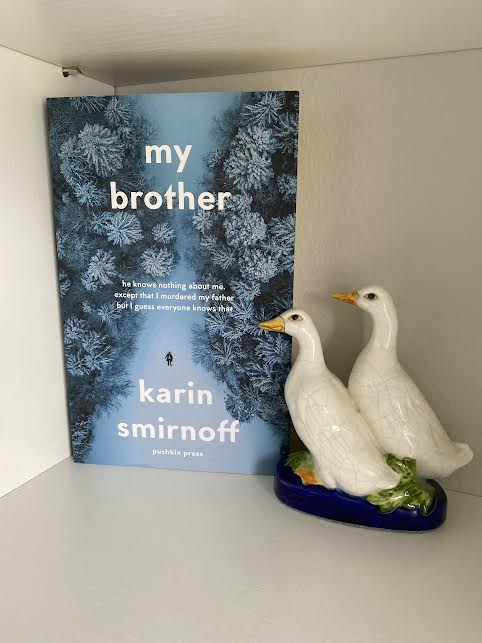
After reading a few pages, I decided to postpone reading Smirnoff’s novel, set in Sweden, until later in the year. Not to worry! It’s part of my Reading Europe Challenge; I’ll finish when I’m next in a noirish mood!

So that’s it for Scandinavia, folks!  Now on to the next adventure:

0
Percy wants to depart the frozen north for warmer climates  . . . .

European Reading Challenge 2022

ERC 2022
The Journey begins!  After shadowing the tour in 2021, this year I’m officially signing up for the trip . . . .

Although I have a dismal completion rate, I adore book challenges!  There are few joys to compare with lovingly pawing through my stacks (and I really do have stacks.  And stacks) of unread books, searching for just the combination that will inspire me (for once) to finish whatever challenge it is that I’ve decided to undertake.  I think I basically love book challenges for the sense of possibility they offer, the lure that this will be the year I read Ulysses; or five 19th century classics by unfamiliar authors; or a pre-1970 novel that has an animal in the title!  Of course, my January exuberance is counter-balanced by my December  reality check, when I (again) sadly acknowledge that most of these wonderful accomplishments didn’t materialize (even so, however, I always discover at least a few great new books/authors).  But away with the pessimism because — it’s the beginning of January!  The possibilities are endless!  Reverting to my southern, down-home roots, I tell you, dear readers, that January, with its plethora of fresh, shiny new challenges, is a month when I’m in hog heaven!

One of my favorite challenges from last year was Rose City Reader’s European Reading Challenge, which focuses on reading books by European writers or set in European countries.  Given my dismal completion rate for such things, I was sensibly doubtful about participating.  The Challenge looked so much fun, however, and was such a painless way to read more translated literature, I decided to go for it.  I had only discovered the challenge, however, very late in January and lingered just a bit too long over my selections.  Then, with my utter lack of technical ability, I was unable to satisfy Mr. Linky in time to sign up officially.  Quel désastre!  There was clearly only one solution — I would be a shadow participant!  Although I ultimately didn’t review any of my selections, I actually read quite a number of them and, most importantly, really enjoyed the experience.  After a few substitutions for my original choices and a false start or two (my apologies to Linda Olsson’s Astrid and Veronica, but the time just wasn’t ripe for you), I read eight books I selected specifically for this challenge.

0-3
The very satisfying results of my shadow participation in last year’s European Reading Challenge.  Each of these authors was new to me and each novel offered something enjoyably different from the others.  What more could a bookish blogger reasonably ask?

After shadowing in 2021, I decided that in 2022 I’d do the real thing and officially sign up for this year’s Challenge (besides, I now have almost a month to outwit Mr. Linky!).  The Challenge simply requires participants to read books set in a European country or by a European writer; each book must be by a different writer and set in a different country.  It’s very flexible in that participants decide how many books they want to read, from Pensione Weekender (one qualifying book in 2022) to a Deluxe Entourage (five).  This year, as I did as a shadow participant, I will also observe a couple of my own idiosyncratic rules in choosing my selections.  Because my reading is so overwhelmingly slanted towards books originally written in English, I will choose novels by non-Anglophone writers set, where possible, in their native or adopted countries.  For the same reason I also won’t select any works by writers from the U.K. or Ireland; at least half of my reading comes from British and Irish writers, and for this Challenge I’d like to continue learning more about books from other European countries.  Because I’m full of January optimism, and given that last year I read eight books that met the Challenge’s requirements, I’ve decided in 2022 to sign up for the deluxe package!

One result from a year of massive self-indulgence in acquiring books is that I’ve managed, with very little effort, to compile a list of some very enticing possibilities.  This has been aided enormously by the fact that I’d already decided to participate in Annabookbel’s Reading Nordic Literature month; in effect, I’ve already had a lot of fun looking for reading possibilities from Scandinavia.  As the reading year develops, my precise itinerary may change, i.e., I may add or eliminate countries and/or books; what you see below is simply the rough pool from which I plan to draw my selections.  Although my goal is a minimum of five, I hope to read at least a few more.  Because Scandinavia is a very much anticipated part of my tour, I’m starting my European journey with:

0-8
Since Annabel’s Nordic Lit month begins with Denmark, I decided to begin my European journey in Copenhagen, with Tove Ditlevsen, a new-to-me writer.  Originally published in three volumes, these autobiographical works were combined and published together around 2019.  I’m almost through Childhood, with Youth & Dependency yet to come.  Spoiler alert:  so far it’s wonderful!

After Denmark, I’m on to

0-10
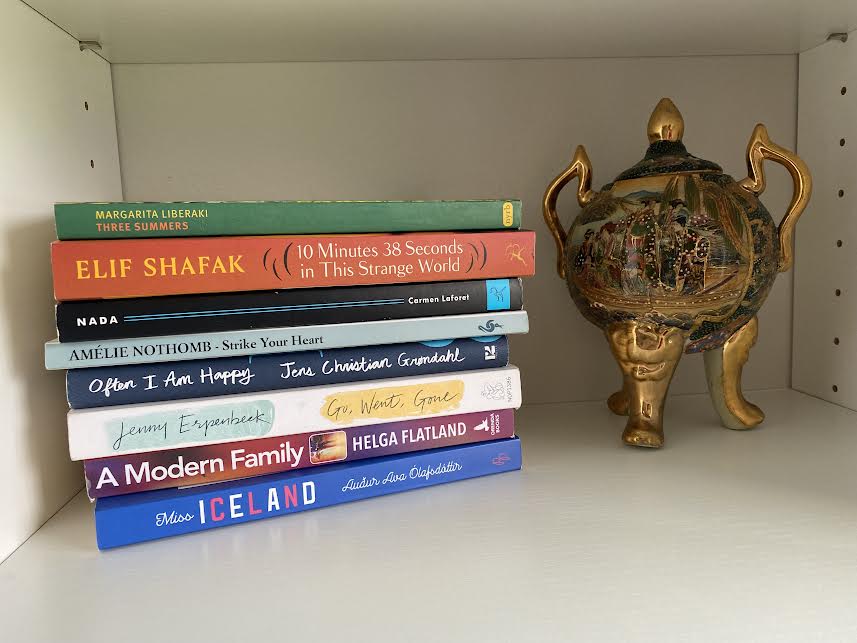
the rest of my Nordic journey.  Iceland (Land of Love & Ruins, top of the stack, deliberately blurry title on spine); Finland (Dark as My Heart); Norway (Novel 11, Book 18) and Sweden (My Brother).  Land of Love & Ruins, an autobiographical novel told in the form of journal entries, is a definite stylistic stretch for me.  As for Novel 11, I may end up replacing it with Vigdis Hjorth’s Will & Testament (dark family secret uncovered by a sibling struggle over property), which has long been on my TBR.  

It’s now time to head south for to visit the German speaking lands:

0-8
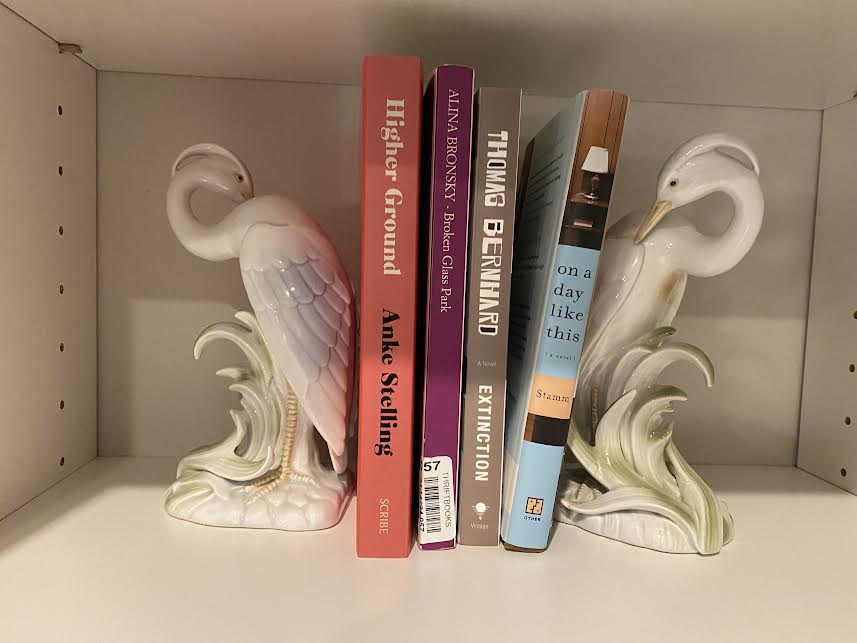
Higher Ground & Broken Glass Park are both set in Germany, so I’ll have to choose one; I’m leaning towards Park because I very much liked the other Bronsky novel I’ve read (The Hottest Dishes In The Tartar Cuisine).  For Austria, I’m attracted to Thomas Bernard’s Extinction, a tale of an Austrian aristocrat who rejects his heritage but . . . it does look difficult & I may need a backup!  On A Day Like This, by the Swiss German writer Peter Stamm, almost made my list last year . . . .

It’s finally on to a very interesting tour through France, Belgium, Italy and Spain:

0-11
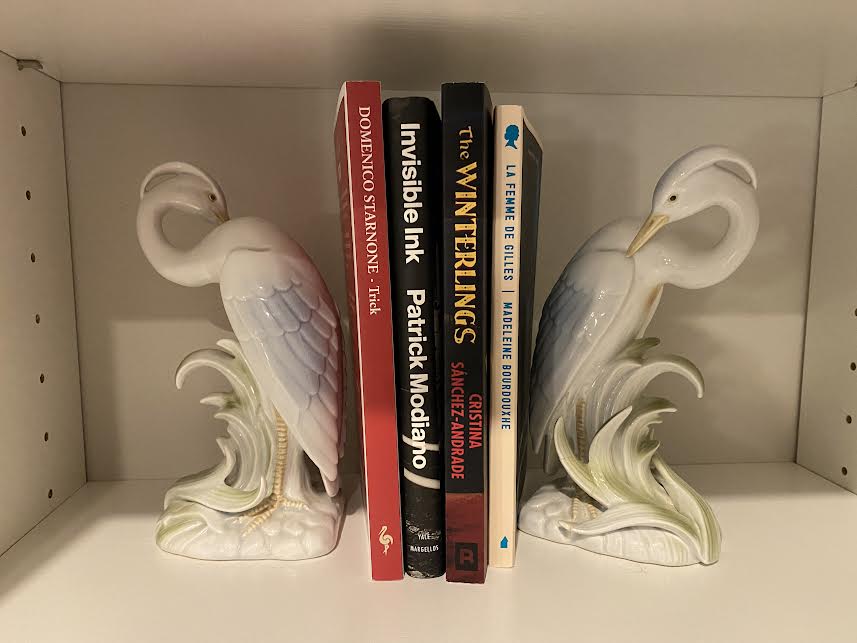
Several new writers here for me!  I’ve read a little of France’s Patrick Modiano in the past and liked it, so his Invisible Ink (a mystery dealing with the illusion of memory) was a relatively easy choice.  For Italy, I was very tempted to choose Natalie Ginzburg’s Family Lexicon; because I’m somewhat familiar with her work and wanted to try something new, however, I decided to go with Domenico Starnone’s Trick (besides, there’s always women’s literature in translation month for Ginzburg!)  Did you know (I didn’t) that Madeleine Bourdouxhe worked for the Belgian resistance in WWII?  I very much look forward to her La Femme de Gilles, her tale of a love triangle set in 1930s Belgium.  I’m a little dubious about Winterlings, as it was an impulse selection; but its setting (northwestern Spain in the 1950s) sounded quite interesting.  Has anyone read it? 

If I’m not totally exhausted by this point, I may take brief side trip:

0-12

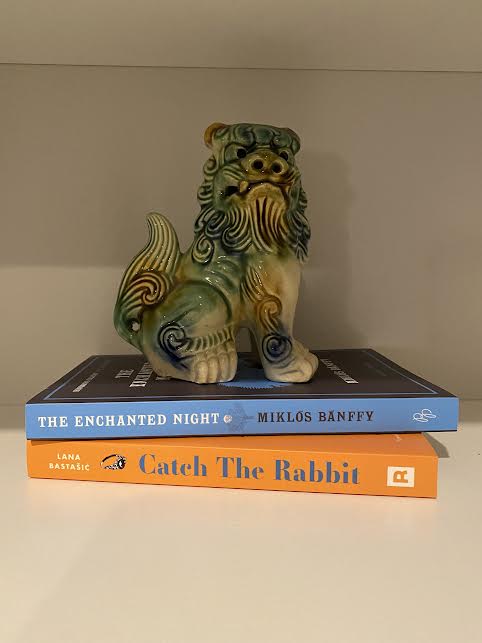
I’ve had a copy of the great Hungarian writer Miklós Bánffy’s Transylvanian Trilogy gathering dust on my shelves for several years now.  I won’t say I’ve totally ignored it; every year or two I read a few pages, scratch my head and decide that, next summer will be the perfect time to dive in!  You can imagine my delight when I discovered The Enchanted Night, Pushkin Press’s collection of Bánffy’s short stories.  At last, something that fits my attention span and is (I hope) an accessible introduction to Bánffy’s work.  Lana Bastašić is a contemporary Serbian writer whose debut novel, Catch The Rabbit, won the 2020 European Union Prize for Literature.  Having been in a few myself, I love stories about complicated friendships;  Bastašić’s tale of two semi-estranged childhood friends on a road trip through post-war Bosnia looks really interesting.

Well, that’s it for my 2022 trip through Europe.  Has anyone read any of my choices?  If so, please share your opinion!

Drifting Through A Dreamscape: Fleur Jaeggy’s “The Water Statues”

1-179
Although this photo is unrelated to The Water Statues (it’s actually a shot of an underwater museum off the coast of Mexico) it captures perfectly the eerie, dreamlike atmosphere of Jaeggy’s novella.  (Uncredited photo taken from the website of the touring company Aquaworld).  

Although I prefer realistic fiction and am most comfortable with a style that at least nods to tradition, I do occasionally venture further afield.  After all, dear readers, we don’t want to read Anthony Trollope all the time, do we?  Or even dear Jane, as fond as we are of Lizzie’s adventures and Anne Elliot’s romantic travails?  When I do venture to sail in unfamiliar waters (I’m afraid the nature of the book I’m about to discuss has me thinking in aquatic metaphors), it’s a struggle for me to be open to work that is totally new, particularly if it’s written in a non-traditional style.  

My immersion in the blogging world, however, has slowly, slowly, expanded my reading horizons, albeit in inverse proportion to my bank account!  This was the year, for example, that I’ve almost become comfortable reading translated literature.  Having dipped my toe into non-anglophone waters and survived, I decided to take on the ultimate challenge:  a subscription to “the New Classics Club” sponsored by New Directions publishing.  Once I did so, strange, exciting & frequently disconcerting works of fiction began arriving in my mail box on a monthly basis.  This November, for example, brought me:

0-9
Although new to me, those who are better read than I have long enjoyed Fleur Jaeggy’s fiction. New Directions has recently released this early work, translated from the Italian by Gini Alhadeff.

For those who are interested in bio, Jaeggy was born in 1940 in Zurich, Switzerland, where she spent most of her early life.  Like many of her fellow nationals, Jaeggy is multi-lingual and grew up speaking French, German and Italian.  In her twenties she moved to Rome, where she became friends with the Austrian novelist Ingeborg Bachman.  It was in Rome that she also met, and eventually married, the Italian writer and publisher Roberto Calasso.  Jaeggy, who writes exclusively in Italian, has continued to live in Italy, where she has bagged most of the country’s major literary prizes.  The Water Statues, originally published in 1980, is an early work; it was in 1989, with Sweet Days of Discipline (translated by Tim Parks) that Jaeggy became widely known.  New Directions has published English translations of these as well as others of Jaeggy’s novels, essays and story collections.  In addition to writing fiction, Jaeggy has also translated the work of Thomas de Quincy and Marcel Schwob into Italian.

All very interesting, I can hear you mutter, but — what about the book?  Who are the characters, what is the plot and, most importantly, what is your opinion of it?  Ah, dear readers, it’s easier to provide questions than to supply answers regarding this enigmatic little work, whose nature and meaning are as elusive as the element contained in its title.  Jaeggy’s novel (more properly novella) clocks in at a scant eight-nine pages of generously spaced text that, technically, could be read in an hour or two.  Its impact, however, is disproportionate to its word count.  Unlike my usual way of plowing through a work of fiction, I read this one very slowly, in small bits spread over several days and stopped frequently to re-read a phrase and to savor the atmosphere.  The impression it creates remains long after the last word is read.

For a variety of reasons, The Water Statues doesn’t lend itself to an analytical discussion.  For one thing, it concerns encounters rather than events and marks time in a circular or even random, rather than linear, fashion.  Essentially its “structure” is a seamless web in which one’s point of entry or exit doesn’t matter too much.  Stylistically, TWS struck me as a hybrid of poetry and prose (some of its short sections definitely call prose poems to mind) as well as a combination of a play — Jaeggy begins with a list of nine “Dramatis Personae” and there are a few sections that consist solely of dialogue — and, well, what isn’t a play. TWS’ viewpoint continually shifts among the characters, who sometimes address the reader directly; these shifts in view and narration heighten the malleable, fragmentary nature of the reality they are experiencing.  The inclusion among the named characters of an additional individual who is never identified but who sometimes narrates or gives his/her version of events further heightens the novella’s mysterious nature.  Who is this person and what are they doing in the story?

The protagonist, to the extent there is one, is Beeklam, the rich and eccentric collector of the statues that provide the novella with its title.  Early in the novella Beeklam relates how as a child he experienced the death of his mother Thelma.  After her death (pp 8-9):

He’d abandoned his newly widowed father to go and “buy statues,” he said, and it was as if he were joking.  From early childhood he’d been drawn to figurative imitations of grief and stillness; from childhood he’d been a collector, museums were in him; statues were his playthings, a privilege of all who are born lost and who start out from where they end.  The child looked at them: he inspected eyelids and napes, drawn into their definitive dimensions of seriousness, some molded by artists of renown, others by unknown workshops.  He had a name for each:  Roselind, Diane, Magdalena, Thelma, Gertrud.  Those statutes with their often amiable faces disclosed the things that dwell in things themselves, vitreous things.

After abandoning his father, Beeklam moves to Amsterdam, where he lives, “quite alone” with his statues in the basement of a villa close to the sea.  Because the villa’s basement extends “down to the water,” its gaps and cracks give (p 8):

a sense of the movement of the waves:  of a submerged world that he [Bleeklam] believed to be populated by other statues with feet (if they still had them) tied to stones; and whose knuckles of stone knocked on his walls.  No one shooed him away when he rested his head on the wall and waited — perhaps for the statues of water to return, or to summon him.  The child now wished to live as though he’d drowned.

Although I don’t pretend to any expertise in interpreting these strange and beautiful images, it seems to me that Jaeggy is hinting that the wall between living and dead is thin and that we each long for some form of permanence in a shifting and unstable universe. In this respect, I think it’s significant that Beeklam calls one of his statues by his dead mother’s name. It’s also worth noting that Jaeggy dedicated TWS to her close friend Ingeborg Bachmann, who had died several years previously in a fire (at one point (p 22) Bleeklam remembers reading that “Water is a burnt body,” a line that further hints of themes of death and mortality.)

Emerging from his basement of statues, Beeklam wanders the streets of Amsterdam in the late spring twilight, accompanied by his servant Victor. The lives they observe at a distance and their sporadic encounters with others are their only human connections: fleeting encounters and detached observations, with no lasting effect or central meaning.

The second part of TWS concerns Katrina and Kaspar, who may, or may not, be Katrina’s father.  These “two loners” reluctantly share a pavilion on the grounds of a boarding school; “reticent in speech, they tolerate brief and stinting evening conversations” (p 44).  Images, phrases, characters and even some of Beeklam’s statues make a reappearance in this section of the novella, reinforcing its non-linear structure and the circularity of time.  As once character puts it (p 72), “One says goodbye to everything here; in places like these it’s as if all that is yet to happen were already in the past.”  

It’s impossible to quit this overly long review without briefly mentioning the beauty of Jaeggy’s language and images, all the more striking because her prose is so very economical.  Without wasting a word, or deploying any particularly lush or descriptive adjectives, Jaeggy has an unbelievable knack for creating images that stick in the mind long after her novella is finished.  A crow’s eyes are “two miniature swatches of velvet” (p 53); cabbage leaves dropped in a garden are transformed overnight into “green drawing rooms” teeming with snails (p 84); the child Beeklam has “a horror of anything hereditary, because whatever comes * * * by natural inheritance belongs to the dead” (p 38).  This particular combination of beauty and reticence is something new in my reading experience.

Have any of you, dear readers, explored Jaeggy’s fiction?  If so, what do you think of it?  Although TWS tested my limits a bit, I’m glad I read it and will definitely try more of this very interesting writer’s work (most probably I Am the Brother of XX, a collection of short stories).  Would I recommend TWS to others?  It’s definitely not for those wedded to a traditional style and a linear plot, but for those willing to tolerate ambiguity and open to atmosphere it’s an immersive and rewarding work.