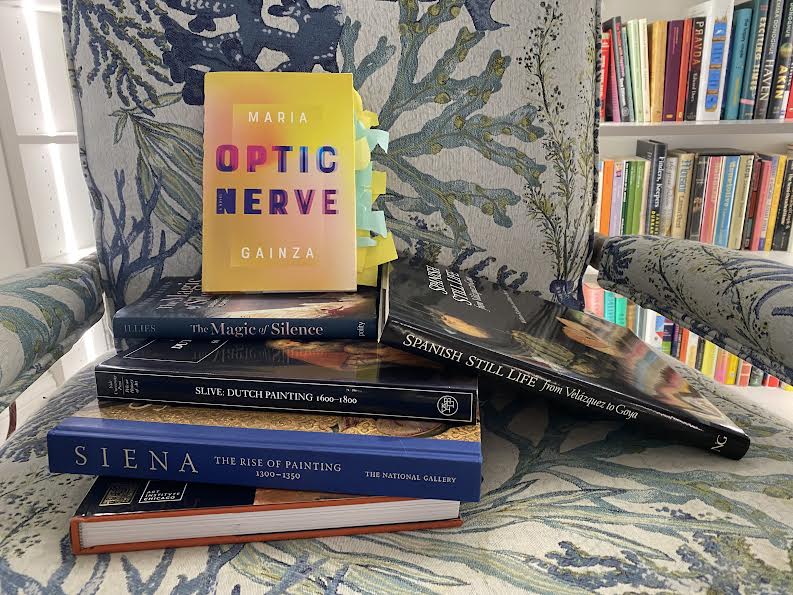
Do you ever re-read a novel/novella/short story? If so, do you have certain cherished texts, to which you return at intervals over the years? Or are you a “one and done” type, getting all you wanted/needed from a work the first time around, then moving on to answer the siren call of unread wonders, unwilling to waste time on a delight you’ve already tasted? Being an inveterate re-reader myself, I considered it a no-brainer to include this category in the “Gentle Challenge” launched earlier this month by my dear amiga, Silvia (although she’s been gracious enough to list me as co-host, don’t be deceived! I did a little word smithing & offered a few suggestions while Silvia is doing all the work!). Despite being obviously invested in this category, I found it surprisingly difficult to select a specific book for it: one choice was too long; another too emotionally demanding for my currently fragile mood; and a third was available to me only in a yellowing, brittle, visually displeasing edition (what can I say, Readers? I’m in a very “Aesthetic Movement” vibe this month; anything to distract from the political horror, right?). I finally settled on what was, from the very beginning, the obvious choice — María Gainza’s Optic Nerve, published in Thomas Bunstead’s translation from the original Spanish in 2019. Why obvious? WelI . . . when I first read Optic Nerve in 2020, I immediately lost myself in its lovely, dream-like phantasmagoria of images, literature, popular culture and events from the life of a young Argentine woman. Optic Nerve was easily one of my reading highlights that year and I intended to post about it, I really, really did, but somehow, for some reason (a cat probably jumped on my lap, or the dishwasher pinged to be unloaded) I never quite got around to it. Thanks to Silvia’s Challenge, however, I now have a chance to make amends and (one of the great pleasures of re-reading) to see if either I or the book have changed in the last five years!
My first reaction to Optic Nerve back in 2020 was similar to those fortunate few who first saw Superman, i.e., “What is it, exactly?” A novel? A memoir? A collection of essays on art or an interlocked series of short stories? This isn’t an easy question to answer, despite Optic’s relatively straightforward structure. Each chapter follows a similar pattern of focusing (although not exclusively) on one artist. For example, “Lightning at Sea” describes Courbet’s seascapes and “A Life in Pictures” discusses Rothko’s color abstractions. The paintings (mostly from the 19th and 20th centuries) spark an incursion into art history and are linked to events of “Maria’s” personal life and/or her family’s history. I use quote marks for “Maria” because, as with any work of this nature, questions arise regarding the extent to which the narrated events reflect the author’s reality. Aside from sharing their first names, both the author (Gainza) & her creation (Maria) are art critics living in Buenos Aires. Both, additionally, hail from aristocratic, once wealthy families whose finances and status were severely diminished by Argentina’s political upheavals (Juan Perón’s government confiscated the influential newspaper founded & owned by Gainza’s family). There are other resemblances between Gainza and Optic’s Maria: author Gainza is a widow and mother of a daughter; while Optic’s Maria, as we learn in bits & pieces, is pregnant and has a severely ill husband. The first time I read Optic Nerve in 2020 I was so caught up in its enchantment I naively assumed that the narrator’s biographical details were factual accounts of Gainza’s life, in effect a memoir. This time around I’m far more cautious about this assumption, especially after reading an interview in which Gainza herself describes the biographical details contained in her work as “drop[s] of color,” which she expands and amplifies in her narrative.
Although these biographical speculations are fun, they really have little to do with the thrust of Gainza’s complex, multi-layered work, which deals, above all, with the connection between an art work and its beholder, connections that transcend both time and geography and that are mental, emotional and even physical. In Optic’s first chapter, “Dreux’s Deer,” Maria first encounters the painter’s work when she’s shepherding a pair of rich tourists around a private art collection in Buenos Aires (since I’ve already clicked to wiki, I’ll spare you the work, dear Readers: Alfred de Dreux was a highly successful 19th century French painter, known for his equestrian portraits). Although Maria’s reaction is polite, she privately dismisses the painting as mere decoration, the work of a technically gifted but fundamentally empty artist. Five years later, however, when she encounters a different painting by Dreux (2019 Catapult edition, p. 6), a hunting scene in which a deer is about to go under, mauled by a pack of hunting dogs (very popular subject this, in wealthy 19th century dining rooms):
it was fireworks, what A.S. Byatt called ‘the kick galvanic.’ It reminded me that all of art rests in the gap between that which is aesthetically pleasing and that which truly captivates you. And that the tiniest thing can make the difference. I had only to set eyes on the painting and a sensation came over me: you might describe it as butterflies, but in fact for me it’s less poetic. It happens every time I feel strongly drawn to a painting. One explanation is of dopamines being released in the brain, and the consequent rise in blood pressure throughout the body * * * *
The dying animal’s look of “helpless astonishment” reminds Maria of a similar incident in Lampedusa’s great novel, The Leopard, and how well Lampedusa understood “the unpredictability of events, their tendency to go full circle at the last * * * always leaving * * * something ultimately ephemeral, certain to be lost in the mists of time.” (p. 6) The chapter closes with Maria’s recollection of a university girlfriend, who had visited a sister in France at the latter’s expense & insistence. Despite bad weather, the two decided to spend the weekend at a chateau in the countryside near Paris, bordered by a hunting preserve. During a chilly outdoor luncheon, the friend, needing to stretch her “long legs–since the age of nine she’d had the spindly legs of a deer” (p. 13), went for a slow stroll around the grounds. Bending over to free her boot, caught by chance in a pocket of mud, she’s killed by a stray bullet from the nearby hunt. As Maria observes (p. 14-15)
Whenever I think of her it’s in the second when her boot sticks in the mud and she stops where the bullet is about to strike. And I cannot tell what I should do with a death as ridiculous as hers as pointless and hypnotic, nor do I know why I mention it now, though I suppose it’s always probably the way: you write one thing in order to talk about something else.
And there you have Gainza’s beautiful, elusive technique in a nutshell: “you write about one thing” in order to talk about another. If you’re a linear type who demands a clear route from Point A to Point B this book isn’t for you. If, however, you’re willing to let the current carry you, Optic Nerve is a treasury of riches. My clumsy summary does little to give you the full impact of Gainza’s work, with its links between Henri Rousseau’s paintings of clouds & hot air balloons and Maria’s fear of flying; between an estranged brother and the paintings of El Greco; between Courbet’s seascapes and the melancholy life of a young cousin plagued by mental illness. Some of Gainza’s writing is straight art criticism & history; some of it observations on the nature of perception; and some (my favorite bits) lovely, poetic stories woven around Maria’s experiences & history. Perhaps others have as successfully integrated their personal story with the art they love (Laura Cumming’s recent Thunderclap springs to mind) but in my limited experience Gainza has created something unique.
All of this art, literature and history would be totally unbearable if Gainza’s was the least bit pedantic. Added to her other virtues, however, is a dispassionate honesty about her and her family’s privileges and a sharp wit regarding her subject. As a dropout from the docent program administered by a local museum, for example, I very much appreciated Gainza’s description of a group of school children, arranged in their little semi-circle on the floor of the art museum, bored out of their minds by their guide’s lecture on a Velázquez painting. As Maria so aptly observes (p. 148), “Carelessly administered, the history of art can be as lethal as strychnine.”
An obvious question about Optic Nerve is whether one needs to know anything about art to enjoy it. My answer is “absolutely not”! True, I wouldn’t recommend it to anyone who has an aversion to the visual arts, just as I wouldn’t recommend it to anyone who demands a structured plot or a traditional narrative. Provided, however, that you’re open to Gainza’s highly individual technique and her strong opinions about various artists, you’re in for a treat. Because she focuses on works that are largely available in Buenos Aires’ public museums, her choice of artists is an interesting mix, including the known-to-me painters that I’ve previously mentioned (El Greco, Toulouse-Lautrec, Rothko, Rousseau & Courbet); lesser lights (Hubert Robert & Dreux, for instance) and interesting artists who were previously unknown to me, such as Cándido López, Foujita & Josep Maria Cert. “But won’t that require an awful lot of googling?” I hear you ask. You may google the images if you like (they’re readily available for almost all of these publicly held works) but Gainza is such a master of ekphrasis that you can pretty much get what you need from her written descriptions alone. Nor do you have to worry, dear Readers, about physically handling one of those zillion pound art books. Gainza numbers among her many virtues a pronounced talent for understatement and an elegantly terse style. At a mere 193 pages, you can breeze through Optic Nerve in an afternoon, or ponder its contents if you choose for the rest of your life.
The most interesting aspect of re-reading any book is comparing one’s present reaction to the one(s) that preceded it. If I’ve accomplished my task here, you can have no doubt that I love the book in 2025 as much as I did in 2020. As with any re-reading, however, something is lost and something is gained. This time around Optic Nerve lost some of its emotional impact for me (Gainza’s chapter on a lost friendship, “Separate Ways,” hit me particularly hard when I first encountered it). On the other hand, having a more analytical approach helped me make connections that had previously eluded me. Half the fun of reading this book is teasing out the links between the art and the personal stories; sometimes these are obvious, such as the chapter on Dreux’s deer; sometimes they are hard to discern indeed. This time around I actually begin to see themes emerging from certain chapters. Maybe third time around I’ll know for sure!






 "You Might as Well Read"