Category: summer reading

My 2023 Reading: PART I

This pile contains many of the books I read, dipped into or (gasp!) abandoned during the early months of 2023.  I rely quite heavily on my kindle, however, when I’m traveling, so I’ve also been reading quite a few e-books this year, mostly beloved old things that are now scarce or out of print.

My heavens, dear readers!  Can it possibly be early July?  Is the year half-way over already?  And me without a single review to my name for 2023?  However could such a shameful state of affairs happen?  Well  . . .

The year did not begin for me on an auspicious note.  Nothing wrong in a major way, but the New Year found me feeling a certain ennui that is generally rather foreign to my nature, especially when it comes  to books.  Have you ever had a period in which you struggled to read?  That despite having piles and piles of lovely unread books, chosen with great excitement (and, in many cases, considerable expense), you just didn’t feel like reading any of them?  This was precisely my mood as the new year rolled around.  Despite an enormous TBR list that offered endless possibilities for new discoveries (not to mention fun), I’m afraid the beginning of 2023 found me in zombie mode as far as reading was concerned.  Usually I love January, with its buzz of bookish Challenges; typically I spend several intensely pleasurable days pawing through my treasures and making totally unrealistic reading plans for the upcoming year.  Not so this January!  The arrival of 2023 saw me twiddling my thumbs, bored (actually bored) with my books and not even beginning a single new novel.  Quelle horreur!

Despite this, I did manage to read a few things simply by powering through my malaise (not to be trendy, but I suppose you could say I leaned into it) — not reading much, by my standards; but reading.  Like nursing an illness, I made reading easy on myself by picking only a few things by authors I had previously enjoyed.  I also re-read several books or novellas I had liked or admired in the past and picked fiction heavy on character and stylistic elegance, the main features that attract me in novels.  In short, I marked time until my reading mojo chose to reappear!  By February, and the discovery of some truly great novels things were definitely looking up.  Although I still didn’t feel like reviewing anything myself, I did resume reading some of your lovely blog posts and leaving a comment here and there.  All in all, it was an incredible relief to find my bookish life ever so slowly returning to normal.

As far as posting was concerned, however, I’m afraid my recovery’s remained incomplete.  As I suspect some of you know, it’s hard to get back into blogging after a break, particularly when other, very enjoyable activities are calling your name!  Chief among these has been travel, as Mr. J. and I have slowly emerged from our covid cocoon, dusted off our passports and resumed our (very) mild wanderings on the earth.  I’ve also been spending much more energy & time on art history and nature , centering the travel when possible on these long-time hobbies of mine (Bernini’s David! The Ghent altarpiece!  The Iiwi!)  Loads of fun, but definitely not conductive to keeping the blog current!  (When I do Part II of this Post, hopefully in a few days, I may throw in some of Mr. J’s excellent photos.  Other than that, I won’t bore you with details).

But enough of the mea culpa — time to talk about books!  Even in low energy times I generally keep a sort of running list of the books I’ve read.  This year, contrary to my usual practice, my list has actually morphed into a hybrid between a list and a journal, as it frequently included my brief impressions/assessments of what I was reading as well as how it slotted into my life at the time I was reading it.   Working from this, I decided to post an overview of my 2023 reading as this seemed the least painful way to ease myself back into blogging.  While I’ve retained my journal’s chronological format & style, I’ve done some mild editing & expanded several entries to reflect additional thoughts about certain books that I found particularly interesting.  TBH, dear readers, the whole thing is a bit of a hodgepodge, but I’ve thrown in some photos & headings that should make it easier for you to navigate to particular items you might find interesting, or to click away from those that you don’t.  I’ve also resisted the temptation to leave out some of my (ahem!) “lighter” choices.  After all, I can’t be the only one out there who loves Georgette Heyer, pulp sci-fi of a certain vintage and the occasional chick lit best seller, can I?

JANUARY 2023: STRUGGLING THROUGH SLUMP MONTH

Don’t you love Melville House novellas?  Aside from their convenient size (so handy to pop into a purse or backpack) the colors alone are enough to jolt one out of a slump!  My overflowing TBR pile includes almost all of Melville’s “art of the novella” series, so it was natural enough I’d go to my stash to read Kate Chopin’s best known work.  Did you know that few, if any, of Chopin’s contemporaries had anything good to say about Awakening, with even Willa Cather criticizing it as immoral?  The backlash was so heavy, in fact, that it ended poor Kate’s hitherto successful writing career.  Even in zombie mode, I adored Awakening and am now eager to read some of Chopin’s other works.  Any recommendations?  I’m inclined to begin with this little book of short stories (issued by Counterpoint Press) but I’m open to other suggestions.

I began the New Year with a re-read of Kate Chopin’s The Awakening, whose novella length and status as a re-read made it a perfect beginning for my apathetic, low energy month.  Chopin’s Louisiana setting was an additional attraction; I lived in New Orleans many years ago, loved the place and felt in the mood to revisit the city through the eyes of Edna Pontellier, Chopin’s protagonist.  I was also interested in comparing my present reaction to the novel to that when I first encountered it many years ago.  The first time around (before I lived in New Orleans, I might add) I’d literally raced through Awakening; to my shame, I was mostly relieved to cross it off my list and move on to the next newly discovered feminist classic.  In other words, I’d liked it in a rather mild kind of way but wasn’t particularly impressed.  What a difference a second reading can make, particularly when it comes so much later in life!  This time I savored practically every phrase, awed by Chopin’s skill with the language and her boldness in depicting the limitations of the world inhabited by her protagonist, trapped in her beautiful doll house and meaningless life.  Chopin’s beautiful style, her ability to create atmosphere and her sheer honesty about, and insight into, her Edna’s psychology are leagues beyond what so many of her contemporaries were churning out.  How could such a marvelous writer have been so thoroughly forgotten for so long?

WILL ONE OF MY FAVORITE AUTHORS BREAK THROUGH MY JANUARY ENNUI?

I’ve loved William Trevor’s fiction since I first read Felicia’s Journey, back in the 1990s.  As you can see I have a little Trevor Trove (groan) of his work, minus several novels I very reluctantly discarded (I had read them) during my long distance move a few years ago.  Did resorting to a beloved master shake me out of my reading malaise?  Well . . .  

I Was delighted when Cathy746 announced a year of “Reading William Trevor,” as it reminded me of how very much I love his work.  Surely reading something, anything, from such an old favorite, a master of style and psychology, would restore my reading enthusiasm!  Sad to say, my remedy failed.  No reflection on William, he remains as great as ever in my estimation, but even his considerable literary power wasn’t enough to break through my apathy, particularly when the latter was combined with a truly nasty, late January sinus infection.  I wanted to save Felicia’s Journey and After Rain, two of my all time favorites, for happier times, wasn’t in the mood for short stories (so difficult to decide which to read first, n’est-ce pas?) and didn’t have the energy to embark on a totally new novel.  After a certain amount of apathetic dithering about, I returned to two Trevor works that I’d first read decades ago.  I picked these two because I’d liked both very much but remembered very little about the plot of either.

I began with Two Lives, which contains two separate and seemingly unrelated novellas under one cover.  The novellas are a study in contrast — as each explores two very different protagonists — are set in wildly different locales and strike very different emotional chords.  My House In Umbria begins with the reminiscences of Mrs. Emily Delahunty, now retired from her career as a lady of pleasure in colonial Africa to the serenity of the Italian countryside (as Mrs. Delahunty explains early on, she’s used many different names over the years and the “Mrs.” is a courtesy title; “strictly speaking” she’s never been married).  Ensconced in a charming Umbrian villa, and ably assisted by her rather sinister factotum Quinty (one of Trevor’s great minor characters) she occasionally assists the local hotels when they’re overbooked by taking guests at her villa.  Mostly, however, Mrs. Delahunty spends her days writing florid and very successful romance novels.  All goes reasonably well until, suffering from writer’s block (she’s unable to flesh out her new novel, tentatively titled “Ceaseless Tears”) & looking for inspiration, Mrs. Delahunty boards the wrong train at the wrong time.  After surviving the ensuing terrorist attack that kills many of her fellow passengers, she impulsively and generously offers accommodation at her villa to the survivors (Quinty, less generous, ensures that the lodging isn’t free).  The heart of the novella concerns both the complex relationships that develop among the survivors as well as Mrs. Delahunty’s past, which Trevor gives to us in funny, heart-breaking and oh-so-realistic fragments, in a way that only he can do.

In contrast to the exotic Mrs. Delahunty and her Umbrian menagerie, Mary Louise Dallon of Reading Turgenev is a much less colorful and seemingly more tragic protagonist.  Mary Louise is the younger daughter of poor farmers who “struggled * * * to keep their heads above water” (page 4) in the dwindling Protestant community of a small Irish hamlet in the mid-1950s.  Realizing that her dream of being a shop assistant in town is unobtainable, Mary Louise makes a marriage of convenience to a much older man (a naive thirty-five to her naive twenty-one) who’s one of the few Protestant bachelors in her community.  After enduring years of a loveless and miserable-to-both-parties marriage, Mary Louise secretly begins to visit her invalid cousin Robert, whom she had not seen since childhood.  During these surreptitious visits, Robert exposes Mary Louise to the literature and poetry, particularly the works of Turgenev, which had been the solace and comfort of his restricted and lonely life.  As the two bond, Mary Louise becomes aware through the fiction they read of a world that transcends her own grim existence and experiences, for the first time, the comfort of having another human being who listens and understands her as no one else has ever done.  After Robert dies unexpectedly, Mary Louise fashions his memory into an image of the great love that she believes they were destined to share.  Her iron determination to own this memory, to keep and shape it for herself, insulates her from the assaults of her quotidian life and leads to tragic results.  Or — does it?  It’s part of Trevor’s greatness that he doesn’t leave the reader with an easy answer to this question.

When I first encountered Mrs. Delahunty and Mary Louise oh, so many years ago, it didn’t occur to me to ask the the obvious question of why Trevor paired these two novellas (Readers, I was quite young at the time!).  Particularly with a novelist to whom character is so important, their juxtaposition suggests linkages between the two very different protagonists and their worlds.  Using contrasts to heighten differences is an obvious and very old trick; it also seems an insufficient reason to pair these two novellas for a writer as subtle as Trevor.  To me, the two lives, so very different on the surface, are actually quite alike in a very fundamental way.  Despite their obvious differences, the paths taken by both women demonstrate the power of fiction and of the imagination in enabling us to transcend the mundane and often painful “realities” of our lives.  Mrs. Delahunty, the product of a sordid past and unspeakable abuse, very consciously fashions sentimental stories with happy endings that allow her and her readers to escape, if only briefly, from their own lives into a reality that’s been shaped more to their likening.   Mary Louise uses the literature she shared with Robert as a gateway to a world far removed from the horror of her daily life and as the foundation for fashioning her ideal of an eternal, transcendent love that she was destined to experience.  Is the way these two very dissimilar women use art/literature a positive or negative thing?  Trevor seems to suggest that it’s both.

It’s always interesting to re-read a work after a being away from it for many years; re-reading exposes lapses in memory, changes in sympathy and, occasionally, a greater appreciation of the writer’s craft.  When I first read Two Lives, I preferred Umbria for its black humor and the clever way Trevor had Mrs. Delahunty unknowingly reveal so much about herself that she would have clearly preferred to keep private.  I actually thought, first time around, that Turgenev was a bit boring, in a well written kind of way.  My reaction on re-reading, however, was wildly different.  Although I still enjoyed Umbria’s mix of irony, pathos & dark humor (it is very funny at times), this time around it was Turgenev that blew me away (irrelevant aside: Trevor was nominated for the Booker for this work but lost; how could that possibly be?).  Last year (or was it the year before? too lazy, I’m afraid, to look it up), I read and very much enjoyed Claire Keegan’s Foster & Small Things Like These.  Re-reading Turgenev reminded me very much of the tradition Claire Keegan is working in; her work is almost the equal of Trevor’s in its subtlety, psychological insight and craft.  For me, there’s no greater praise.

Despite my renewed appreciation of Trevor, however, Two Lives failed to restore my joie de livre.  Operating on the theory that, if one Trevor didn’t work, I might as well double down on a second, I went for a re-read of The Silence In The GardenAgain, I remembered little from my earlier encounter with  this tale of decaying Anglo-Irish aristocrats in 1930s Ireland, haunted by something akin to blood guilt.  Rich (perhaps a little too much so) in metaphors, Garden isn’t one of my favorite Trevor novels.  Nevertheless, it’s a good story, beautifully written, and has some amazingly well-drawn characters (check out “Holy” Mullihan, a sadistic goon who’s a master in using religion to cloak his bullying).  Second time through, I found Garden definitely worth the time, although I’d not place it at the top of my personal list of Trevor favorites.

WHERE DO I GO AFTER WILLIAM TREVOR?

Three more of my “just powering through the slump” reads (the Trollope novels in the background date from a more energetic & ambitious period)  . . . .

I first encountered Laura van den Berg almost a decade ago, when I read her short story “Opa-locka” in one of those “best of the year” anthologies.  LVDB’s elegiac melancholy, combined with her ability to depict a reality that was just a bit off-kilter quite haunted me; she immediately won a spot on my reading radar and I resolved to check out more of her work.  But — we all know what happens to those good intentions about our TBR list, don’t we?  I would probably never have gotten to I Hold A Wolf By The Ears without the enthusiasm of my good friend Silvia, who read and loved this collection (thank you, Silvia!)   As with any collection of short stories, I liked some more than others, but none was a dud.  How to resist a writer who begins a story (“Last Night”) with the words “I want to tell you about the night I got hit by a train and I died”?

Still operating on reading autopilot, I cast about rather desperately for something short and undemanding to read.  I settled on J.L. Carr’s A Month In The Country, which had been tempting me for a very, very long time.  Did it live up to expectations?  Well, yes and no.  Despite my grumpy, listless mood I found it to be a lovely read.  It was tinged with a most appealing nostalgia, with its protagonist’s remembrance, many years later, of events that would have altered his life had he acted differently.  Carr is a wonderfully descriptive novelist; he made it very easy for me to visualize an English countryside in spring that I’ve never seen in reality.  One aspect of the novel that I didn’t expect and that I found totally captivating was its underlying theme about the transcendent value of art and art’s endurance, despite its fragility, to the ravages of time.  Despite all these good things, however, my attention did occasionally wander and I had to force myself just a teeny bit at times to continue reading.  Although I could blame “the Slump” for my reservations, I don’t think I quite succumbed to the novella’s charms.  Unfairly or not, I found Country perhaps just a bit too twee, its nostalgia a little too manipulatively pulling at the heart strings.  Have any of you read it?  If so, what did you think?  Am I being a heartless curmudgeon or what?

January’s Discovery & Its February Continuation:  I don’t read much poetry any more, so you can imagine my surprise when I unexpectedly became quite obsessed with Eliot’s The Wasteland.  Could it be that sometimes only poetry will do?  I was barely familiar with the poem, having read only a small portion of it several years back (and then only because it was required reading in a class I was taking) and had pretty much forgotten about it.  For some reason, however, during a time when I was struggling to read even a novella, I became fascinated by Wasteland, which I read at least four or five times during my slump (assisted needless to say, by various cribs & guides as well as Eliot’s own very entertaining and idiosyncratic notes).

January’s “I Just Couldn’t Do It” Book:

Although I’ve very much enjoyed Wilson’s work in the past (loved The Family Fang & found his Nothing To See Here a very enjoyable skim) I put his latest aside after only seven chapters.  This may have simply been a case of “wrong book at the wrong time;” perhaps I’ll give it another try later on.  Or not.

FEBRUARY 2023: A FALSE START THEN — BREAK THROUGH!
Despite reading some wonderful things the previous month, February saw my reading enthusiasm at its same tepid level.  Clearly time to try a nuclear option, which in my case is the “Heyer (Georgette, that is) Cure.”  Georgette has gotten me though many dismal times involving airports, long flights, minor illnesses and an unspeakably horrible camping trip (culminating in an unsuccessful attempt to see a Golden Backed Mountain Tanager ).  If you’re a fan of Heyer’s work, you’ll understand my passionate devotion.  If not, all I can say is you’re missing some of the best comedic dialogue since Bertie Wooster met Jeeves.  I decided to skip some of my very favorite Heyers (Black Sheep; The Unknown Ajax and Bath Tangle) to focus on a couple of her (IMO at least) lesser Regency RomancesStill feeling rather dismal after a quick back-to-back of these minor gems (Sprig Muslin & Friday’s Child), I quickly added The Grand Sophy, one of Heyer’s very best, to my little binge read.

The result was disappointing; despite some temporary relief, the Heyer Cure failed to jolt my reading enthusiasm back to life.  At this point, having nothing to lose, I decided to try something outside my comfort zone, which does not encompass works relating to 1930s Germany.  Despite my general avoidance of the WWII era, however, I’d actually been quite excited a few months previously to discover McNally Editions’ reissuance of Lion Feuchtwanger’s The Oppermanns.  Although I had put it aside for other things (at the time I hadn’t felt like beginning such a lengthy novel), its wonderful cover art and glowing reviews kept it on my reading radar.  In a “what do I have to lose” mode (after all, I was already pretty bored), and with re-reads and gentle choices having failed me, I decided to give it a go.  And the result?  Bingo!  Have you ever had that special feeling, when you know, just know, right from the opening pages, that the book you’re reading is just right for you at that moment in your life?  Gentle readers, my mojo was back!

Has anyone read Lion Feuchtwanger’s The Oppermanns?  The little tchotchkes on either side are based on details from paintings by Hieronymus Bosch; quite appropriate, don’t you think, for a novel set during the rise of the Nazi party in Germany?  I love the cover art (a removable half-flap that can do double duty as a bookmark) but haven’t been able to discover whether it’s based on an actual painting.  If anyone recognizes it, do share your information. 

On its most superficial level, The Oppermanns recounts the destruction of a wealthy, assimilated family of German Jewish businessmen who have been loyal and patriotic citizens of the German state since the early 19th century.  Among the mementos displayed in the family’s business office is one of their proudest treasures, a framed letter from Field Marshall von Moltke thanking Emmanuel, the founder of the family business, for his services during the Franco-Prussian War of the 1870s.  When the novel opens, Emmanuel’s grandson Martin runs the family’s furniture business, known in Berlin for its quality goods and reasonable prices; his brother Edgar is a famous and successful doctor and Gustav, the third brother and the novel’s main POV character, is a devotee of the arts and a would-be literary biographer (a fourth brother, we learn late in the novel, perished fighting for Germany during WWI).  Without reading too much into the text, it seems to me that the Oppermann brothers rather subtly embody the foundations of the German culture of their time, i.e., business, science and the arts, and their fates illustrate the decay of 1930s Germany and its vulnerability to the increasingly powerful Nazi movement.  Rounding out the family picture is an Oppermann sister, who makes an occasional appearance, along with her astute & far-sighted husband, who’s regarded as not quite one of the family, being a native of eastern Europe rather than Berlin.  The younger Oppermann generation is represented by Martin’s idealistic teenage son; Edgar’s daughter, who’s an increasingly passionate exponent of the Zionist movement; and Heinrich, the Oppermann brothers’ cautious and pragmatic nephew.

One of the things I particularly loved about the novel is its inclusion of characters outside the upper reaches of the wealthy and cultured haute bourgeois world in which the Oppermanns move.  This opens out the story and conveys that what was happening affected an entire society and not just a rarefied and prosperous segment.  Some of Feuchtwanger’s most interesting chapters (IMO at least) center on a clerk in the Oppermanns’ employment who lives in humble but contented circumstances; this ends when he runs afoul of an “Aryan” neighbor who covets his apartment.  For all its length (my McNally edition clocks in at 368 pages, not counting a very helpful section of notes and a great intro by Joshua Cohen) the novel’s time frame is brief.  It begins on Gustav’s fiftieth birthday in late 1932 and ends less than a year later, with the near-total destruction of the Oppermanns’ world.

Although it excels as a family saga, as well as a very realistic snapshot of a particular time and place, there’s a moral dimension to The Oppermanns that elevates it far beyond the story of individuals caught in the terrifying grip of history.  Although I fear I’m mangling Joshua Cohen’s insights (his essay, if you’re interested, is available in the New York Times book review, link provided below), the novel in many ways is a meditation on identity and the testing of an individual’s character; the inhabitants of Feuchtwanger’s world, especially Gustav, question the purpose of their life and/or their duty to resist the evils of the time in which they live.  In effect, Feuchtwanger asks whether one’s “work” is the completion of a literary biography (and by extension, participation in the arts); political involvement/resistance to the forces shaping one’s times; the perpetuation and survival of Jewish identity or, perhaps, self-reinvention and healing?  At various times throughout his great work, Feuchtwanger suggests it is all of these things.  It’s worth noting that Feuchtwanger himself had chosen to use his literary talents to serve his political beliefs, a decision for which he paid a high personal price.  He wrote his novel in “real time” and about contemporary events, some of which he’d experienced at first hand (like his character Gustav, for example, Nazi goons ransacked Feuchtwanger’s house and destroyed valuable personal papers and drafts of his work).  During the time in which he wrote Oppermanns, Feuchtwanger had fled Germany for life as an exile in England, been stripped of his German citizenship and seen his works banned by the Nazi party.

Although I’ve rattled on too long, I can’t leave this novel without a few words about the McNally edition shown in my photo (thanks again, Jacquiwine, for putting this publisher on my radar!).  The publishing arm of the McNally Jackson bookstores in New York, McNally editions has a small but exciting list of  “hidden gems” (quote & info, BTW, taken from the publisher’s website) which it reissues in beautifully produced paperback editions.  Although I’m unsure of McNally’s distribution and availability, particularly outside the U.S., those of you in the U.K. with a yearning for Feuchtwanger need not despair, as Persephone has also published The Oppermanns (Book No. 136).  I believe both publishers are using the same 1930 translation by James Cleugh; Joshua Cohen, however, has updated it and written a great introduction for McNally (note, however, that his NYT review is adapted from his introduction and is only a click away).

MY STREAK CONTINUES:
The only downside to reading a really great book is greed; having read something really, really good, you naturally want your next selection to be just as wonderful.  And really, dear readers, how often does that happen?  As if to counter balance those horrible reading weeks of early 2023, however, my next February selection was (almost) the equal of The Oppermanns.

Any Jane Gardam fans out there?  If so, I’d be most interested in learning your reaction to her Old Filth Trilogy or, indeed, to any of her novels.  After years of being largely indifferent to Gardam’s work, I’m now a most avid member of her fan club!

Although I’d read and (mildly) enjoyed a Jane Gardam novel several years ago, I must admit that I had trouble understanding all the fuss about her work (the novel I’d read, in fact, left so little impression on me I’ve forgotten its title).  I mean, her novel was o.k., I liked it, but I certainly didn’t rush out to read more.  I did try Old Filth, supposedly one of her best, but didn’t get very far.  Ditto for my second attempt; in fact, I may even have tried it a third time.  Having ditched the Challenges this year, I decided 2023 was my “now or never” year for Gardam and I’m so glad I did!  Where has this writer been my entire life?  I not only raced through Old Filth, I quickly followed it with The Man In The Wooden Hat and Last Friends.  Although I think there are some weaknesses, particularly in Last Friends, the trilogy is a wonderful achievement and easily one of the best things I’ve read in ages.  Gardam, was, thankfully, a fairly prolific author so I’ve lots of catching up to do regarding her back list.  Any recommendations?

February’s Orphan, Abandoned For No Good Reason:
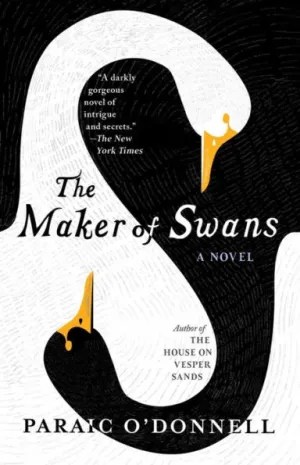
O’Donnell’s poetic style and mysterious setting hooked me in, but I’m afraid I stopped reading when the orphan cygnets showed up.  I just knew something bad was going to happen to them and couldn’t face it! Has anyone read this one?  Can you reassure me that the baby swans are all right at the end?  If so, I’ll probably return & finish!

MARCH 2023:  Back To My Usual (If Slightly More Frantic) Pace
March was another travel month, with lots of airport time.  Although I sometimes read serious stuff when I travel (I once finished Joseph Roth’s The Radetzky March during a single marathon flight), on the whole I tend to stick to mysteries or to more popular contemporary works.  I’m a long time fan of Ruth Rendell’s dark psychological novels (originally published under her “Barbara Vine” pseudonym) and the presence of her work on my kindle dominated March, as I read four of her twisty, clever and psychologically acute novels at various points during the month (Judgment In Stone; A Dark-Adapted Eye; House of Stairs; & King Solomon’s Carpet).  In a psychologically much lighter vein, I also read and enjoyed Jenny Jackson’s much ballyhooed Pineapple Street (so reassuring, dear readers, to discover that folks with thirty-seven million dollar trust funds need love too).  Last, but far from least, was Deanna Raybourne’s tale of a squad of retired female assassins, Killers of a Certain Age; perfection itself for those with five-hour layovers in Kansas City.

One of my rare forays into non-fiction:

Although I’d no intention of reading it at the time, one look at its marvelous photos and I quickly became absorbed in Seymour’s biography of Jean Rhys, I Used To Live Here Once.  (Has anyone read Athill’s account of her relationship with Rhys in Stet.?  It’s a marvelous picture of this most difficult artist.)  Aside from including great photos and much fascinating background about the Rhys family, Seymour provides a sensitive and very readable account of Rhys’ life.  Most valuable for me, however, was Seymour’s very convincing argument that Rhys, both as a woman and an artist, was much more than the protagonists she portrayed.  Like many readers, I first came to Rhys via The Wide Sargasso Sea and was a little disappointed in reading her other novels to discover they were quite unlike that work!  After reading this biography, I’d now like to return to  Rhys’ fiction, particularly her short stories, none of which I’ve previously read.

Some Of My Other March Reads:

One Old, one new; both very enjoyable diversions!  If you’ve read either of these, do share your reactions . . .

Although I’m not rabid about it, I do tend to like Emma Donoghue’s work & have read several of her novels. She’s an eclectic writer; one of those rare artists who produces something different with each book.  I purchased this one impulsively, on one of my milder book buying binges, and had no immediate plan to read it.  By early March, however, my bookish mojo was up!  Looking for something easy and contemporary, I started Haven pretty much on a whim and found it (surprise!) quite absorbing.  It really helped to get into the mood by recalling a bleak arctic island or two I’d seen on some past birding trips, all rocky cliffs, wild ocean and seabird nesting colonies.  Although I don’t think this was a great novel (or even one of Donoghue’s best), it was a quick and enjoyable read that, surprisingly, speaks directly to some very pressing contemporary issues.

After repeated and unsuccessful attempts to read Margaret Kennedy’s The Constant Nymph (unfairly or not, I just couldn’t get into the older man/nymphet thing), I decided to approach Kennedy through a different novel, The Feast (although it’s hard to tell from the photo, this is another of those adorable McNally editions).  To my surprise, I loved it!  So clever, to have the novel begin with an Anglican minister writing a funeral sermon, thereby ensuring the reader is hooked into guessing for whom the sermon is intended!  Clever, well written and very funny at times, I’m now up for exploring more of Kennedy’s work.  Who knows? perhaps I’ll even make it through The Constant Nymph!

This was my second novel by Johnson, a writer to whom I’ve become ever-so-slightly addicted.  Fortunately for me, her work seems to be enjoying a mild renaissance these days, with reissuances making her novels far easier to obtain than before (I must say, however, that I hate the cover art).  Although I’m still not sure that Friend’s plot entirely worked for me, I loved Johnson’s setting, a small seaside town in Belgium, as well as her very believable depiction of a middle-aged English couple on holiday with their young son. In May, I read another Johnson novel, The Last Resort, but I’m saving my discussion of that one for Part II of my catch-up post!

March’s New Discovery:

Although curious, I’ve been hesitant to tackle Dazui’s novels.  New Directions Storybook Editions, however, provides a very approachable (if rather pricey) way to try a new novelist with a minimum commitment of time.  This collection includes three of Dazui’s short stories (“Early Light;” One Hundred Views of Mount Fuji” and “Villon’s Wife”), all of which I found quite interesting.  I can’t say the collection converted me into an instant fan, but it did confirm my opinion hat Dazui is an author whose work I’d like to pursue. 

March’s Trip Down Memory Lane:

xxxxx
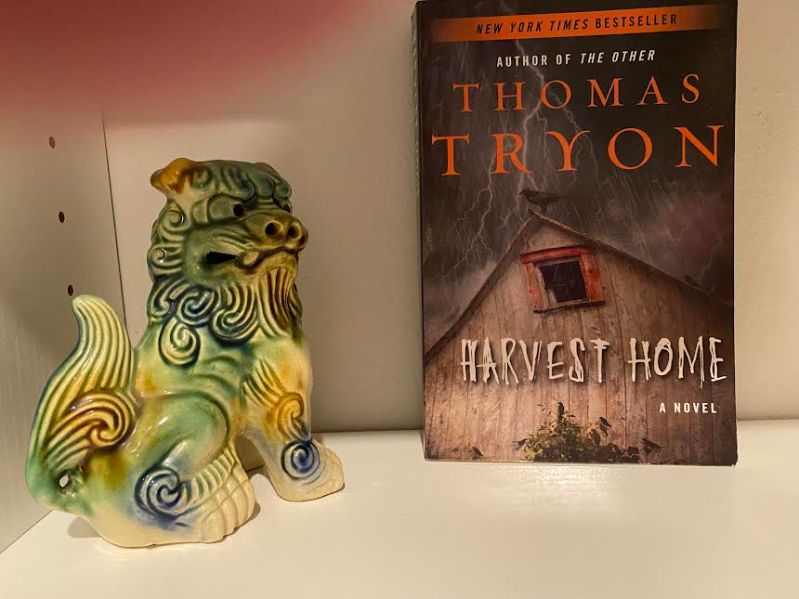
If you’ve previously dipped into my blog, you probably know that I’ve a deep and abiding fondness for the horror genre (comes, no doubt, from reading Dracula at a highly impressionable age).  I’m particularly addicted to folk horror, involving secret rituals in remote, forgotten villages  . . .

I’d read, and enjoyed, Harvest Home when it was first published aeons ago (in the 1970s, I think) but had largely forgotten it in the years since.  During a recent browse through the NYRB Classics’ website (those flash sales! totally irresistible!), I came across The Other, perhaps Tryon’s best known novel, which I’d also read shortly after encountering Harvest, but not liked as much.  Acting on sheer whim, I tracked down a replacement copy of Harvest (my original having been long since discarded) and settled in for a trip down memory lane.  I must admit that, second time around, I found the writing rather clunky, the descriptions sometimes just a teeny bit hackneyed (there’s been a lot of literary fiction under my bridge in the intervening years) and the story at times rather gratuitously gruesome.  But — Tryon can tell a story!  With no intention of reading the whole thing, I quickly became immersed in his tale of rural dark doings and didn’t come up for air until I’d finished.  The years, however, have definitely affected my opinion and not particularly for the better.  In addition to noticing the stylistic defects that I’ve already mentioned, I also became a little uncomfortable at the sometimes not-so-latent misogyny that pervades the story.  I’d have to know you personally, dear reader, to recommend this one, but for someone such as moi, with a taste for melodramatic trash horror and no demands for subtlety, this could prove a richly rewarding reading experience!

DIPPING INTO:

Unbeknownst to me, Saltz is a very prominent art critic indeed, writing for New York magazine for many years & winning a Pultizer in 2018. This collection of essays, obits & reviews is perfect for tiny bite sized reading.  His material ranges from Caravaggio to Kara Walker, so the collection has something for every artistic taste! 

March’s “Just Couldn’t Do It” Books:

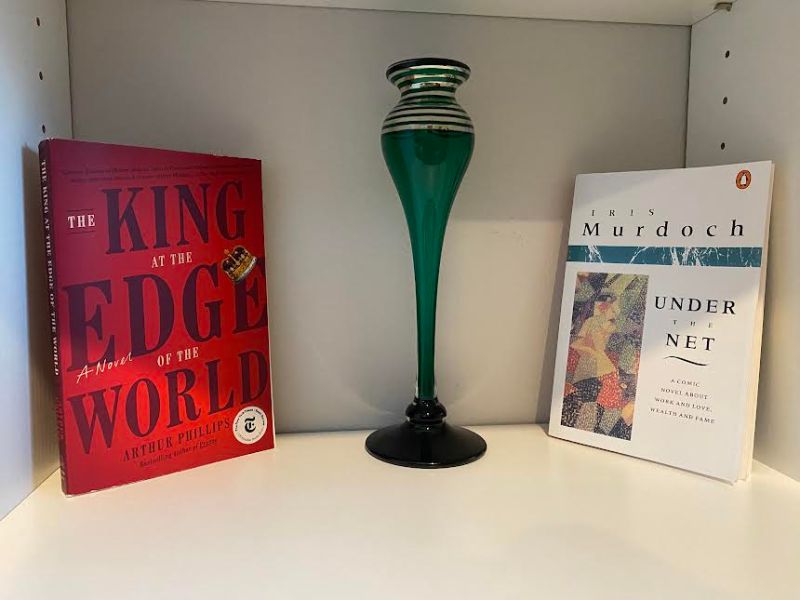
Isn’t it sad, when bad things happen to good books (which both of these are)?  March was just the wrong time for the Murdoch.  I will return!  As for Arthur Philips, well, not so sure.  I’ve occasionally enjoyed his work in the past, but after a hundred pages or so I just lost interest in this one.

FINALLY (PAST TIME, DON’T YOU THINK?)

If you’re still with me at this point, you deserve (1) a medal for patience and (2) a little visual treat.  I hope to be returning in a few days with Part II of my 2023 reading; meanwhile, I recommend you accept this advice from Zen Master Percy:
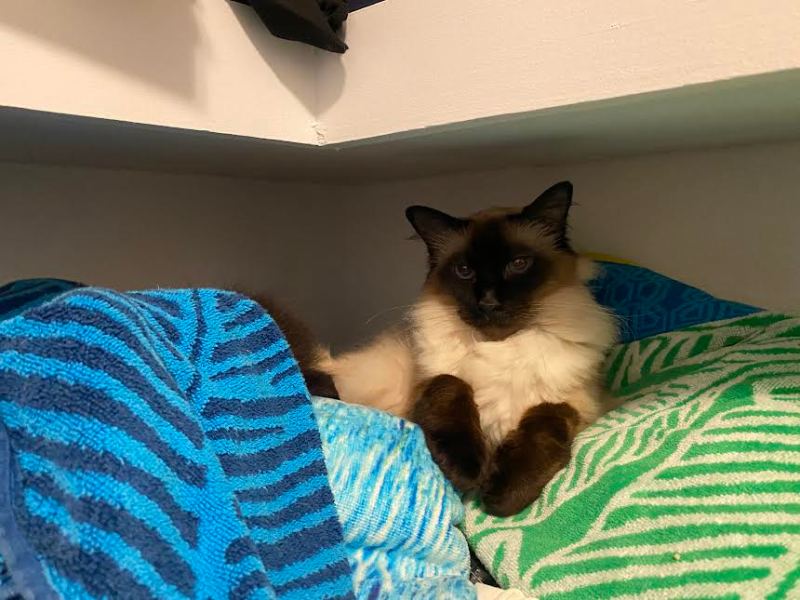
The zen lord of Beach Towel Mountain says “it’s time to sack out!”

“Six In Six”: My 2021 Reading So Far

About halfway through June I discovered the very amusing “Six In Six” Challenge sponsored by Jo at Book Jotter.  Since I’ve posted so very little this year while reading more than I have in quite some time, I decided this was an excellent way to share at least a little of the many great books that have come my way in what is shaping up to be a banner year for reading.  Besides, isn’t quantifying one’s journey almost as much fun as undertaking the trip in the first place?  

The challenge is to pick six categories and, having done so, to list six books that you’ve read by the end of June within each chosen category (as I understand it, the selections should be posted by the end of July.  Since I just wouldn’t be me if I actually posted on time, I’m shooting for August 1!)  In addition to supplying a multitude of categories from which to choose, Jo has very cleverly left room for participants to exercise their creativity by adding something new.  I’ve taken advantage of her leniency by adding two categories of my own, “Short Reads,” which is self-explanatory, and my “Shelf of Shame,” a list of six books that I’ve had on my shelves unread for over six years!  Can you, dear readers, match my brave honesty?  If so, please share in a comment! 

SIX AUTHORS I HAVE READ BEFORE 

0-10
Six of my “repeaters,” as of June 30.  Although I don’t read each of these writers every year, I do tend to return to them at periodic intervals . . . .

As a reader I am both loyal and tenacious, i.e., when I find a writer I like, I’m automatically “in” for her next novel and will frequently start working on that writer’s backlist as well.  As a result, my yearly list almost always includes at least a few writers from prior years, although the particular combination of names may vary.  Six of this year’s repeaters (there have actually been more but hey — we’re doing a “six in six” roundup here!) include:   

Beryl Bainbridge (BB).  Although I’ve always enormously enjoyed BB’s work, I took a rather extended break from it after reading a novel or two that didn’t quite do it for me.  This year, however, Tony’s excellent review of BB’s The Bottle Factory Outing reminded me of just how much I enjoyed Bainbridge’s elegant prose and her unique view of the world.  Resisting the temptation to re-read an old favorite or two (since I’m big on re-reading, this was difficult) I opted to try Every Man for Himself, in which a very privileged young man (he’s a nephew of J.P. Morgan) thinks it’s a great idea to book a homeward voyage on the Titanic.  Well, we know how at least one part of the story is going to end, don’t we?   Bainbridge, being Bainbridge, however, never fails to throw her readers a curve ball or two and this particular luxury ship as a metaphor is a perfect vehicle for her gimlet gaze at Edwardian Society at its height.  Because I tend to avoid fiction (and movies ) invoking the Titanic (frequently too sentimental and/or melodramatic, don’t you think?) I was very skeptical the novel would work for me.  Another of my egregious literary misjudgments, I’m afraid, as it was a fabulous read.  If you share my phobia about things Titanic (Titanophobia?), fear not, gentle reader.  This coming-of-age tale conjoined with the sinking of a very large ship is Bainbridge at her best.

Sylvia Townsend Warner.  A favorite writer of mine, so much so that I actually summoned the energy last year to write a real review of one of her wonderful books.  Since that time I’ve been hoarding The Flint Anchor to read for Gallimaufry’s annual STW week.  Although Anchor is classified as historical fiction, it’s leagues above what’s included in this genre.  Warner’s combination of realism and imagination is equaled IMO only by Hilary Mantel’s; both writers have the ability to convince me that I’m reading an actual account of an era while at the same time enriching their stories with modern flashes of insight and imagination.  If you haven’t read Warner before I wouldn’t recommend that you begin with Anchor, which does start a bit slowly; if you need sympathetic characters with which you’re able to identify, I’d probably skip Warner altogether.  If you’re looking, however, for an unforgettable reading experience from a master of English prose, then head for this novel about a 19th century Norfolk merchant and his tyrannized family.  Despite my intense enjoyment of Flint Anchor, I didn’t manage a review for STW week.  Not to worry, gentle readers, as Gallimaufry’s excellent review says it all.  (Note to Gallimaufry: typepad frequently gives me technical problems, so I wasn’t able to leave any comments.) 

Valerie Martin.  A prolific and wonderfully skilled author that I’ve somewhat lost track of in recent years (if you haven’t read Property, put it on your TBR list immediately!).  I was happy to renew our acquaintance this year with Martin’s latest, I Give It To You, a wonderful novel involving a writer’s use, and sometimes misuse, of fiction to interpret another’s life.  Set in a beautifully described Tuscan countryside, with an interwoven plot strand involving Mussolini’s Italy, what’s not to like?

Joe Abercrombie:  No one does dark fantasy better than Joe A.  Why read George R.R. Martin’s Game of Thrones when Abercrombie’s novels are available?  And better?  Unlike Martin, Abercrombie does tight plots, has a wicked sense of humor and can actually finish a story line (is it obvious, dear reader, that I’m a disgruntled fan of George R.R.?)  From December 2020 to mid-February 2021, Abercrombie’s novels were calling my name; I totally immersed myself in his deliciously cynical world.  Abercrombie’s realpolitik, tricky plots and flawed characters were such a perfect escape from pandemic and moving-to-a-new-house stress.  When the dust cleared, shortly after my eyesight gave out, my total was two complete trilogies and the first two volumes of a third (last volume’s due out this September.  Guess what I’ll be doing then?).  Readers, what can I say?  That’s a lot of trilogies.  If you’d like to sample Abercrombie’s work on a less immersive basis, I’d recommend Best Served Cold, which can easily be read as a standalone novel.  

Elizabeth Bowen.  As I’ve noted before, Bowen is one of those writers with whom I have long had a problematical relationship.  She’s one of the greats, no doubt about it, and her prose can be absolutely gorgeous but  . . .  at times she’s just a bit too nuanced and elliptical for little old me, who dearly loves an unambiguous story told in a straightforward manner (yes, dear reader, some of us never quite leave our childhood behind).  Yet Bowen is one of those writers to whom I keep returning and I’ve slowly but steadily whittled away at her novels after discovering her work a decade or so ago.  (I think Hotel and A World of Love are the only ones I haven’t yet read.)  This year’s Bowen was Eva Trout, a wonderful novel involving a socially challenged and very rich young woman, a gun that goes off at a most unexpected time and the inability of humans in general to communicate anything important to each other.  As if Bowen’s wonderful prose and the very interesting questions she raises aren’t enough to make it one of the best things I’ve read this year, the novel is also very, very funny in spots (there’s a luncheon scene I’d rank with some of Saki’s finer sketches).

Anita Brookner.  After being a rabid (if one may use such a word in connection with such a genteel writer) fan for many years, I drifted away from Brookner’s work when she was slightly past mid-career.  Undeterred by my desertion, the wonderful Ms. B just kept turning out her elegant, psychologically insightful novels.  I hadn’t intended to read anything by Brookner this year, but Jacquiwine’s reviews of Brookner’s novels (she’s working her way through them in publication order) have been so much fun to read I was inspired last spring to re-read Misalliance, one of my favorites.  This time around, I enjoyed Brookner’s tale of the intelligent, lonely Blanche and her nemesis, a husband stealer named Mousey, every bit as much as before.  

SIX BOOKS THAT I’VE READ IN AN ENGLISH TRANSLATION AND SIX WRITERS WHO ARE NEW TO ME 

Until I started blogging, I really avoided translated literature for a variety of reasons, none of them good.  One of the great joys of the last year (and, face it, weren’t we all seizing on the teeniest little bit of joy in that awful pandemic year?) was letting go, or at least beginning to let go, of that irrational prejudice, with some very happy results as a reward (the only downside has been an exponential explosion in my TBR list).   Since I’m new to reading translated fiction, practically every translated novel that I read in the early part of this year (exception noted below) was by a writer who was new to me. Taking advantage of Jo’s invitation to be creative, I’ve decided to combine these two categories.  

0-11
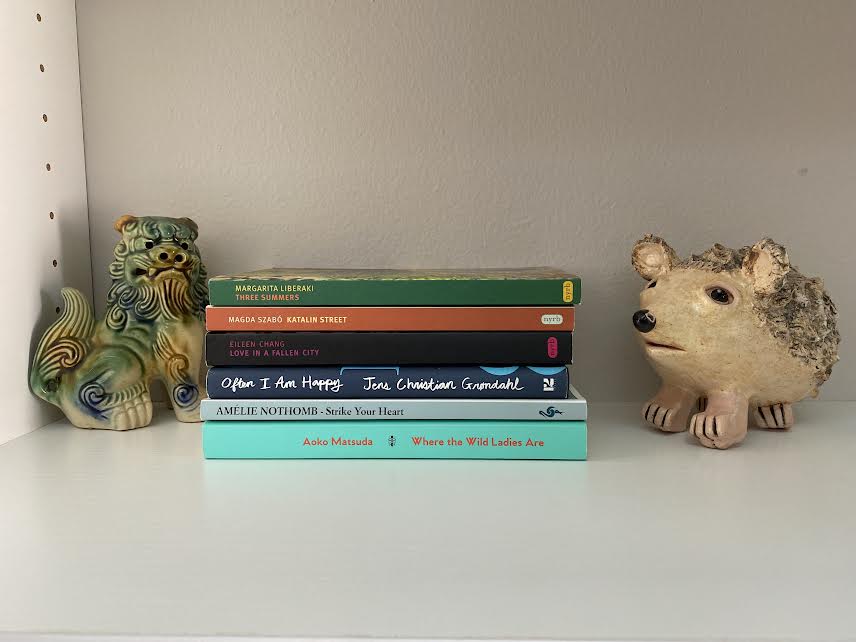
Several of these novels are thin, but mighty; their authors know how to pack a powerful punch into a minimum of pages.

Aoko Matsuda.  Placed at the bottom of my pile only for convenience (the other books stack up nicely on top of it), Matsuda was one of this year’s wonderful discoveries.  Humor!  A feminist slant!  A great translator (Polly Barton)!  Great characters and clever plots!  Matsuda’s collection of short stories inspired by Japanese folk & fairy tales has everything.  Although I read it back in January, thus beginning 2021 on a really high note, I’m afraid Abercrombie’s fantasy novels and my move to a new house got in the way of a proper review (I’m somewhat optimistic that I’ll manage this for #WIT month which begins, my heavens, can it really be tomorrow????)

Amélie Nothomb.  I’ve been intending for (literally) years to read something, anything by this very interesting French/Belgian/grew-up-in-Asia novelist.  Since she’s amazingly prolific (think Joyce Carol Oates) I had quite a lot to choose from.  Because I’m drawn to mother-daughter tales, I decided on Strike Your Heart, the story of an unloved daughter and the effects of that maternal deprivation on her life.  Since I’ve not read any of Nothomb’s previous work, I wasn’t sure what to expect; I must admit I was surprised by her terse style and the almost mythic nature of her story.  This short and disturbing novel (the mother’s psychological brutality in the opening pages made me mildly queasy) can be read in an afternoon.  Its effects, however, linger for quite some time afterward.  

Magda Szabo.  Including Szabo’s Katalin Street in this twofer category is a bit of a cheat, since I’ve previously read her wonderful novel The Door.  But, hey — this is my list and if adding it here causes any of you to read it I’m sure you’ll forgive me for you’ll be reading a marvelous novel.  Szabo’s tale of three interlocked Budapest families whose lives are torn apart by the German occupation of 1944 is quite different from The Door (aside from a more complex story arc, Szabo plays with a touch of magical realism by making one of her many characters a ghost) but is almost as good.  Absolutely not to be missed.

Jens Christian Grøndahl.  Grøndahl’s Often I Am Happy was another great discovery from the earlier months of the year.  I must admit that a somewhat prurient curiosity drew me to this novel in which the narrator addresses her dead best friend, who just happens to have stolen the narrator’s husband (I’m addicted to tales of marital betrayal.  Don’t ask why).  You can imagine my surprise in finding a spare, poetic meditation on grief, friendship and marriage.  I absolutely loved this book and have now added to my TBR list everything of Grøndahl’s that’s been translated into English.

Margarita Liberaki.  Do you, dear readers, enjoy coming of age novels written in beautifully sensual prose?  Are interesting female characers and a sense of atmosphere high on your requirements for an ideal reading experience?  Are you less exacting with respect to plot and action sequences?  If so, Liberaki’s Three Summers, which charts the lives and relationships of three young sisters growing up in a suburb of Athens shortly before WWII, should be your next novel.  Regardless of the time and place in which you read it, Liberaki will instantly transport you to the Greek countryside of the mid-1940s, in which you’ll almost smell those red poppies and hear the bees in the garden.

Eileen Chang.  Languages as well as a universe of emotional difference separates Liberaki’s novel from the beautiful, brutal short stories contained in Love In a Fallen City (oddly, I think the two women are roughly contemporaries).  If you’re seeking gentle tales of romantic love, well, Chang is not your writer.  Despite the title, her stories are about anything but love; rather, they center on power, exploitation and raw sexual politics, all told against the exotic setting of mid-20th century Hong Kong.  I loved this collection of stories, originally published separately in the 1930s-1940s, and put together by NYRB Classics.  Next on my reading for Chang will be her Little Reunions, also an NYRB Classic.

SIX BOOKS I’VE ENJOYED THE MOST 

As I noted above, 2021 has been an exceptionally good year for me as far as my reading selections are concerned, with scarcely a dud among the lot.  Although it’s difficult to limit my choice to six (for one thing, I keep changing my mind) my current selection is as follows (those who bother to count will notice that I’ve sneaked in a seventh novel):  

Jean Stafford’s The Catherine Wheel.  Another take on a love triangle, combined with a sensitively rendered portrait of childhood, told in beautiful prose by a marvelous, and marvelously underrated, American writer.  Stafford was a journalist and writer of short stories, with only three novels to her name.  Of these, only one, The Mountain Lion, seems to have remained continuously in print.  Thankfully, NYRB Classics has recently republished Stafford’s Boston Adventure (very high on my TBR list) and the Library of America has taken up her work as well. 

Elizabeth Bowen’s Eva Trout.

Henry James’s The Spoils of Poynton.  A year without a Henry James novel is a sad year indeed.  As much as I adore James, one has to be realistic about one’s available time and attention span, so I chose a shorter work to squeeze in this spring, keeping in mind that “short” does not equate to simple when reading HJ.  Being a material girl myself, I was eager to see how this duel to death over the family heirlooms would play out.  As usual, HJ did not do the expected but then — that’s why he’s The Master.    

Paula Fox’s  The God of Nightmares.  This is the year that I’ve finally gotten to Paula Fox, a very interesting American writer whom I’ve been intending to read for years and years.  This novel of a young woman, her fading actress-aunt and their bohemian circle of friends in 1940s New Orleans is told beautifully and with a complete lack of sentimentality (always welcome in novels with New Orleans’ settings).  I am now an avid fan of Paula Fox and expect to read many more of her novels.    

Sigrid Nunez’s The Last of Her Kind.  One of my “rescued from the back shelf” books; that it remained unread for so many years speaks very poorly of my judgment.  I loved this novel, for all the reasons I discussed in one of my few reviews this year.

Sylvia Townsend Warner’s The Flint Anchor.

Jane Austen’s Persuasion.  An impulse choice, but can one ever go wrong with Austen?  Because I first read Persuasion at a particularly low point in my life, when facing the results of several very bad choices, this novel has a special place in my affection.  Don’t we all need to be reminded at times that a bad choice can be redeemed?  Aside from a wonderful heroine in Anne Elliot, Sir Walter is one of Austen’s great comic creations.  

SIX SHORT READS

This is one of my “invented” categories, i.e., it’s not on Jo’s “Six in Six” list.  Although I’ve never been a big reader of short stories or novellas, I found myself turning increasingly to both in 2020, when I (like many others) found it so difficult to concentrate on novels.  The willingness to try shorter works has carried over to 2021, when I’ve finally started to read some of those many Melville House and Penguin novellas that have been sitting, neglected, on the shelf.  So far this year I’ve managed:  

Willa Cather’s “Alexander’s Bridge.”  A very early work, with an uncharacteristically urban setting (Boston and London, no less), this is a satisfying if flawed introduction to Cather’s work.  A love triangle in which two strong and very interesting women are being strung along by the same guy, who can’t quite make up his mind between the two.  Considered by critics to be not among Cather’s best, it’s still very much worth reading.  

Edith Wharton’s “The Touchstone.”  Not quite first rank Wharton IMO but still better than almost anything else written during that period.  A brilliant, famous woman bestows her love on an unworthy object, who ultimately betrays her trust in a particularly dishonorable fashion.  Wharton’s style and signature irony save this novella from being a tad sentimental and melodramatic.  

Ivan Turgenev’s “First Love.”  Another coming of age tale, with a twist.  Although I guessed the plot well in advance, this novella was a wonderful way to spend an afternoon.  It’s the first thing I’ve read by Turgernev; now I’m eager to read his Fathers and Sons.  

Joseph Conrad’s “The Duelist.”  After watching Ridley Scot’s great movie of the same name for the umpteenth time, I finally read the source material.  Although I’m not a big Conrad fan, this story of mad obsession, in which the irrational rancor of the duelists reflects the insanity of Napoleonic Europe, was a gripping and very satisfying read.

Stefan Zweig’s “Fear.”  Ah, the carnal lust lurking beneath the respectable facade of the Viennese bourgeoisie!  Adultery, guilt and blackmail!  No one does this type of thing better than Zweig.  

James Joyce’s “The Dead.”  I’ve read it before, but what does that matter?  A work to re-read, as many times as possible during one’s life. 

SIX BOOK COVERS THAT I LOVE

0-6

0-4

0-5

0-7

0-8

0-3

MY SHELF OF SHAME:  SIX BOOKS THAT I’VE HAD FOR MORE THAN SIX YEARS WITHOUT READING THEM

0-12

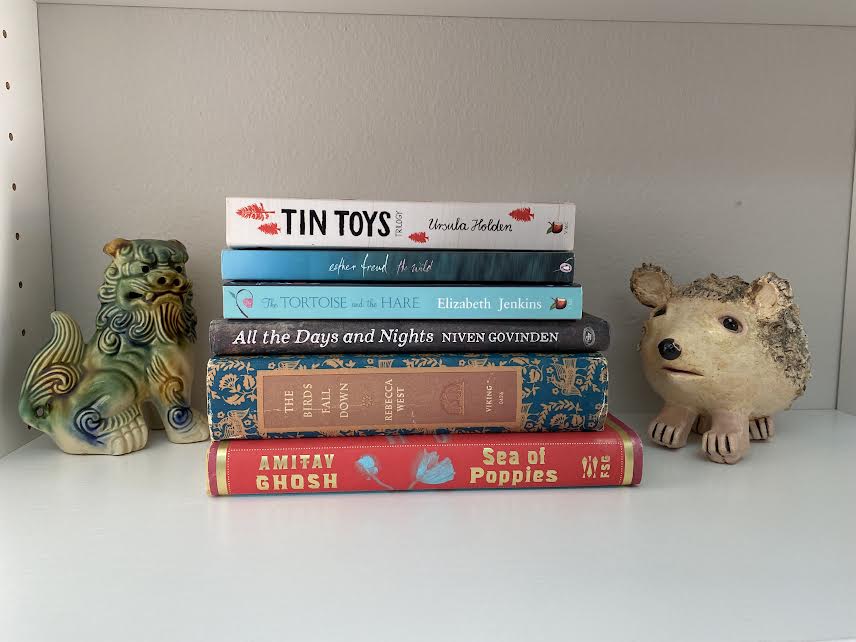
As I indicated at the beginning of this post,  I devised this category largely because I have so very many unread books.  The above, a mere bump on the iceberg, were chosen purely at random:

Rebecca West’s The Birds Fall Down: this one belonged to Mr. Janakay’s grandmother, who was quite a reader.  In my possession, unread, since 1985.  I love West’s novels, but just can’t seem to get to this one.

Amitav Ghosh’s Sea of Poppies:  In my possession since shortly after its publication in 2008 (note: I have the other two volumes of the trilogy as well, also unread).  Not to worry, dear readers!  I’ll get to all three.  Sometime.

Niven Govinden’s All the Days and Nights:  sitting on my shelf since 2015; I can’t understand why, as I’ve always wanted to read it.

Elizabeth Jenkins’ The Tortoise and the Hare.  I’ve been dying to read this one since 2009.  One day.

Ursula Holden’s The Tin Toys.  I don’t know the precise date I acquired this, but it’s been warming the shelf for at least a decade.  I actually took it with me on a long overseas birding trip, but ended up reading several of Patrick O’Brien’s Aubrey-Maturin novels instead.

Esther Freud’s The Wild.  Again, no precise date of acquisition, but this one’s looking pretty foxed.  It was published in 2000, and I’m guessing I acquired it in 2011, when I first discovered Freud’s novels and went on a massive Esther Freud binge.  I love her work, so I’ll definitely read it.  At some point.  


0-1
All this unread stuff is just too, too depressing; Maxi’s had enough of this “Six in Six” business!  She’s probably right.  It’s time, dear readers, to follow her example . . . .

April Is For Poetry

images
Doesn’t this attractive young lady look like she’s having fun, sunbathing on her fluffy white cloud while strewing flowers of inspiration on the world below?  She’s the Muse of Poetry, as depicted by French artist Henri LeRolle (1848-1949) and April is her very special month!

Well, hello again, dear readers!  After many months of silence, or near silence, I’m finally taking a stab at inserting (or, should I say “inflicting”) a new post on my almost moribund blog.  It’s requiring a bit more of an effort than usual, given the enormous and frightening changes in the world since my last post in January.  Then I had two major preoccupations, one being the very pleasant task of choosing my books for the 2020 Back to the Classics Challenge hosted by Books and Chocolate, the other the not-very-enjoyable labor of planning and executing a long-distance move (a task that proved almost, but not quite, too much for Janakay!).  In those halcyon, pre-pandemic days, Covid-19 was barely a shadow on the horizon.  Now it appears to dominate my life.  When I’m not washing my hands or sanitizing hard surfaces with whatever disinfectant’s at hand, or enjoying those very entertaining bird videos with the cats (Birds of Australia is a particular favorite at our house), I spend far too much time reading news accounts and statistics relating to this terrible disease.  Covid-19, dear readers, has given Janakay some (very) minor and unwelcome insights into life during those medieval plague years that were the subject of several of her college history courses.  Except, of course, medieval plague sufferers lacked both Purell and the internet (how would we all survive without both?)

And yet, however imperfectly, life goes on in this year of the plague.  Because it is “insufficient,” however, merely to survive (if, like me, you adore Emily St. John Mandel’s work, you’ll recognize that I’m lifting this line from her great Station Eleven, which in turn borrowed the idea from a Star Trek episode!) literature and art accrue even more value amidst the horrors of our chaotic times.  To survive in any meaningful sense of the word in these difficult days one must read!  Although I’ve not been sharing my thoughts online, I have been reading steadily, in the time between packing boxes and moving furniture; my reward has been discovering a number of remarkable classic and contemporary novels.  Hopefully I’ll be giving you at least some general reactions shortly but only after I finish unpacking the dishes!

0-4.jpeg
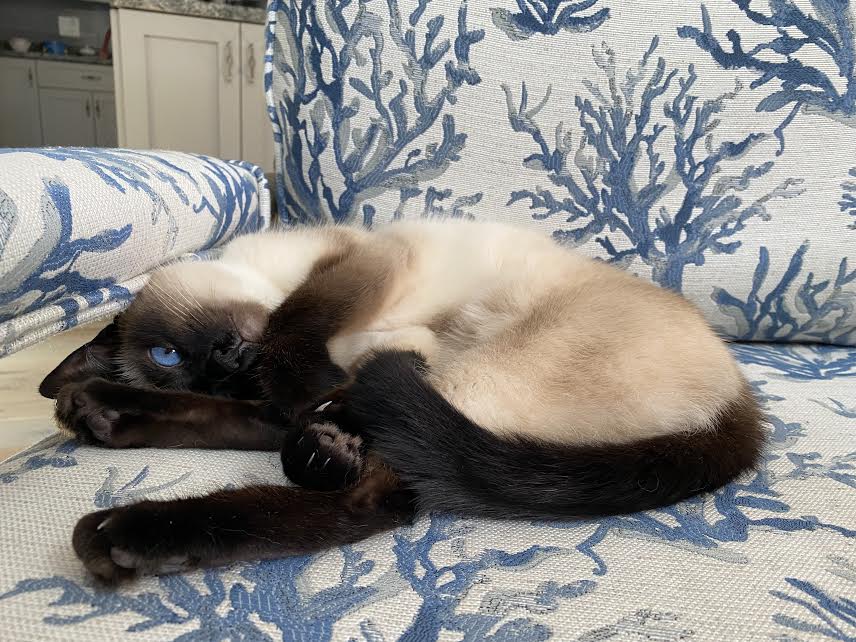
I’m absolutely positive those kitchen dishes are in there somewhere!  Maxi knows where, but is too sleepy to bother telling!

If you’ve visited my blog in the past, you are aware that I love novels, which are almost always the subject when I write about bookish things.  As I’ve posted before, I’m a little ambivalent about poetry (short stories, too, but for different reasons).  Although poetry was very important to me at one time in my life, it’s a difficult and demanding art form that requires time, attention and insight, which for many years were in short supply for anything other than Janakay’s job (kitty kibble is expensive and hungry cats can be positively savage!).  Although I don’t focus on poetry these days, I honor the art and do still attempt to save a little time for reading it.  I also attempt, in a mild sort of way, to venture beyond my youthful favorites, which included lots of poems about Corinnas and Lucastas gathering rosebuds and knights riding to many-towered Camelot and so on (Janakay obviously adored Cavalier Poets and the Victorians.  How could you not?  Their stuff all rhymed and was usually easy to understand.  “Ah, youth,” as one of my old fav poets might have sighed).  My efforts these days don’t amount to much; I read a poem now and then, usually something in a traditional mode and, occasionally, check out The Guardian’s weekly poetry column (for me it’s a great resource for finding unfamiliar work.  A bonus feature is Carol Rumens’ commentary, which always accompanies her weekly selection).  

My biggest gesture of support for my former love usually comes in April, designated “National Poetry Month” by these squabbling, competing and currently very disunited States of America.  Every April I make a point of actually buying a book of poetry; while I don’t have any rules about what I select, I do try to make it a work of a contemporary poet, or at least a poet who’s unfamiliar to me (this includes almost everyone writing poetry after 1900 or so).  My choice this year was Nina Maclaughlin’s Wake, Siren 


0-11
Honestly, isn’t this the greatest cover ever?  The critters surrounding the siren’s face represent the fate of the book’s various heroines.

in which Maclaughlin reimagines the stories of several mythical heroines taken from 

0-11

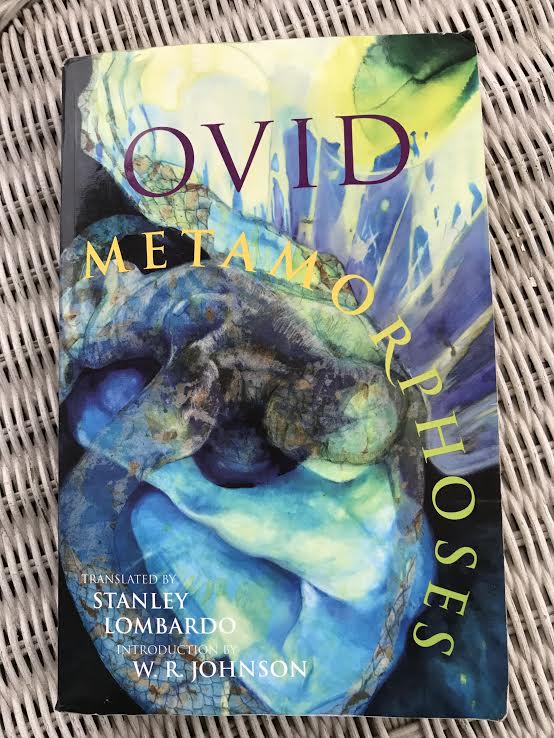
Metamorphoses, the great narrative poem written by the Latin poet Ovid in the first century CE.  Any lovers of Ovid out there, or just anyone who likes good stories?  As the name indicates, Ovid describes an unstable universe in which the world and its creatures constantly shift and transform from one shape or substance into another.   Chaos morphs into an orderly universe of form and matter; a golden age transforms into one of silver or bronze; male shifts to female and vice versa; humans transform into animals or plants or constellations  — well, you get the drift.  Many of Ovid’s stories involve human women or nymphs (lesser female divinities associated with nature) who happen to catch a god’s attention, almost always with disasterous results.  The women in Ovid don’t get many happy endings, unless you count being changed into a bear, a spider or a laurel tree as such.

In a very clever metamorphosis of her own, Nina Maclaughlin transforms the traditional stories recounted by Ovid by taking thirty of Ovid’s female characters and transposing them to a modern setting.  Maclaughlin’s women wear jeans, do yoga, go to music festivals and talk to their therapists using language familiar to Janakay from her days as a seaman apprentice (the narrator in “Agave,” for instances, tells her visitor that “there’s some beer in the fridge” and describes — sanitized version — King Pentheus of Thebes as “this asshole jock, this clean-cut rapey beef-brained” guy).  Most importantly, they tell their own stories in a series of monologues of varying length, speaking not in verse but in a type of flowing prose-poetry.  Maclaughlin’s approach adds depth and richness to Ovid’s tales and while you may not always agree with her take on the characters (who knows? Maybe Pentheus has some fans out there!) it frequently makes you rethink what’s going on in the stories.  Considering that these tales have been retold in verse, prose and music for over two millenia, this is a considerable accomplishment.

Maclaughlin’s format (like Ovid’s) is very conducive to reading in small dips and nibbles, which is very congenial to my currently fractured span of attention (so difficult to concentrate, don’t you find, with all this constant hand washing and disinfecting?).  It also has the advantage of letting you skip around, from short monologue (Nyctimene, two pages) to long (Tiresias, twelve pages), from happy (Pomona) to sad (Callisto).  My favorite piece so far (I’ve been dipping in and out for several days now) is Maclaughlin’s retelling of the Orpheus myth, the ancient and popular story of a divine musician who descends to Hades, charms the very dead with his song and almost, but not quite, retrieves his beloved wife, killed by a serpent’s bite on their wedding day.  In Maclaughlin’s version, Eurydice is the neglected daughter of a rock legend with music in her blood and a great deal of talent of her own.  After several unsuccessful and demeaning relationships that reinforce her low self-esteem, she hooks up with “O.,” a world famous singer who adds physical to psychological abuse in his attempts to silence her own song.  Realizing on her wedding day that she can’t go through with it, Eurydice flees to the Cobra Club, a raunchy honky-tonk located in a basement and run by HayDaze and his relunctant wife Penny, who goes away every summer on tour (the club’s sign features a red snake, naturally, and Eurydice and her friends joke when they go there that they’ve been “bitten by the serpent.”)  O. follows and, using his music to charm and bewitch, almost leads Eurydice to the top of the stairs and out of the club.  One final act of cruelty, however,  gives Eurydice the impetus to free herself from his spell and, with relief, return to her refuge, the club where everyone goes eventually and which always has room for one more (even at the sold-out shows).  Rather than being gimmicky, Maclaughlin’s clever inversion of the myth’s plot and visual elements makes the ancient story as relevant to us as it was to Ovid’s original readers.  It also makes for a lively, amusing and horrifying piece of work.  (For another great take on the Orpheus myth, try Carol Ann Duffy’s “Eurydice,” from her wonderful poetry collection The World’s Wife.)

So, do I recommend Wake, Siren?  Oh yes but . . . with a few teeny caveats.  Although Janakay adores giving a new spin to old material and is very fond of a feminist slant, she is aware that not every reader shares her taste for this sort of thing.  If, unlike her, you prefer your mythology straight, Maclaughlin’s book is obviously not for you (in that case, you might check out the edition of Ovid pictured above.  Stanley Lombardo’s translation is great, there’s a wonderful introductory essay discussing the themes underlying Ovid’s work and some helpful additional features, such as a glossary of names and a table grouping the myths into various categories).  There’s also the question of language, which is very uninhibited.  Again, this is fine with Janakay (any naughty word she didn’t hear in the navy turned up when her college Latin class translated Petronius’ Satyricon) but if it’s an issue for you, well, there are plenty of other sources to choose from. Oh — before I forget — it isn’t necessary to know the traditional form of the myth to enjoy Maclaughlin’s version, but it’s fun if you have the time and energy to read the two in tandem.

Well, that’s it for tonight, dear readers.  Stay healthy, keep washing those hands and if you’ve time to honor the muse in her special month by reading a poem or two, share any particular treasures you may find!


Summer Reading: The Beauty of Lists

Do you ever have nights when the internet is calling your name, in a voice not to be denied?  When you just can’t stop clicking, going from website to website?  When it happens to me, it’s a bit akin to Odysseus and the sirens, except that I don’t have the magic ear plugs or whatever to protect me, so I just keep clicking away.  I can’t explain the phenomenon but I’ve noticed (oddly enough) that it always seems to occur when I’m facing a day filled with tasks I don’t want to do or appointments I don’t want to keep!

Today my clicking compulsion centered on summer reading lists, which abound this time of year.  I adore lists of summer reading recommendations!  Although I don’t really change my reading selections by the season, it’s always fun to see what other people are reading, or what they think you should be reading; I’m a bit lazy and checking out lists of reading recommendations is also an easy way for me to stay somewhat current with new books, as many summer reading lists heavily feature newly published work.  Since I’d hate to keep the fruit of my “labor” to myself, I’m listing the lists my clicking has uncovered!

Tibout_Regters_-_De_belastinginner_-_2252_-_Rijksmuseum_Twenthe
This 18th century fellow is, I believe, actually doing a tax tally. I like to think, however, that he’s doing a booklist!

I rely pretty heavily for my reading recommendations on the book section contained in The Guardian.  Although it can be a little frustrating when there’s a lag in the U.S. edition (I’ve sometimes waited for months before a particular title becamse available in the U.S.), the Guardian covers numerous U.S. as well as U.K. authors and its reviews are truly excellent.  For 2019 it’s published an excellent “Summer Reading Guide,” with a hundred recommended fiction and non-fiction titles.  The guide lists relatively recent books, covers a wide variety of genres (such as “Modern Life” and “Page Turners,”which are thoughtfully listed with the title) and encompasses non-fiction as well as fiction.  I found some interesting fiction recommendations here, of books I had either forgotten (Tom Rachman’s The Italian Teacher) or didn’t know about, such as Halle Butler’s The New Me.  The Guardian doesn’t have a pay wall (an increasingly rare occurrence), so no problem with access.  I really love The Guardian’s book section.

The New York Times has also compiled a Summer List of seventy-five titles from a similarly wide variety of genres such as “Thrillers,” “Travel,” “Crime,” Horror,” “Outdoors” and so on.  Unlike The Guardian’s more traditional format, the Times’ list is more of an interactive affair, so more clicking is required.  Also unlike The Guardian, the Times has a paywall, so if you’ve exceeded your monthly quota of free clicks, you may have to wait until next month to see the list.

The Washington Post has given a slightly different twist to its summer recommendations, coming up with “100 Books for the Ages.”   Want to know what to read when you’re 43 years old?  Why, Claire Messud’s The Woman Upstairs, of course!  Dodie Smith’s I Capture the Castle is for the 24 year olds, while Alex Comfort’s The Joy of Sex is recommended for the age 30 set.  O.k., o.k., I know it’s gimmicky but it is kind of fun!  And it’s quite encouraging to see Herman Wouk’s Reflections of a 100-Year-Old Author recommended for the centenarians among us.  The Post has also a more conventional “20 Books to Read This Summer,” which is a bit heavy (for my taste) on non-fiction, such as Steven Gillon’s biography of John F. Kennedy Jr. (The Reluctant Prince) and Evan Thomas’ bio of Sandra Day O’Connor (First).  Although pretty conventional, the fiction choices are of all the latest & trendiest, so you’ll be well able to impress the other lawyers when you’re standing around the water cooler.  And there is one piece of exciting news:  Colson Whitehead has a new novel, The Nickel Boys, which will be available on July 16th.   The Washington Post, like the NY Times, has a paywall; if you’ve only one free click left I’d go for “100 Books for the Ages.”

Bustle’s “30 New Books Coming Out in June 2019 To Look Forward To Reading This Summer” is worth a glance.  Each title has a brief descriptive paragraph, which is a nice feature.  The article also contains internal links to additional recommendations for different genres such as graphic novels and rom-coms.

Just as a reminder that tastes differ, and that mine differ quite a bit from the terminally esoteric, I usually check out the seasonal reading recommendations from contributors to the Times Literary Supplement.  Each contributor offers a chatty little paragraph discussing his or her reading choices, which can be particularly interesting if you have a thing for a particular contributor, such as the great classicist Mary Beard.  On a somewhat less elevated level, the New Yorker’s writers have compiled a “What We’re Reading This Summer” feature, which, as you might expect, covers a select but quite broad range of fiction, memoir, and non-fiction.  Both publications are picky about subscriptions so your access ability may be limited if you’re a non-subscriber who browses them on a frequent basis.

To find some recommendations that offer different perspectives on race and gender, NPR’s Code Switch Book Club has some interesting selections drawn from its listeners’ recommendations.   These include Kwame Appiah’s The Lies That Bind: Rethinking Identity and Uzma Jalaluddin’s Ayesha at Last, a modern take on Austen’s Pride and Prejudice set in Toronto’s Muslim community.

Well, I could keep going but I’m sure you’ll agree that enough is enough, at least from me!  Do you have any great lists or recommendations you’d like to share?  If so, I’d love to see them.

Oh — before I forget — the painting at the beginning of this post is called The Tax Collector and is by Tibout Regters, an 18th century Dutch artist.