Category: horror fiction

My 2023 Reading: PART I

This pile contains many of the books I read, dipped into or (gasp!) abandoned during the early months of 2023.  I rely quite heavily on my kindle, however, when I’m traveling, so I’ve also been reading quite a few e-books this year, mostly beloved old things that are now scarce or out of print.

My heavens, dear readers!  Can it possibly be early July?  Is the year half-way over already?  And me without a single review to my name for 2023?  However could such a shameful state of affairs happen?  Well  . . .

The year did not begin for me on an auspicious note.  Nothing wrong in a major way, but the New Year found me feeling a certain ennui that is generally rather foreign to my nature, especially when it comes  to books.  Have you ever had a period in which you struggled to read?  That despite having piles and piles of lovely unread books, chosen with great excitement (and, in many cases, considerable expense), you just didn’t feel like reading any of them?  This was precisely my mood as the new year rolled around.  Despite an enormous TBR list that offered endless possibilities for new discoveries (not to mention fun), I’m afraid the beginning of 2023 found me in zombie mode as far as reading was concerned.  Usually I love January, with its buzz of bookish Challenges; typically I spend several intensely pleasurable days pawing through my treasures and making totally unrealistic reading plans for the upcoming year.  Not so this January!  The arrival of 2023 saw me twiddling my thumbs, bored (actually bored) with my books and not even beginning a single new novel.  Quelle horreur!

Despite this, I did manage to read a few things simply by powering through my malaise (not to be trendy, but I suppose you could say I leaned into it) — not reading much, by my standards; but reading.  Like nursing an illness, I made reading easy on myself by picking only a few things by authors I had previously enjoyed.  I also re-read several books or novellas I had liked or admired in the past and picked fiction heavy on character and stylistic elegance, the main features that attract me in novels.  In short, I marked time until my reading mojo chose to reappear!  By February, and the discovery of some truly great novels things were definitely looking up.  Although I still didn’t feel like reviewing anything myself, I did resume reading some of your lovely blog posts and leaving a comment here and there.  All in all, it was an incredible relief to find my bookish life ever so slowly returning to normal.

As far as posting was concerned, however, I’m afraid my recovery’s remained incomplete.  As I suspect some of you know, it’s hard to get back into blogging after a break, particularly when other, very enjoyable activities are calling your name!  Chief among these has been travel, as Mr. J. and I have slowly emerged from our covid cocoon, dusted off our passports and resumed our (very) mild wanderings on the earth.  I’ve also been spending much more energy & time on art history and nature , centering the travel when possible on these long-time hobbies of mine (Bernini’s David! The Ghent altarpiece!  The Iiwi!)  Loads of fun, but definitely not conductive to keeping the blog current!  (When I do Part II of this Post, hopefully in a few days, I may throw in some of Mr. J’s excellent photos.  Other than that, I won’t bore you with details).

But enough of the mea culpa — time to talk about books!  Even in low energy times I generally keep a sort of running list of the books I’ve read.  This year, contrary to my usual practice, my list has actually morphed into a hybrid between a list and a journal, as it frequently included my brief impressions/assessments of what I was reading as well as how it slotted into my life at the time I was reading it.   Working from this, I decided to post an overview of my 2023 reading as this seemed the least painful way to ease myself back into blogging.  While I’ve retained my journal’s chronological format & style, I’ve done some mild editing & expanded several entries to reflect additional thoughts about certain books that I found particularly interesting.  TBH, dear readers, the whole thing is a bit of a hodgepodge, but I’ve thrown in some photos & headings that should make it easier for you to navigate to particular items you might find interesting, or to click away from those that you don’t.  I’ve also resisted the temptation to leave out some of my (ahem!) “lighter” choices.  After all, I can’t be the only one out there who loves Georgette Heyer, pulp sci-fi of a certain vintage and the occasional chick lit best seller, can I?

JANUARY 2023: STRUGGLING THROUGH SLUMP MONTH

Don’t you love Melville House novellas?  Aside from their convenient size (so handy to pop into a purse or backpack) the colors alone are enough to jolt one out of a slump!  My overflowing TBR pile includes almost all of Melville’s “art of the novella” series, so it was natural enough I’d go to my stash to read Kate Chopin’s best known work.  Did you know that few, if any, of Chopin’s contemporaries had anything good to say about Awakening, with even Willa Cather criticizing it as immoral?  The backlash was so heavy, in fact, that it ended poor Kate’s hitherto successful writing career.  Even in zombie mode, I adored Awakening and am now eager to read some of Chopin’s other works.  Any recommendations?  I’m inclined to begin with this little book of short stories (issued by Counterpoint Press) but I’m open to other suggestions.

I began the New Year with a re-read of Kate Chopin’s The Awakening, whose novella length and status as a re-read made it a perfect beginning for my apathetic, low energy month.  Chopin’s Louisiana setting was an additional attraction; I lived in New Orleans many years ago, loved the place and felt in the mood to revisit the city through the eyes of Edna Pontellier, Chopin’s protagonist.  I was also interested in comparing my present reaction to the novel to that when I first encountered it many years ago.  The first time around (before I lived in New Orleans, I might add) I’d literally raced through Awakening; to my shame, I was mostly relieved to cross it off my list and move on to the next newly discovered feminist classic.  In other words, I’d liked it in a rather mild kind of way but wasn’t particularly impressed.  What a difference a second reading can make, particularly when it comes so much later in life!  This time I savored practically every phrase, awed by Chopin’s skill with the language and her boldness in depicting the limitations of the world inhabited by her protagonist, trapped in her beautiful doll house and meaningless life.  Chopin’s beautiful style, her ability to create atmosphere and her sheer honesty about, and insight into, her Edna’s psychology are leagues beyond what so many of her contemporaries were churning out.  How could such a marvelous writer have been so thoroughly forgotten for so long?

WILL ONE OF MY FAVORITE AUTHORS BREAK THROUGH MY JANUARY ENNUI?

I’ve loved William Trevor’s fiction since I first read Felicia’s Journey, back in the 1990s.  As you can see I have a little Trevor Trove (groan) of his work, minus several novels I very reluctantly discarded (I had read them) during my long distance move a few years ago.  Did resorting to a beloved master shake me out of my reading malaise?  Well . . .  

I Was delighted when Cathy746 announced a year of “Reading William Trevor,” as it reminded me of how very much I love his work.  Surely reading something, anything, from such an old favorite, a master of style and psychology, would restore my reading enthusiasm!  Sad to say, my remedy failed.  No reflection on William, he remains as great as ever in my estimation, but even his considerable literary power wasn’t enough to break through my apathy, particularly when the latter was combined with a truly nasty, late January sinus infection.  I wanted to save Felicia’s Journey and After Rain, two of my all time favorites, for happier times, wasn’t in the mood for short stories (so difficult to decide which to read first, n’est-ce pas?) and didn’t have the energy to embark on a totally new novel.  After a certain amount of apathetic dithering about, I returned to two Trevor works that I’d first read decades ago.  I picked these two because I’d liked both very much but remembered very little about the plot of either.

I began with Two Lives, which contains two separate and seemingly unrelated novellas under one cover.  The novellas are a study in contrast — as each explores two very different protagonists — are set in wildly different locales and strike very different emotional chords.  My House In Umbria begins with the reminiscences of Mrs. Emily Delahunty, now retired from her career as a lady of pleasure in colonial Africa to the serenity of the Italian countryside (as Mrs. Delahunty explains early on, she’s used many different names over the years and the “Mrs.” is a courtesy title; “strictly speaking” she’s never been married).  Ensconced in a charming Umbrian villa, and ably assisted by her rather sinister factotum Quinty (one of Trevor’s great minor characters) she occasionally assists the local hotels when they’re overbooked by taking guests at her villa.  Mostly, however, Mrs. Delahunty spends her days writing florid and very successful romance novels.  All goes reasonably well until, suffering from writer’s block (she’s unable to flesh out her new novel, tentatively titled “Ceaseless Tears”) & looking for inspiration, Mrs. Delahunty boards the wrong train at the wrong time.  After surviving the ensuing terrorist attack that kills many of her fellow passengers, she impulsively and generously offers accommodation at her villa to the survivors (Quinty, less generous, ensures that the lodging isn’t free).  The heart of the novella concerns both the complex relationships that develop among the survivors as well as Mrs. Delahunty’s past, which Trevor gives to us in funny, heart-breaking and oh-so-realistic fragments, in a way that only he can do.

In contrast to the exotic Mrs. Delahunty and her Umbrian menagerie, Mary Louise Dallon of Reading Turgenev is a much less colorful and seemingly more tragic protagonist.  Mary Louise is the younger daughter of poor farmers who “struggled * * * to keep their heads above water” (page 4) in the dwindling Protestant community of a small Irish hamlet in the mid-1950s.  Realizing that her dream of being a shop assistant in town is unobtainable, Mary Louise makes a marriage of convenience to a much older man (a naive thirty-five to her naive twenty-one) who’s one of the few Protestant bachelors in her community.  After enduring years of a loveless and miserable-to-both-parties marriage, Mary Louise secretly begins to visit her invalid cousin Robert, whom she had not seen since childhood.  During these surreptitious visits, Robert exposes Mary Louise to the literature and poetry, particularly the works of Turgenev, which had been the solace and comfort of his restricted and lonely life.  As the two bond, Mary Louise becomes aware through the fiction they read of a world that transcends her own grim existence and experiences, for the first time, the comfort of having another human being who listens and understands her as no one else has ever done.  After Robert dies unexpectedly, Mary Louise fashions his memory into an image of the great love that she believes they were destined to share.  Her iron determination to own this memory, to keep and shape it for herself, insulates her from the assaults of her quotidian life and leads to tragic results.  Or — does it?  It’s part of Trevor’s greatness that he doesn’t leave the reader with an easy answer to this question.

When I first encountered Mrs. Delahunty and Mary Louise oh, so many years ago, it didn’t occur to me to ask the the obvious question of why Trevor paired these two novellas (Readers, I was quite young at the time!).  Particularly with a novelist to whom character is so important, their juxtaposition suggests linkages between the two very different protagonists and their worlds.  Using contrasts to heighten differences is an obvious and very old trick; it also seems an insufficient reason to pair these two novellas for a writer as subtle as Trevor.  To me, the two lives, so very different on the surface, are actually quite alike in a very fundamental way.  Despite their obvious differences, the paths taken by both women demonstrate the power of fiction and of the imagination in enabling us to transcend the mundane and often painful “realities” of our lives.  Mrs. Delahunty, the product of a sordid past and unspeakable abuse, very consciously fashions sentimental stories with happy endings that allow her and her readers to escape, if only briefly, from their own lives into a reality that’s been shaped more to their likening.   Mary Louise uses the literature she shared with Robert as a gateway to a world far removed from the horror of her daily life and as the foundation for fashioning her ideal of an eternal, transcendent love that she was destined to experience.  Is the way these two very dissimilar women use art/literature a positive or negative thing?  Trevor seems to suggest that it’s both.

It’s always interesting to re-read a work after a being away from it for many years; re-reading exposes lapses in memory, changes in sympathy and, occasionally, a greater appreciation of the writer’s craft.  When I first read Two Lives, I preferred Umbria for its black humor and the clever way Trevor had Mrs. Delahunty unknowingly reveal so much about herself that she would have clearly preferred to keep private.  I actually thought, first time around, that Turgenev was a bit boring, in a well written kind of way.  My reaction on re-reading, however, was wildly different.  Although I still enjoyed Umbria’s mix of irony, pathos & dark humor (it is very funny at times), this time around it was Turgenev that blew me away (irrelevant aside: Trevor was nominated for the Booker for this work but lost; how could that possibly be?).  Last year (or was it the year before? too lazy, I’m afraid, to look it up), I read and very much enjoyed Claire Keegan’s Foster & Small Things Like These.  Re-reading Turgenev reminded me very much of the tradition Claire Keegan is working in; her work is almost the equal of Trevor’s in its subtlety, psychological insight and craft.  For me, there’s no greater praise.

Despite my renewed appreciation of Trevor, however, Two Lives failed to restore my joie de livre.  Operating on the theory that, if one Trevor didn’t work, I might as well double down on a second, I went for a re-read of The Silence In The GardenAgain, I remembered little from my earlier encounter with  this tale of decaying Anglo-Irish aristocrats in 1930s Ireland, haunted by something akin to blood guilt.  Rich (perhaps a little too much so) in metaphors, Garden isn’t one of my favorite Trevor novels.  Nevertheless, it’s a good story, beautifully written, and has some amazingly well-drawn characters (check out “Holy” Mullihan, a sadistic goon who’s a master in using religion to cloak his bullying).  Second time through, I found Garden definitely worth the time, although I’d not place it at the top of my personal list of Trevor favorites.

WHERE DO I GO AFTER WILLIAM TREVOR?

Three more of my “just powering through the slump” reads (the Trollope novels in the background date from a more energetic & ambitious period)  . . . .

I first encountered Laura van den Berg almost a decade ago, when I read her short story “Opa-locka” in one of those “best of the year” anthologies.  LVDB’s elegiac melancholy, combined with her ability to depict a reality that was just a bit off-kilter quite haunted me; she immediately won a spot on my reading radar and I resolved to check out more of her work.  But — we all know what happens to those good intentions about our TBR list, don’t we?  I would probably never have gotten to I Hold A Wolf By The Ears without the enthusiasm of my good friend Silvia, who read and loved this collection (thank you, Silvia!)   As with any collection of short stories, I liked some more than others, but none was a dud.  How to resist a writer who begins a story (“Last Night”) with the words “I want to tell you about the night I got hit by a train and I died”?

Still operating on reading autopilot, I cast about rather desperately for something short and undemanding to read.  I settled on J.L. Carr’s A Month In The Country, which had been tempting me for a very, very long time.  Did it live up to expectations?  Well, yes and no.  Despite my grumpy, listless mood I found it to be a lovely read.  It was tinged with a most appealing nostalgia, with its protagonist’s remembrance, many years later, of events that would have altered his life had he acted differently.  Carr is a wonderfully descriptive novelist; he made it very easy for me to visualize an English countryside in spring that I’ve never seen in reality.  One aspect of the novel that I didn’t expect and that I found totally captivating was its underlying theme about the transcendent value of art and art’s endurance, despite its fragility, to the ravages of time.  Despite all these good things, however, my attention did occasionally wander and I had to force myself just a teeny bit at times to continue reading.  Although I could blame “the Slump” for my reservations, I don’t think I quite succumbed to the novella’s charms.  Unfairly or not, I found Country perhaps just a bit too twee, its nostalgia a little too manipulatively pulling at the heart strings.  Have any of you read it?  If so, what did you think?  Am I being a heartless curmudgeon or what?

January’s Discovery & Its February Continuation:  I don’t read much poetry any more, so you can imagine my surprise when I unexpectedly became quite obsessed with Eliot’s The Wasteland.  Could it be that sometimes only poetry will do?  I was barely familiar with the poem, having read only a small portion of it several years back (and then only because it was required reading in a class I was taking) and had pretty much forgotten about it.  For some reason, however, during a time when I was struggling to read even a novella, I became fascinated by Wasteland, which I read at least four or five times during my slump (assisted needless to say, by various cribs & guides as well as Eliot’s own very entertaining and idiosyncratic notes).

January’s “I Just Couldn’t Do It” Book:

Although I’ve very much enjoyed Wilson’s work in the past (loved The Family Fang & found his Nothing To See Here a very enjoyable skim) I put his latest aside after only seven chapters.  This may have simply been a case of “wrong book at the wrong time;” perhaps I’ll give it another try later on.  Or not.

FEBRUARY 2023: A FALSE START THEN — BREAK THROUGH!
Despite reading some wonderful things the previous month, February saw my reading enthusiasm at its same tepid level.  Clearly time to try a nuclear option, which in my case is the “Heyer (Georgette, that is) Cure.”  Georgette has gotten me though many dismal times involving airports, long flights, minor illnesses and an unspeakably horrible camping trip (culminating in an unsuccessful attempt to see a Golden Backed Mountain Tanager ).  If you’re a fan of Heyer’s work, you’ll understand my passionate devotion.  If not, all I can say is you’re missing some of the best comedic dialogue since Bertie Wooster met Jeeves.  I decided to skip some of my very favorite Heyers (Black Sheep; The Unknown Ajax and Bath Tangle) to focus on a couple of her (IMO at least) lesser Regency RomancesStill feeling rather dismal after a quick back-to-back of these minor gems (Sprig Muslin & Friday’s Child), I quickly added The Grand Sophy, one of Heyer’s very best, to my little binge read.

The result was disappointing; despite some temporary relief, the Heyer Cure failed to jolt my reading enthusiasm back to life.  At this point, having nothing to lose, I decided to try something outside my comfort zone, which does not encompass works relating to 1930s Germany.  Despite my general avoidance of the WWII era, however, I’d actually been quite excited a few months previously to discover McNally Editions’ reissuance of Lion Feuchtwanger’s The Oppermanns.  Although I had put it aside for other things (at the time I hadn’t felt like beginning such a lengthy novel), its wonderful cover art and glowing reviews kept it on my reading radar.  In a “what do I have to lose” mode (after all, I was already pretty bored), and with re-reads and gentle choices having failed me, I decided to give it a go.  And the result?  Bingo!  Have you ever had that special feeling, when you know, just know, right from the opening pages, that the book you’re reading is just right for you at that moment in your life?  Gentle readers, my mojo was back!

Has anyone read Lion Feuchtwanger’s The Oppermanns?  The little tchotchkes on either side are based on details from paintings by Hieronymus Bosch; quite appropriate, don’t you think, for a novel set during the rise of the Nazi party in Germany?  I love the cover art (a removable half-flap that can do double duty as a bookmark) but haven’t been able to discover whether it’s based on an actual painting.  If anyone recognizes it, do share your information. 

On its most superficial level, The Oppermanns recounts the destruction of a wealthy, assimilated family of German Jewish businessmen who have been loyal and patriotic citizens of the German state since the early 19th century.  Among the mementos displayed in the family’s business office is one of their proudest treasures, a framed letter from Field Marshall von Moltke thanking Emmanuel, the founder of the family business, for his services during the Franco-Prussian War of the 1870s.  When the novel opens, Emmanuel’s grandson Martin runs the family’s furniture business, known in Berlin for its quality goods and reasonable prices; his brother Edgar is a famous and successful doctor and Gustav, the third brother and the novel’s main POV character, is a devotee of the arts and a would-be literary biographer (a fourth brother, we learn late in the novel, perished fighting for Germany during WWI).  Without reading too much into the text, it seems to me that the Oppermann brothers rather subtly embody the foundations of the German culture of their time, i.e., business, science and the arts, and their fates illustrate the decay of 1930s Germany and its vulnerability to the increasingly powerful Nazi movement.  Rounding out the family picture is an Oppermann sister, who makes an occasional appearance, along with her astute & far-sighted husband, who’s regarded as not quite one of the family, being a native of eastern Europe rather than Berlin.  The younger Oppermann generation is represented by Martin’s idealistic teenage son; Edgar’s daughter, who’s an increasingly passionate exponent of the Zionist movement; and Heinrich, the Oppermann brothers’ cautious and pragmatic nephew.

One of the things I particularly loved about the novel is its inclusion of characters outside the upper reaches of the wealthy and cultured haute bourgeois world in which the Oppermanns move.  This opens out the story and conveys that what was happening affected an entire society and not just a rarefied and prosperous segment.  Some of Feuchtwanger’s most interesting chapters (IMO at least) center on a clerk in the Oppermanns’ employment who lives in humble but contented circumstances; this ends when he runs afoul of an “Aryan” neighbor who covets his apartment.  For all its length (my McNally edition clocks in at 368 pages, not counting a very helpful section of notes and a great intro by Joshua Cohen) the novel’s time frame is brief.  It begins on Gustav’s fiftieth birthday in late 1932 and ends less than a year later, with the near-total destruction of the Oppermanns’ world.

Although it excels as a family saga, as well as a very realistic snapshot of a particular time and place, there’s a moral dimension to The Oppermanns that elevates it far beyond the story of individuals caught in the terrifying grip of history.  Although I fear I’m mangling Joshua Cohen’s insights (his essay, if you’re interested, is available in the New York Times book review, link provided below), the novel in many ways is a meditation on identity and the testing of an individual’s character; the inhabitants of Feuchtwanger’s world, especially Gustav, question the purpose of their life and/or their duty to resist the evils of the time in which they live.  In effect, Feuchtwanger asks whether one’s “work” is the completion of a literary biography (and by extension, participation in the arts); political involvement/resistance to the forces shaping one’s times; the perpetuation and survival of Jewish identity or, perhaps, self-reinvention and healing?  At various times throughout his great work, Feuchtwanger suggests it is all of these things.  It’s worth noting that Feuchtwanger himself had chosen to use his literary talents to serve his political beliefs, a decision for which he paid a high personal price.  He wrote his novel in “real time” and about contemporary events, some of which he’d experienced at first hand (like his character Gustav, for example, Nazi goons ransacked Feuchtwanger’s house and destroyed valuable personal papers and drafts of his work).  During the time in which he wrote Oppermanns, Feuchtwanger had fled Germany for life as an exile in England, been stripped of his German citizenship and seen his works banned by the Nazi party.

Although I’ve rattled on too long, I can’t leave this novel without a few words about the McNally edition shown in my photo (thanks again, Jacquiwine, for putting this publisher on my radar!).  The publishing arm of the McNally Jackson bookstores in New York, McNally editions has a small but exciting list of  “hidden gems” (quote & info, BTW, taken from the publisher’s website) which it reissues in beautifully produced paperback editions.  Although I’m unsure of McNally’s distribution and availability, particularly outside the U.S., those of you in the U.K. with a yearning for Feuchtwanger need not despair, as Persephone has also published The Oppermanns (Book No. 136).  I believe both publishers are using the same 1930 translation by James Cleugh; Joshua Cohen, however, has updated it and written a great introduction for McNally (note, however, that his NYT review is adapted from his introduction and is only a click away).

MY STREAK CONTINUES:
The only downside to reading a really great book is greed; having read something really, really good, you naturally want your next selection to be just as wonderful.  And really, dear readers, how often does that happen?  As if to counter balance those horrible reading weeks of early 2023, however, my next February selection was (almost) the equal of The Oppermanns.

Any Jane Gardam fans out there?  If so, I’d be most interested in learning your reaction to her Old Filth Trilogy or, indeed, to any of her novels.  After years of being largely indifferent to Gardam’s work, I’m now a most avid member of her fan club!

Although I’d read and (mildly) enjoyed a Jane Gardam novel several years ago, I must admit that I had trouble understanding all the fuss about her work (the novel I’d read, in fact, left so little impression on me I’ve forgotten its title).  I mean, her novel was o.k., I liked it, but I certainly didn’t rush out to read more.  I did try Old Filth, supposedly one of her best, but didn’t get very far.  Ditto for my second attempt; in fact, I may even have tried it a third time.  Having ditched the Challenges this year, I decided 2023 was my “now or never” year for Gardam and I’m so glad I did!  Where has this writer been my entire life?  I not only raced through Old Filth, I quickly followed it with The Man In The Wooden Hat and Last Friends.  Although I think there are some weaknesses, particularly in Last Friends, the trilogy is a wonderful achievement and easily one of the best things I’ve read in ages.  Gardam, was, thankfully, a fairly prolific author so I’ve lots of catching up to do regarding her back list.  Any recommendations?

February’s Orphan, Abandoned For No Good Reason:
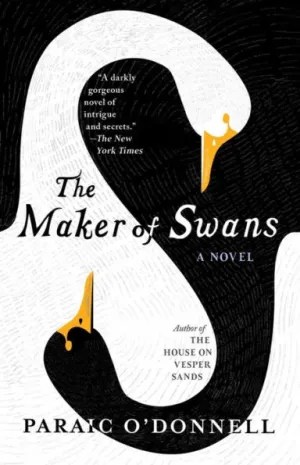
O’Donnell’s poetic style and mysterious setting hooked me in, but I’m afraid I stopped reading when the orphan cygnets showed up.  I just knew something bad was going to happen to them and couldn’t face it! Has anyone read this one?  Can you reassure me that the baby swans are all right at the end?  If so, I’ll probably return & finish!

MARCH 2023:  Back To My Usual (If Slightly More Frantic) Pace
March was another travel month, with lots of airport time.  Although I sometimes read serious stuff when I travel (I once finished Joseph Roth’s The Radetzky March during a single marathon flight), on the whole I tend to stick to mysteries or to more popular contemporary works.  I’m a long time fan of Ruth Rendell’s dark psychological novels (originally published under her “Barbara Vine” pseudonym) and the presence of her work on my kindle dominated March, as I read four of her twisty, clever and psychologically acute novels at various points during the month (Judgment In Stone; A Dark-Adapted Eye; House of Stairs; & King Solomon’s Carpet).  In a psychologically much lighter vein, I also read and enjoyed Jenny Jackson’s much ballyhooed Pineapple Street (so reassuring, dear readers, to discover that folks with thirty-seven million dollar trust funds need love too).  Last, but far from least, was Deanna Raybourne’s tale of a squad of retired female assassins, Killers of a Certain Age; perfection itself for those with five-hour layovers in Kansas City.

One of my rare forays into non-fiction:

Although I’d no intention of reading it at the time, one look at its marvelous photos and I quickly became absorbed in Seymour’s biography of Jean Rhys, I Used To Live Here Once.  (Has anyone read Athill’s account of her relationship with Rhys in Stet.?  It’s a marvelous picture of this most difficult artist.)  Aside from including great photos and much fascinating background about the Rhys family, Seymour provides a sensitive and very readable account of Rhys’ life.  Most valuable for me, however, was Seymour’s very convincing argument that Rhys, both as a woman and an artist, was much more than the protagonists she portrayed.  Like many readers, I first came to Rhys via The Wide Sargasso Sea and was a little disappointed in reading her other novels to discover they were quite unlike that work!  After reading this biography, I’d now like to return to  Rhys’ fiction, particularly her short stories, none of which I’ve previously read.

Some Of My Other March Reads:

One Old, one new; both very enjoyable diversions!  If you’ve read either of these, do share your reactions . . .

Although I’m not rabid about it, I do tend to like Emma Donoghue’s work & have read several of her novels. She’s an eclectic writer; one of those rare artists who produces something different with each book.  I purchased this one impulsively, on one of my milder book buying binges, and had no immediate plan to read it.  By early March, however, my bookish mojo was up!  Looking for something easy and contemporary, I started Haven pretty much on a whim and found it (surprise!) quite absorbing.  It really helped to get into the mood by recalling a bleak arctic island or two I’d seen on some past birding trips, all rocky cliffs, wild ocean and seabird nesting colonies.  Although I don’t think this was a great novel (or even one of Donoghue’s best), it was a quick and enjoyable read that, surprisingly, speaks directly to some very pressing contemporary issues.

After repeated and unsuccessful attempts to read Margaret Kennedy’s The Constant Nymph (unfairly or not, I just couldn’t get into the older man/nymphet thing), I decided to approach Kennedy through a different novel, The Feast (although it’s hard to tell from the photo, this is another of those adorable McNally editions).  To my surprise, I loved it!  So clever, to have the novel begin with an Anglican minister writing a funeral sermon, thereby ensuring the reader is hooked into guessing for whom the sermon is intended!  Clever, well written and very funny at times, I’m now up for exploring more of Kennedy’s work.  Who knows? perhaps I’ll even make it through The Constant Nymph!

This was my second novel by Johnson, a writer to whom I’ve become ever-so-slightly addicted.  Fortunately for me, her work seems to be enjoying a mild renaissance these days, with reissuances making her novels far easier to obtain than before (I must say, however, that I hate the cover art).  Although I’m still not sure that Friend’s plot entirely worked for me, I loved Johnson’s setting, a small seaside town in Belgium, as well as her very believable depiction of a middle-aged English couple on holiday with their young son. In May, I read another Johnson novel, The Last Resort, but I’m saving my discussion of that one for Part II of my catch-up post!

March’s New Discovery:

Although curious, I’ve been hesitant to tackle Dazui’s novels.  New Directions Storybook Editions, however, provides a very approachable (if rather pricey) way to try a new novelist with a minimum commitment of time.  This collection includes three of Dazui’s short stories (“Early Light;” One Hundred Views of Mount Fuji” and “Villon’s Wife”), all of which I found quite interesting.  I can’t say the collection converted me into an instant fan, but it did confirm my opinion hat Dazui is an author whose work I’d like to pursue. 

March’s Trip Down Memory Lane:

xxxxx
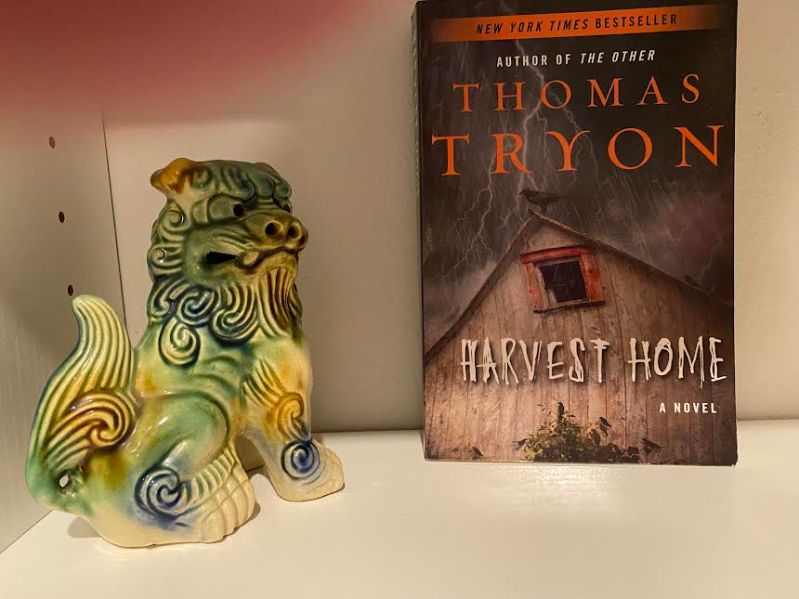
If you’ve previously dipped into my blog, you probably know that I’ve a deep and abiding fondness for the horror genre (comes, no doubt, from reading Dracula at a highly impressionable age).  I’m particularly addicted to folk horror, involving secret rituals in remote, forgotten villages  . . .

I’d read, and enjoyed, Harvest Home when it was first published aeons ago (in the 1970s, I think) but had largely forgotten it in the years since.  During a recent browse through the NYRB Classics’ website (those flash sales! totally irresistible!), I came across The Other, perhaps Tryon’s best known novel, which I’d also read shortly after encountering Harvest, but not liked as much.  Acting on sheer whim, I tracked down a replacement copy of Harvest (my original having been long since discarded) and settled in for a trip down memory lane.  I must admit that, second time around, I found the writing rather clunky, the descriptions sometimes just a teeny bit hackneyed (there’s been a lot of literary fiction under my bridge in the intervening years) and the story at times rather gratuitously gruesome.  But — Tryon can tell a story!  With no intention of reading the whole thing, I quickly became immersed in his tale of rural dark doings and didn’t come up for air until I’d finished.  The years, however, have definitely affected my opinion and not particularly for the better.  In addition to noticing the stylistic defects that I’ve already mentioned, I also became a little uncomfortable at the sometimes not-so-latent misogyny that pervades the story.  I’d have to know you personally, dear reader, to recommend this one, but for someone such as moi, with a taste for melodramatic trash horror and no demands for subtlety, this could prove a richly rewarding reading experience!

DIPPING INTO:

Unbeknownst to me, Saltz is a very prominent art critic indeed, writing for New York magazine for many years & winning a Pultizer in 2018. This collection of essays, obits & reviews is perfect for tiny bite sized reading.  His material ranges from Caravaggio to Kara Walker, so the collection has something for every artistic taste! 

March’s “Just Couldn’t Do It” Books:

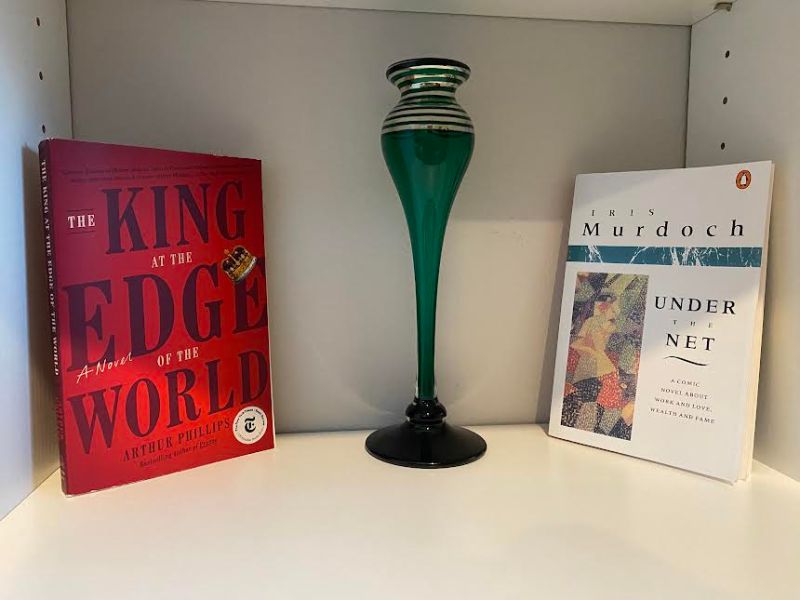
Isn’t it sad, when bad things happen to good books (which both of these are)?  March was just the wrong time for the Murdoch.  I will return!  As for Arthur Philips, well, not so sure.  I’ve occasionally enjoyed his work in the past, but after a hundred pages or so I just lost interest in this one.

FINALLY (PAST TIME, DON’T YOU THINK?)

If you’re still with me at this point, you deserve (1) a medal for patience and (2) a little visual treat.  I hope to be returning in a few days with Part II of my 2023 reading; meanwhile, I recommend you accept this advice from Zen Master Percy:
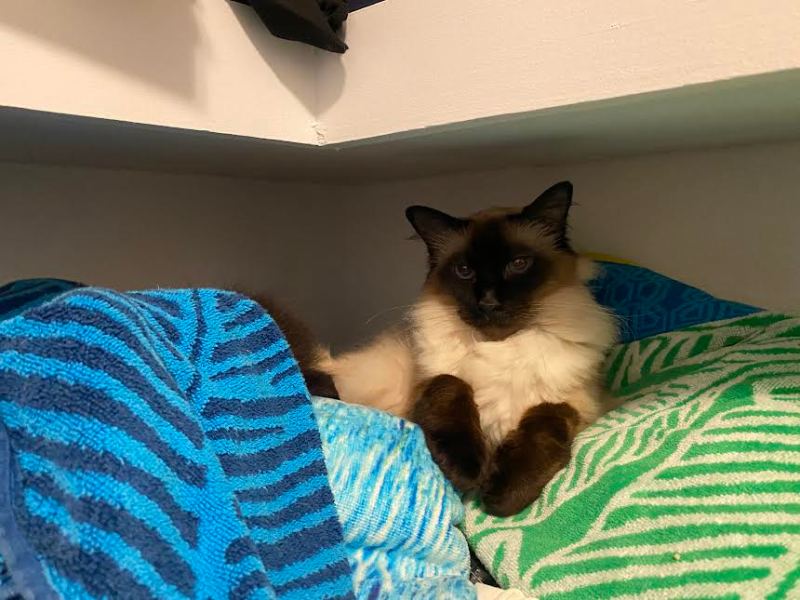
The zen lord of Beach Towel Mountain says “it’s time to sack out!”

My Late, (Very) Late, Autumn Update!

Some of my choices for my hurricane evacuation reading — hastily assembled but a little haste is warranted, don’t you think, when a Category 4/5 storm is headed your way?  How many of these did I actually read? Well . . . .

You know what they say about being late, don’t you?  That it’s better than “never”?  I’m certainly putting that adage to the test, dear readers, by offering a September/October update as November is breathing down my neck.  I’m starting off slowly here, as the next few paragraphs are about non-bookish matters, accompanied by a few of Mr. Janakay’s photographs.  If you’re not interested, just skim on by to the portion of the post where I briefly discuss a novel or two.

That delightfully ambiguous word “interesting” best describes my September, which was quite “interesting” in ways both good and bad.  The “good interesting” occurred early in the month, when I traveled internationally for the first time since the pandemic.  I’m a nervous traveler at the best of times (in my defense, I’ve been on many trips that have gone spectacularly awry) and I had halfway talked myself into staying home but — the fees were paid, the refund period was past, the cat sitter was booked so — off I, Mr. J and Mr. J’s camera went to the Asturias region of northern Spain, to hook up with a birding tour.  What can I say, dear readers, except that my misgivings were totally misplaced and that my trip, so dreaded in advance, was absolutely wonderful?  Lovely scenery, fascinating 9th century churches (none of that newfangled Gothic & Romanesque architecture) nestled in mountain valleys, wonderful food, and pretty good birds.  Not to mention the sheer wonder of viewing paleolithic wall paintings in a cave complex that sheltered humans as early as 33,000 years ago.  Since I don’t want to burden you with a travelogue, I’ll limit myself to perhaps my favorite of Mr. J’s photos:

Cabo Peñas (about as far north as you can get & still be in Spain) was one of my favorite stops. Aside from being a good place to see migrating birds, it also has a great old lighthouse (that Mr. J, alas, couldn’t get into his photo).

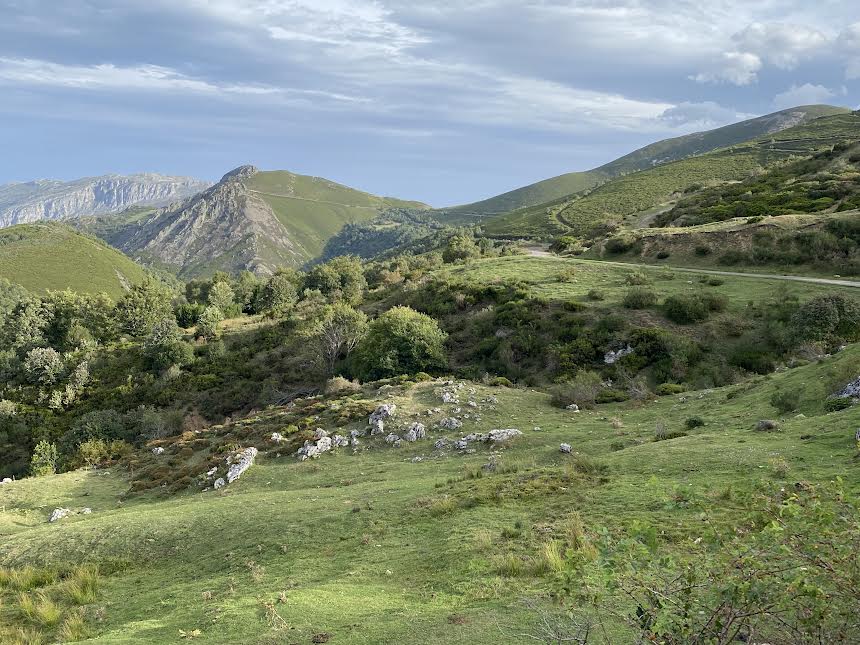
Oh, well, just one more, again courtesy of Mr. J:

The Picos de Europa, a large national park extending over several regions in northern Spain. We didn’t see too many birds when I was there (too windy) but with scenery like this, who cares?

Like all good things, my trip ended and it was home again, home again, to the (U.S.) Florida coast, with the biggest concern being unpacking the bags, doing the laundry and coaxing our feline masters back into a good mood (well, as good as it gets with cats.  That is to say — not very).  As I was doing the laundry, only half listening to the news in the trance state I use to get through such tasks, I did notice some weather person droning on about a hurricane causing considerable damage in Cuba but — hey, Florida’s gulf coast hasn’t had a major storm in . . . .   Oh, dear.  Times do change, don’t they, particularly in our era of heavy carbon emissions!

Have you ever, dear readers, prepared a house to weather a hurricane?  If so, you have a good idea of the physical and psychological strain of our day and a half before my county’s mandatory evacuation order kicked in and we departed for higher ground.  (Unlike many of my neighbors who stayed put, I ran.  This was my first real hurricane & I wasn’t taking any chances.)  Everything outside that could be moved — patio furniture, plants, flower pots, tools, you name it — went inside (my living room became a combination jungle and storage shed).  We did that anxious last minute check, before you lock the front door, departing for — who knows what and for how long?  Roof was new, nothing to do; ditto for lanai cage (these are screen & metal structures that cover an outdoor living area, useful for keeping slithery things with scales from becoming part of the household); windows have double panes, so no need (probably) to board them up (too late anyway to get plywood).  That pile of bricks, remnants of a summer project, stacked in the driveway?  The mental image of each one flying through the air in a 90 mph (144 kmh) wind gave me the energy to make the (considerable) effort to move them into the garage!

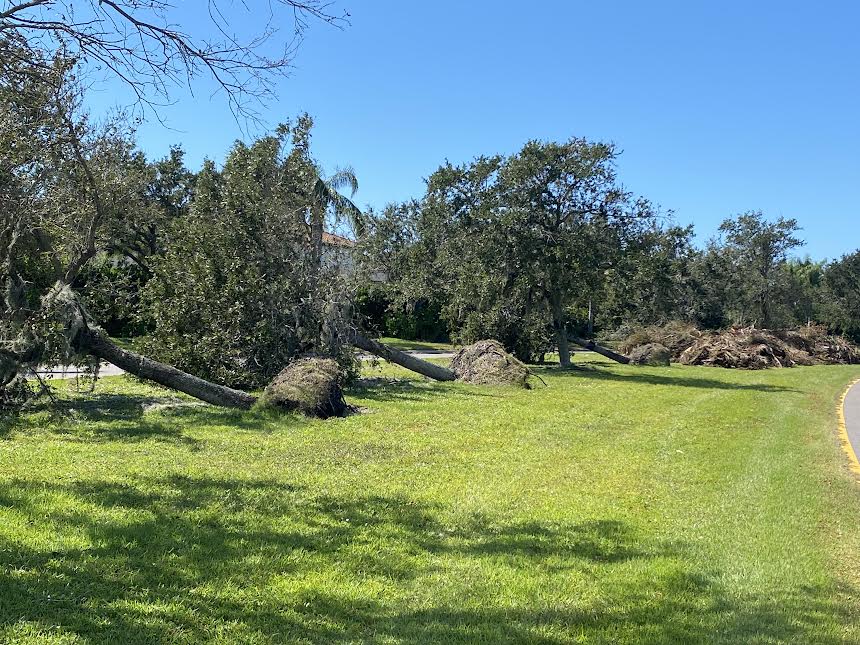
Finally, all was done that could be done; Hurricane Ian was projected to make landfall about 10 miles (16 km) from my front door; time to leave and hope for the best.  Mr. J and I scuttled away, accompanied by three furious cats and several hurriedly assembled bags of books (some of which are in my first photo).  In one of those twists of fate that work well for you and very ill for others, Hurricane Ian shifted course and ultimately made landfall further south, resulting in a far milder impact on my area than the devastation experienced by Naples or Ft. Myers.  My area did take considerable damage, mostly from wind rather than water.  My beloved butterfly tree was uprooted, along with a few other things, and the yard was a mess (did you know that hurricane winds literally strip all the leaves from deciduous trees?) but my house survived unscathed.  My neighborhood itself experienced no flooding and, unlike many others, only relatively brief outages of power and internet.  My relatives a little further south, where Ian first made landfall, weren’t so lucky.  While I was sitting in a nice dry hotel room, albeit one with no electricity (thanks to the storm), they were clearing out attic space “just in case” the rising storm surge made it into their house (thankfully the waters stopped just short of the door, but they & their neighbors are still cleaning up flood damage).  So that was my “bad interesting” September!

This photo of a street a few miles from my house was taken a couple of weeks after the hurricane, when clean-up efforts were well underway.  As you can see, these rather large trees didn’t make it through the storm.

If you’re still reading, I can sense your impatience (I do rattle on, don’t I?) through the ether; whenever will I start discussing the  the only thing we all (passionately) care about, i.e., books!  So enough of birding trips and hurricanes and on to the book piles!  To begin with the question posed in my first photograph, i.e., just how many of those books did I manage to read?  Well . . . not many, and TBH, not really during the hurricane itself.  In my defense, dear readers, it IS difficult to read in a strange hotel room, located in a building with no electricity, and one, moreover, whose walls are shaking in gale force winds (I wasted valuable reading time gazing out the window, wondering how many of those palm trees were going to be snapped in two!)  Still, I did manage a page or two of Bernhardt’s Extinction between gusts, and dipped into Cavafy (one of my favorite poets) a bit.  Not much more than that, I’m afraid, for the last few days of September and early October, which was a rather exhausting “clean up the damage” time.

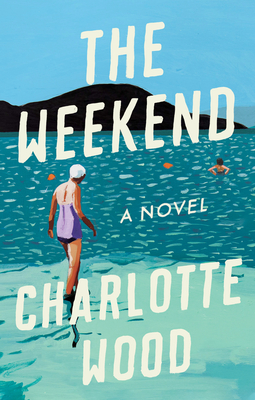
Before nature interfered, however, I did manage to get through four or five books in September, albeit things on the lighter side, for the most part, and read primarily during my trip in the earlier part of the month.  The standout among these was The Weekend, by the Australian author Charlotte Wood, which I found via a (highly deserved) glowing recommendation from Cathy at 746books (thanks, Cathy!  I would have missed this one otherwise).  In Weekend, three women who have known each other for the better part of their lifetimes come together for a few days to tidy up the belongings and clear out a beach house belonging to their recently deceased friend, the fourth member of their group.  During the course of their weekend, the reader learns their back stories and sees their complicated and sometimes problematical relationship with each other; among many other things the novel’s an interesting portrayal of group dynamics, of how survivors adjust (or don’t) to the loss of a vital member of their set.

Although there are some outstanding novels of female friendship floating around the bookish world (Simon has an interesting discussion of a few at stuckinabook), I can’t think of any that focus on women in the latter stages of their life and few that display Wood’s psychological acuity and realism.  As with any halfway realistic novel revolving around characters of a certain age, Weekend does have some bleak moments.  These are balanced, however, by a wonderful sense that despite their looming mortality these three won’t go gently, that they will continue to struggle, to enjoy, to face difficulties and that their lives still contain possibilities, even if their choices must be recalibrated.  Wood is a very skillful writer and keen observer; her setting, a trendy Australian beach town, is lovely (and for this U.S. reader enticingly exotic) and there are some very, very funny moments.  While I do have a few  minor quibbles (there’s some rather obvious symbolism and, perhaps, an overly dramatic situation or two) these are very minor blemishes on a really great read.  If you love character driven novels and aren’t very demanding vis-á-vis action sequences (no shootouts or high speed car chases in this one, I’m afraid) you may very well want to give The Weekend a try.

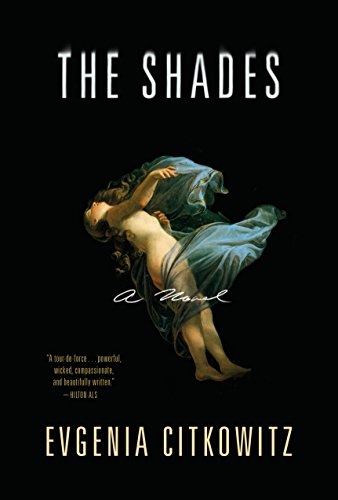
In addition to The Weekend, I spent what could have been a tedious airport layover pleasantly absorbed in Evgenia Citkowitz’s The Shades, thanks to a recommendation from Tony’s Book World:

Do you like creepy Gothic novels with a psychological twist?  A hint of the strange, underlying the rational world?  If so, you might enjoy this elegantly written novel, in which a mother grieving the loss of her teenage daughter becomes enthralled by a young stranger who shows up at her door.  If you’ve ever listened to Gluck’s Orfeo (in one of the novel’s key scenes, two of the main characters attend a performance) you know the basic plot, but it’s still fun to follow the twists. 

Since I adore horror fiction (the “Shirley Jackson Haunting of Hill House variety,” not the “chop up the body parts” kind) I quickly downloaded Lauren Owen’s Small Angels for a travel read as soon as I read the New York Times’ very favorable review.  The novel was well written, atmospheric and employed some of my favorite horror tropes, i.e., the ancestral curse, the magical forest and stubborn village folk in deep denial regarding their complicity in the evil surrounding them.  Action is sparked when Chloe, an outsider to the village & unaware of its history, decides to hold her wedding at Small Angels, a deserted chapel closely tied to the evil haunting the forest.  Using multiple points of view, Owens gives a neat spin to the traditional ghost story, creating some strong female characters along the way.  So I liked this novel, didn’t I?  Well . . .  yes and no.  The first half really held me enthralled as I soaked in that wonderful spooky atmosphere and teased out the story line.  When the action moved into contemporary times, however (Chloe’s perilous wedding; the sibling tension between her village boyfriend & his sister, the modern love stories, etc), my interest diminished, my reading speed picked up and I was quite content for the whole thing to end.  Still, unless you share my perhaps unrealistic & overly stringent expectations for horror fiction (after all, there’s only one Shirley Jackson), this could be quite a satisfying read, as the days darken and the spirits return for their visits!

Beware, beware of Mockbeggar Woods, particularly if you’re a member of the Gonne family, whose fate is ruled by an ancestral curse tied to this sentient forest.  Although it was beautifully done in many respects, my overall reaction to Small Angels was a bit tepid. 

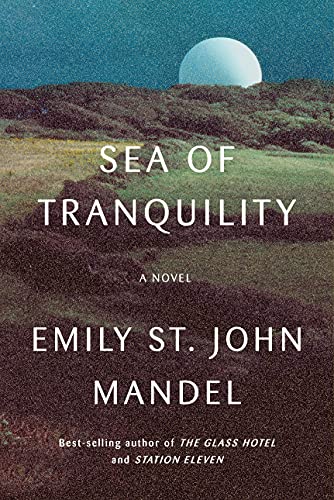
I’ve been a big fan of Emily St. John Mandel’s work since reading Station Eleven several years ago.  Her next novel, The Glass Hotel, was (IMO at least) even better.  (If you’ve read either or both of these books, I’d love to hear your thoughts on this.)  It goes without saying that I took the unusual (for me) step of pre-ordering her latest, as soon as I learned it was coming out last spring:

Like the two novels that immediately preceded it, Tranquility involves multiple story arcs and weaves backwards and forwards in time.  What is the link between a British aristocrat, exiled in 1917 by his family to the Canadian wilderness; a contemporary teenager with a video cam; and a 23rd century writer born and reared in one of the lunar colonies, who’s flogging her latest book during a visit to earth?  Two centuries after the writer’s time, an investigator named after a character in one of the writer’s books attempts to put the puzzle together, adding yet another layer to Mandel’s complex structure.  Mandel deftly uses the tools of speculative fiction to focus on the real subject of the novel (IMO at least), i.e., the seemingly random events that link lives and the patterns that connect human existence over the centuries.  All this is done in Mandel’s beautifully lyrical prose and with the added bonus of cameos from a couple of the characters I first met in The Glass Hotel (although these appearances add a sparkle, you need not have read Hotel beforehand to enjoy Tranquility).  Although I enjoyed Tranquility a great deal, I was just the teeniest bit disappointed, for no reason that I’m able to articulate very clearly. Perhaps it was because that, like many novels told from a multiple point of view, some plot strands are inevitably more to one’s taste than others.  In this case I found many of the events involving the investigator less than compelling; also I felt that, to some extent Mandel was repeating many of the themes from her previous work.

The remainder of my September reading was devoted to Thomas Bernhard’s Extinction (tr. David McClintock), one of my selections for 2022’s European Reading Challenge.

Extinction purports to be a first person account by one Franz-Josef Murau, an expatriate Austrian aristocrat living in Rome in self-imposed exile from his family.  Clocking in at 326 pages in my edition (Vintage International), it was a bit long but, really, how much time can it take to read 326 pages when you’d rather read than go out to dinner with your group and there’s a long plane ride home?  I assure you, dear readers, that it can actually take quite a bit of time when  those three hundred odd pages (no paragraph  breaks, mind you!) are an impassioned rant about Austria’s Nazi past; the evils of the Catholic church; opera; German literature (Murau/Bernhard hates Goethe); the corruption of human civilization by the invention of photography; and the fact that Murau’s sisters as young women purposely ruined his green socks by darning them with red wool (or was it the other way around? must check my notes).  Oh, and those sisters “hopped” about a lot as children, which was very, very annoying to Murau!  Extinction, in short, was a fascinating, exhausting and challenging read; and one that I didn’t actually finish until early October, after I’d completed clearing out the hurricane damage in my yard (I believe the U.K. term for this area is “garden”).  Because I haven’t given up all hope of doing some real reviews this year, particularly of my Challenge books, I’ll reserve my thoughts about Extinction, particularly as it provided me with a great deal to think about.

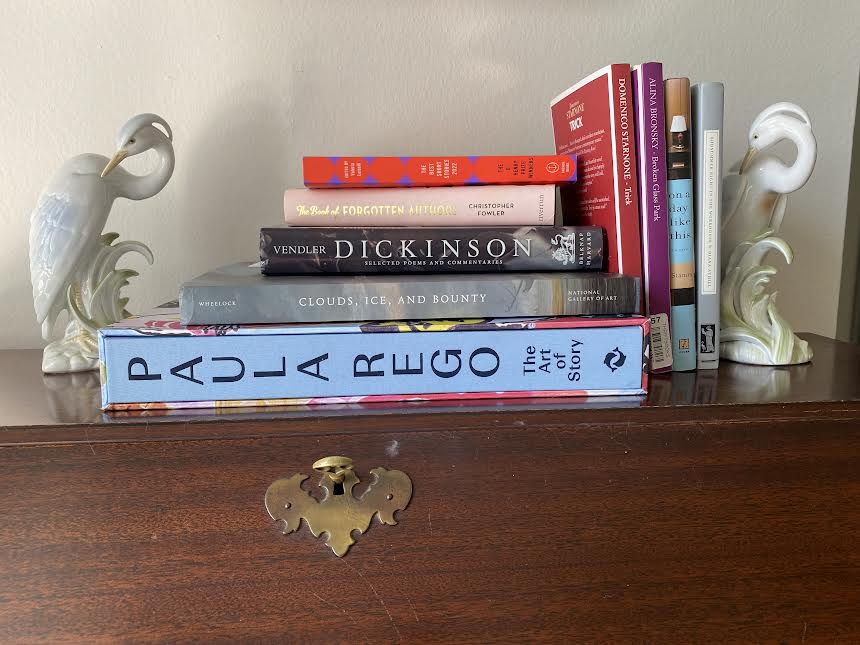
Since I always seem to take forever to post anything (good heavens! Is the first of November actually next week?), I thought I’d  give just a quick little glimpse of what I’ve been reading in October:

I’ve only read the books on the right (the ones standing upright), all selected to fit categories in my Challenges.  The others are books I’ve been “dipping” into as the mood strikes.  The bottom two (Paula Rego & Clouds, Ice and Bounty) are exhibition catalogues; I never read the text of these things, I just look at the pictures!

After a bumpy start, October’s been a pretty good reading month in which I’ve mainly concentrated on finishing a few more Challenge books.  I finally got around to Diana Athill’s short story collection, Midsummer Night In The Workhouse (Persephone ed.), part of my Classics Challenge.  I also made a bit more progress on my Reading Europe Challenge books, finishing Alina Bronsky’s debut novel, Broken Glass Park; Peter Stamm’s On A Day Like This; and Domenico Starnone’s Trick (with a great intro by Jhumpa Lahiri).  Hopefully at least one or two will end up getting a real review in the next two months.

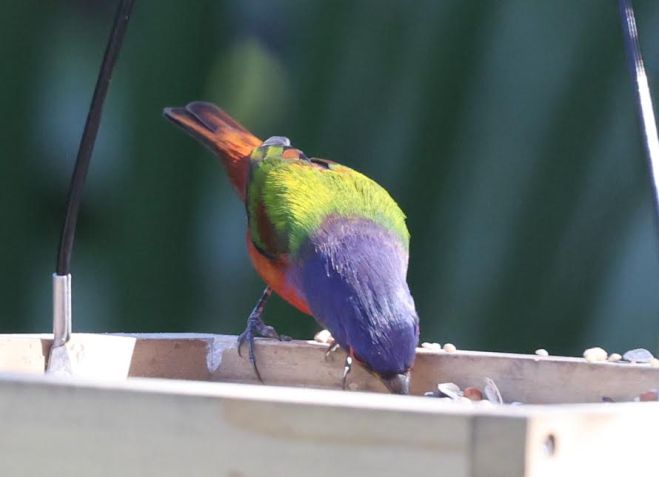
I usually regard these round-up posts as great opportunities to inflict a couple of cute cat photos on any long-suffering readers who’ve hung with me this far.  Today, however, I thought I’d do something a little different, by showing you some nice photos (thanks again, my beloved Mr. J) of a Painted Bunting, a shy little bird that’s one of the most colorful North American songbirds imaginable.  Although Painted Buntings are plentiful right now, as they winter in Florida, they like to hide and they’re hard to see.  Luckily for us, there’s a nice nature reserve (located close to  our thankfully undamaged home) where the local chapter of the Audubon Society maintains a blind and bird feeders the birds find most attractive:

It’s a little hard to see in this photo, but even his (it’s a male painted bunting) eye ring is bright red!
This gives a good view of his back. Again, the light isn’t great, or you’d see that the green is actually very bright.

That’s all for now (and aren’t you glad?); I’m off to check out what everyone’s been reading.

Halloween Greetings! (and some spooky books for scary times)

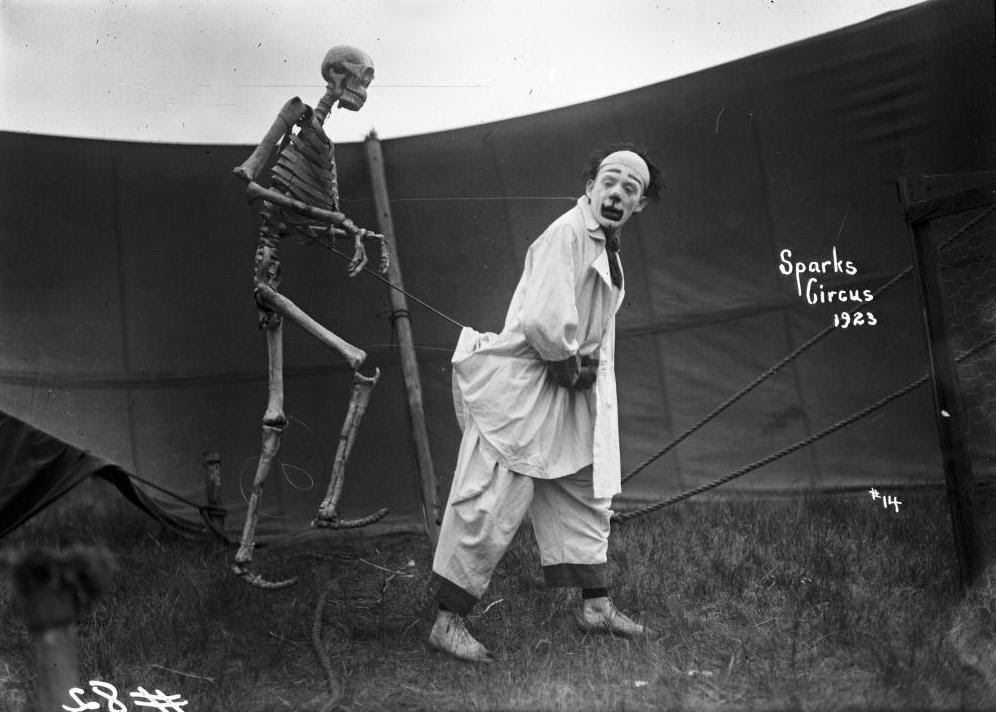
How do you like this rather macabre scene? It’s the work of Frederic W. Glasier, whose extraordinary photos of early 20th century circus performers have recently undergone something of a re-discovery.

Are you, dear reader, a fan of Halloween?  It’s a holiday I remember very fondly from my childhood.  Decked out in a cardboard witch’s hat (costumes were much less elaborate back in the day), I’d join one of the packs of neighborhood kids and spend a few glorious hours going door to door, free of adult supervision, with a candy bag getting heavier at each stop.  The nighttime wandering was followed by the wonderful, if competitive, ritual of examining and comparing our somewhat grubby spoils and making trades.  Did the kid next door get more chocolate than I did?  Could I persuade one of my little buddies to swap his M&Ms for my green jelly beans (generally the answer was “no”)?  Ah, the memories!  A lifetime away from the candy haul, I retain a vestigial fondness for this holiday. So, on Halloween night my lights are always on, the candy bowl by the door filled with primo goodies (no green jelly beans at my house) and the bell is always answered, even when the little goblins and space invaders interrupt a chapter in whatever exciting new book I happen to be reading.  In short, Janakay has always honored the season!

This year, however, I am totally not into it.  Partly it’s my personal circumstances, which have included a long distance move from this:

Can’t you just imagine a forest witch stepping out from those trees at twilight, on this very witchy night of the year?

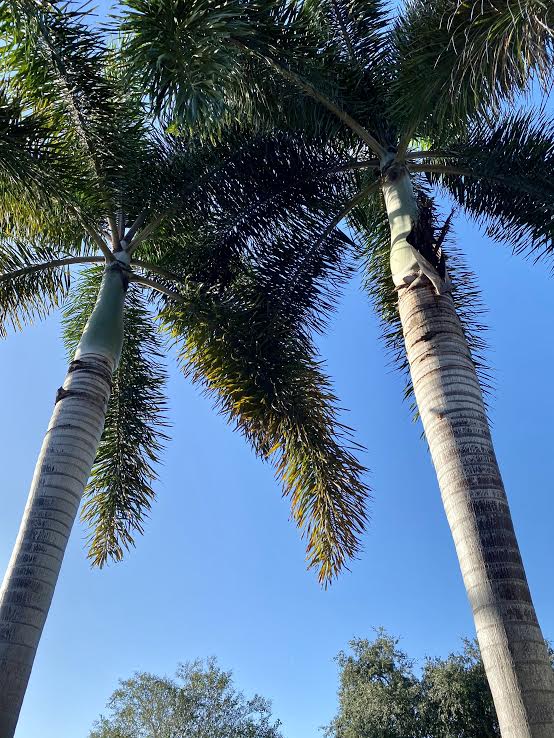
to this:

Despite the menacing angle of Mr. Janakay’s photo, I can’t quite see a hobgoblin emerging from behind one of these palm trees unless it’s wearing a big smile and offering a mimosa! Halloween just doesn’t seem to fit this climate . . .

Primarily, however, the sparkle and playfulness I’ve always associated with Halloween are totally overshadowed this year by the horrors of an ugly and divisive election, civil unrest created by social injustice and a pandemic that has already killed hundreds of thousands. Who can attend to imaginary terrors, when the real things are so frighteningly close at hand?

A news photo of demonstrators; the masks are visible symbols of the terrible disease that’s claimed so many lives (Jose Carlos Fajardo/Bay Area News Group)
One of many polling places near my new residence, thankfully minus the motorcades decorated with banners and flags that seem omnipresent these days (the unfamiliar names you see on some of the signs belong to candidates for such entities as county commission and the mosquito control board, which also appear to be rather hotly contested this election cycle)

But in the midst of chaos and civic unrest, we readers always have our books, don’t we? As I noted last year, I’ve always been fascinated by the fact that we humans love to scare ourselves, as well as by our individual differences in what we each find personally terrifying. I’ve always tended, for example, to favor tales of the occult and supernatural rather than the thriller/slasher brand of horror; more Shirley Jackson and less Freddy Krueger, if that makes sense. And, while I don’t read huge quantities of horror fiction, I have accumulated over the years a clutch of “weird tales,” to use a 1930s term. Although most of my books are still packed and awaiting a home on their new shelves, a quick rummage through what’s available disclosed:

A small but fairly representative sample of my horror fiction, which demonstrates just how versatile the horror genre can be. It includes classics (Sheridan Le Fanu’s Best Ghost Stories and M.R. James); fantasy/sci-fi (Tanith Lee’s Dreams of Dark and Light); conventional mystery with an edge of the occult (Douglas Browne’s What Beckoning Ghost); popular mass market (the great and relatively unknown T.E.D. Klein) and the literary (Margo Livesey’s Eva Moves the Furniture & Hillary Mantel’s wonderful but under-appreciated Beyond Black).

Since I’ve been too enervated and apathetic this year to observe my little ritual of including something creepy and dark in my October reading, I thought I’d share some “horrible” reading from earlier in the year. These are three very different works, read at widely spaced intervals; while I enjoyed all three, I did so in varying degrees. In ascending order of appreciation, I’ll begin with:

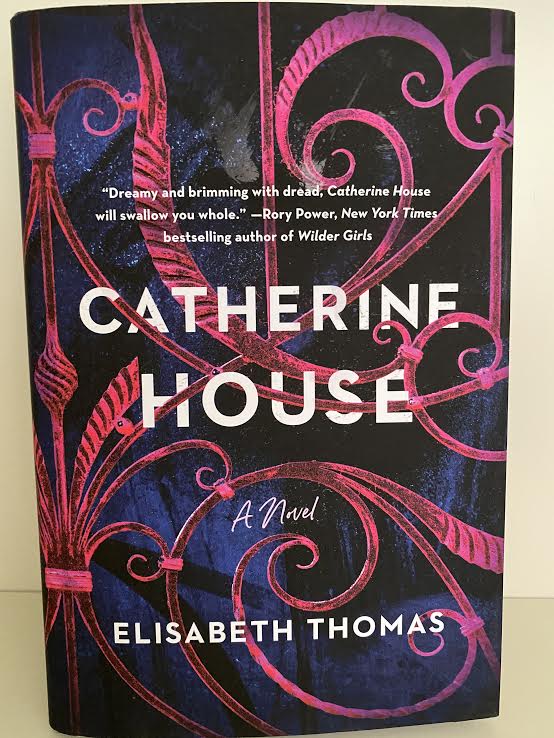
Have you ever, dear reader, moved approximately four thousand books, seven rooms of furniture, a significant other and three very unhappy cats in the middle of a pandemic? Having (barely) survived the experience, being “swallow[ed] . . . whole” by a horror novel was a piece of cake. I spent a week in May soothing myself in Thomas’ debut novel, which follows the adventures of alienated teen Ines Murillo as she navigates her way through the elite corridors of Catherine House, not a college, exactly, although accredited as such; more (2-3)

a community of minds. A crucible of experimental, reformist liberal arts study. Research-and-development institute for the most radical new materials sciences. A postsecondary school more selective than any Ivy League, and so terrifically endowed that tuition was free to any student lucky enough to be accepted. A tiny, pioneering, fanatically private place that by some miracle of chemistry produced some of the world’s best minds; prizewinning authors, artists and inventors, diplomats, senators, Supreme Court justices, two presidents of the United States. A school and an estate: a complex confection of architecture and design, a house — a magnificent house — miles off the highway, in black woods, behind a long iron gate.

In exchange for all this beneficence, students surrender their cell phones, forgo contact with the outside world (including their families) and spend three years secluded on Catherine’s grounds. Does it surprise you, dear reader, to learn that dark deeds are afoot and that Ines, who spends most of her days drinking and — well, engaged in intimate encounters — may be destined for a dark fate? Unfortunately these things were pretty obvious less than halfway through the novel, but Thomas can write and has a real gift for creating an imaginative and disturbing world that’s inhabited by fairly interesting characters (although Ines was admittedly a little tedious at times). If you forget the over the top comparisons to Donna Tart’s Secret History or Ishiguro’s Never Let Me Go (some reviewers never know when to stop, do they?), love novels heavy on atmosphere and don’t mind if you can guess the plot twists, Catherine House is a very enjoyable way to spend a day or two (it clocks in at around 300 pages) and would make a great Halloween read.

A step up from Catherine House, in terms of originality and impact, is

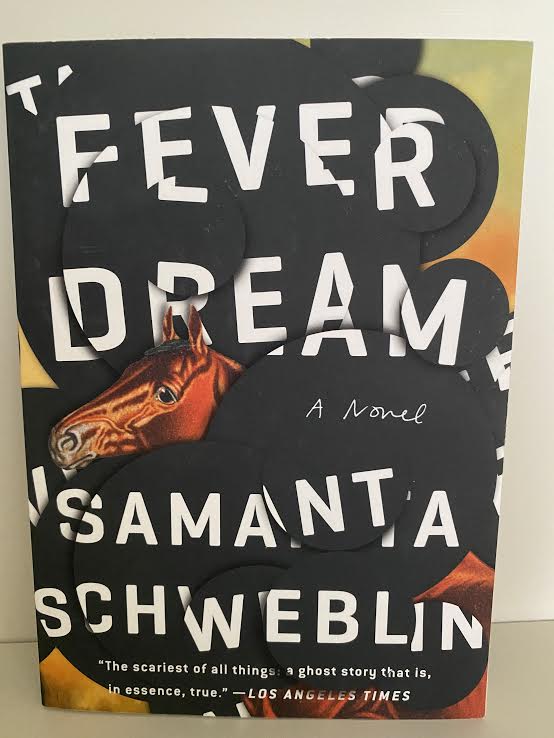
I became interested in Schweblin after reading several very enthusiastic reviews of Little Eyes, her latest novel translated from Spanish into English; I wanted to try Schweblin’s work but didn’t feel up to tackling a full-length novel (her short story collection Mouthful of Birds was off limits because I can’t handle anything involving graphic violence to animals). More a novella than a novel proper (it has 150 pages of very, very large type), Fever Dreams seemed the most accessible introduction to Schweblin’s work. (I actually read this in August, for Spanish Literature month, but never got around to writing a review).

It’s fortunate that Fever Dreams is so brief, because it’s almost impossible to put down once you begin reading it, with its combination of doom, horror and mystery. It’s a tightly structured work, told mostly in conversational questions and answers between Amanda, a young woman who lies dying in a remote, rural hospital, and David, the mysterious child who is not Amanda’s son and whose questions, editings and probings create an almost unbearable level of suspense for both Amanda and the reader. David, you see, is interested in nothing beyond the “worms” or “something very much like worms, and the exact moment” when they first “touch your body.” When Amanda’s account deviates into non-essentials, David reminds her that “there is very little time;” when Amanda doubts the accuracy and reality of her memories, David assures her that her nightmare is indeed real. For all its brevity, Fever Dreams is technically quite complex, as it explains the Amanda and David story arc, set in the present, by means of a dialogue between Amanda and Carla, David’s mother, set in the past. Part environmental disaster, part folk horror and all nightmare, Fever Dreams is an incredible accomplishment. I wasn’t surprised to discover that Granta had recently named Schweblin as one of its top young Spanish language writers or that her subsequent novel was long-listed for the 2020 Man Booker International Prize.

The third (and scariest) of my three scary reads is “The Fly Paper,” a short story by Elizabeth Taylor. Yes, that Elizabeth Taylor, the nice British lady whose reputation has undergone something of a Renaissance in recent times. In the years since I’ve first encountered Taylor (I’ve read almost all of her novels and have begun working on her short stories) my own opinion of her work has shifted significantly, from condescension to true admiration. The surface of Taylor’s deceptively cozy, middle class world can conceal some pretty dark stuff, which is nowhere more evident than in “Fly Paper.” The story concerns Sylvia, a plain and sullen child of eleven with “greasy hair fastened back by a pink plastic slide.” The unmusical Sylvia lives with her grandmother, who won’t let her eat sweets and insists on a weekly music lesson, a torment for the child who’s bullied by her exasperated teacher. Sylvia has received all the usual warnings against speaking to strangers, so she’s duly alarmed when, on her weekly bus ride to her music lesson, a strange man strikes up a conversation and tries to buy her an ice. Her fears are assuaged, however, by a motherly woman who intervenes and invites her to tea. About midway through the story, my flash of where Taylor might be taking me almost literally made me ill and I had to stop reading for a bit. Perhaps I was over reacting, perhaps I was having a bad day, perhaps Taylor was simply a brilliant writer who knew, instinctively or otherwise, that horror is heightened when it’s combined, oh so simply, with the perfectly observed quotidian details of an ordinary day.

“The Fly Paper” was reprinted in this collection of Taylor’s stories published by NYRB Classics, which includes an introduction by Margaret Drabble.

Well, folks, that’s it for this Halloween! It’s time to take a page from Maxi’s book and call it a night.

Maxi says, “A pox on all your electoral factions. Let me sleep.”

Halloween Miscellany! Scary Reads and Pop Culture!

gustavedore_raven8
Isn’t this print wonderfully creepy and compelling? I’m a big fan of Gustave Doré; this is one of his illustrators for Edgar Allen Poe’s “The Raven.”

Greetings to all you denizens of the internet, on this dark and ghastly time of year!  Do you celebrate the Day, complete with your “sexy witch” costume or Freddy Kruger mask, lawn bestrown with cobwebs, plastic skeletons and those huge truly yucky fake spiders that are so unfortunately popular with Janakay’s neighbors?

0-3
Janakay is severely arachnophobic and doesn’t like walking past certain houses in her neighborhood during Halloween week! Needless to say, these folks did NOT consult HER about their Halloween decorations . . .

In my neck of the woods (North American, mid-Atlantic suburban) Halloween decorations have become increasingly common.  They range from folks who clearly regard Halloween as a very, very important milestone in their shopping and celebratory life . . .

0-1
In dawn’s early light, those giant spiders are rather unpleasantly realistic!

to those of a minimalist bent who nevertheless want to mark the occasion . . . .

0
The pumpkin face didn’t come out well in this photo — it’s actually pretty sinister, even if the “ghost” hanging on the porch is a bit laid back!

to the oh so tasteful, who actually changed the permanent outdoor light fixtures (on the left of the gate and the right of the porch) to match their purple Halloween lights!

0
A bit blurry (Halloween night here is appropriately rainy and stormy) but you get the idea  . . .

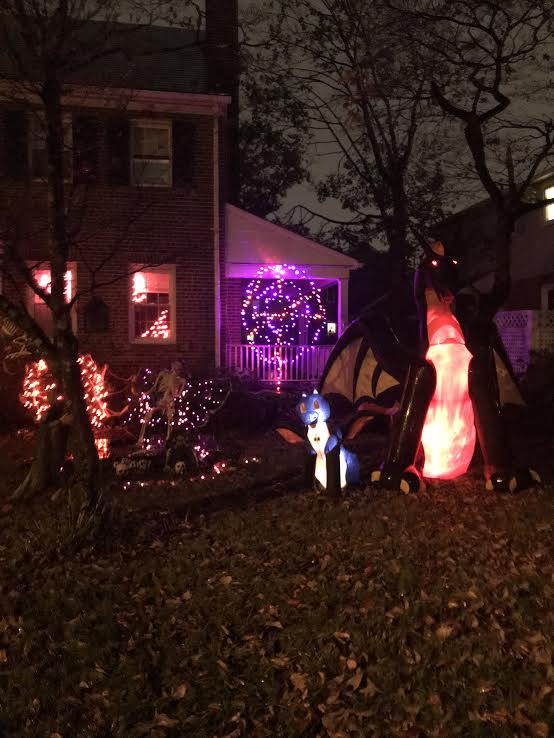
And — the neighborhood’s pièce de résistance!

0-1
To paraphrase that eminent stylist, Edward Bulwer-Lytton, Halloween here is “a dark and stormy night!”  Great for ghostly atmosphere but lousy for photos! Still, squint hard and you can see the red thing on the right is a dragon!  With movable wings!  What will they think of next?

Just as Halloween decorations are becoming more common and elaborate, Halloween costumes have taken a giant leap forward from the cardboard witches’ hats and superman masks of my childhood!  Now we have the adorably traditional:

creative-halloween-costume-ideas-54-57f66129c1373__700.jpg
Grandma is really rocking this one!

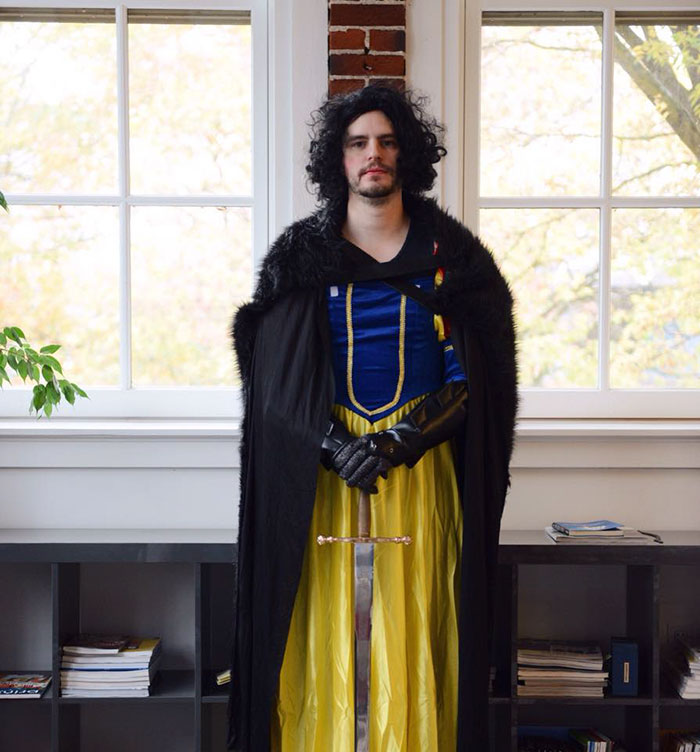
The “traditional with a twist”:

Creative-Halloween-Costume-Ideas-011-57f6641e8a16e__700.jpg
Jon Snow White!

And — the Topical:

M4SNJ6XG74I6TMFGHUBXEG4F54.jpg
This company also offers a “Miss Impeachment” costume (includes a tiara, beauty queen sash and a whistle blower necklace) as well as a sexy “Beyond Burger” getup, complete with a headband bearing the label “Plant Based!”

Well, it’s all certainly very interesting, isn’t it?  Do you follow the lead of these festive folks or do you (like Janakay on a bad year) pretend the day just isn’t happening, as you close the blinds, turn on the TV and ignore the trick or treaters ringing your door bell so you can eat all the best candy yourself in blessed solitude?  Do you have your very own Halloween rituals involving none of the above or do you perhaps hail from a country or follow a tradition that doesn’t acknowledge Halloween?  This space is all about sharing, so — please share with the rest of us how, or even if, you mark the day!

PART SECOND: SCARY READS IN GENERAL.  THOUGHTS, ANYONE?

I bet you never thought I’d get around to the books, did you?  Ha!  Tricked you!  With Jankay, it’s always about the books; no matter how meandering the path, it always comes back to the books; books underlie everything!  And there are such wonderful books associated with this time of year, aren’t there?  And don’t we all have our favorite reads? My own preferred brand of horror tends towards the classic, away from gore and slasher (so very, very unsubtle, don’t you think?) towards the “oh my god, something moved in the corner of my eye” variety.  In other words, away from the Freddy Kruger/Texas Chainsaw Massacre and more towards the Shirley Jackson, Haunting of Hill House end of the horror scale.   In fact, isn’t the whole horror phenomenon fascinating?  Why is it that we humans love so much to scare ourselves and isn’t it interesting how we all vary in what we regard as particularly horrifying?  I was actually settling in to spend some happy hours researching this topic when I realized that I’d be posting this on Christmas if I didn’t wrap it up (speaking of which, have you seen Tim Burton’s Nightmare Before Christmas?  If not, stop reading this instance and go watch!)  Without further ado, here’s a few selections from my short list of creepy reads; these are just things I thought of, fairly quickly and are listed in no particular order:

Bram Stoker’s Dracula: All the ornate Victorian prose can’t obscure one of the scariest stories every written.  I re-read it every now and then and it scares me almost as much as it did when I was fifteen years old, alone for the weekend and very unwisely deciding to try this old 19th century thing.

Shirley Jackson, The Haunting of Hill House.  Some houses are indeed born evil and some writers were born to tell us about them.  Truly one of the most terrifying tales ever conceived, written by an author of breathtaking talent working at the height of her powers.  It would be a shame not to read the book but if you’re in a visual mood Netflix did a recent series that’s sort of o.k.  Far better IMO is the 1963 black and white movie, starring Claire Bloom and Julie Harris.

Anne Rice, Interview with the Vampire.  Anne Rice has built up such a fan base and churned out so much over-written drivel over her long career (my apologies to any fans out there, but we are sharing our honest opinions aren’t we?) that it’s easy to forget just how very good she can be.  This is my favorite Anne Rice novel, an incredibly atmospheric take on the vampire mythos, set in French colonial New Orleans and 19th century Paris.  Erotic, baroque, stomach churning and beautiful, it isn’t easy to forget (the Theatre des Vampires, where vampires feed on victims for the audience’s amusement, is as horrifying as anything I’ve ever read).  Rice’s The Witching Hour, a tale of two centuries of the Mayfair Witch family and its attendant demon Lasher, ranging from its origin in medieval Scotland to its dark doings in contemporary San Francisco & New Orleans, is also pretty good.  Word of advice: avoid the numerous sequels and spinoffs of both novels.

H.P. Lovecraft’s short stories:  H.P. has fallen out of favor these days because he is, let’s face it, a racist, a fact that’s painfully obvious when you start examining his work.  In this area and with this writer, I agree with Victor LaValle (an award winning African American horror writer) that you can reject Lovecraft’s views while still appreciating his work (if you’re new to Lovecraft, the NY Times’ recent review of his annotated works is pretty useful).  I think Lovecraft is at his best when writing short stories, which he mostly sets in a frightening cosmos in which humanity is largely irrelevant to the ancient and terrifying gods who are attempting to reenter the human dimensions.  My own personal favorites among Lovecraft’s stories are “Pickman’s Model;” “The Dunwich Horror;” “The Thing On the Door Step;” and “The Rats in the Walls.”

Additional “dark writings” I’ve enjoyed (and still periodically re-read), without experiencing quite the visceral feelings evoked by Jackson, Lovecraft and Stoker:

Sheridan Le Fanu’s Carmilla:  another vampire tale (I’m particularly fond of vampires, obviously).  My immediate reaction after reading this for the first time was –“what’s the big deal?”  Then I had nightmares for a week.  A classic, whether you give it the psychological interpretation or not.

Ira Levin’s Rosemary’s Baby:  devil worship for our era and a very shrewd commentary on a certain 20th century milieu.  I’ve never read the sequel — why tamper with perfection?

Edgar Allan Poe: anything, really.  If you go for his long poem “The Raven,” try to find Doré’s illustrations (I included one at the beginning of the post.  They’re all great).  For sheer horror, my pick is his short story, “The Fall of the House of Usher.”

Stephen King’s The Shining:  I’m ordinarily not a big Stephen King fan, but I’ve read this one twice.  Despite the re-read, however, this is one of the rare cases where I prefer the film (a Stanley Kubrick masterpiece) to its source material.  Although I didn’t much care for King’s sequel, Doctor Sleep, nothing will keep me away from seeing the film, which will be released November 8th.

William Blatty’s The Exorcist.  I loved it when I read it; a second re-read about twenty years ago left me a bit cold so it’s ripe for a third review.  About the movie there’s no doubt at all — it’s really, really scary.  In fact Mr. Janakay and I are having our own little Halloween celebration tonight (too bad for the trick or treaters who come by after 7 PM!) by watching the director’s cut at our nearby cinema art house!

Poppy Z. Brite’s 1990’s work (she later ventured into dark comedy):  have any of you read this very interesting writer?  She’s so, so southern Gothic and so off-beat; naturally enough she’s a resident of New Orleans!  I have to admit I literally couldn’t read Exquisite Corpse, a novel centering on a homosexual, necrophiliac, cannibalistic serial killer (even for something that could be interpreted as a political metaphor, I do set some limits), but I found her early novels, Lost Souls and Drawing Blood, atmospheric (she’s got the lost, southern hippy thing down pat) atmospheric and absorbing.  Poppy’s appeal is no doubt a bit limited, but if you’re into over the top, you may find her worth checking out.

Marisha Pessl’s Night Film.  This one barely made my cut, as it’s more of a mystery-thriller than a proper horror novel but still — it was nominated for the Shirley Jackson Award.  The book begins with a suicide and continues with an investigation into the dark and violent work of a reclusive horror film director.  I’m a sucker for novels implying that our perceived “reality” rests on dark and unperceived secrets; I also found the interactive aspects of the story, which drive some readers nuts, wildly inventive and interesting.

My list, as I said at the beginning, is short and I’d love to expand it.  Do you have any dark reads you’d like to share?

PART THIRD:  MY 2019 HALLOWEEN READ(S)

My own little Halloween tradition (it actually relates more to autumn in general, than to Halloween per se) is to read something a little dark, a little eerie; something that reminds me that the universe encompasses more than we ordinarily see or perceive; that perhaps our “reality” isn’t the only reality out there.  A bit mystical, I know, but then rationality, while explaining much, doesn’t quite cover it all, does it?  It always seems appropriate to me, as the darkness literally closes in with the year’s waning, to read something a little dark.  What better time than Halloween?  It’s a time to forget the cute costumes and the fake spiders and remember that every culture I can think of had some ritual for celebrating the harvest, the time of bounty before nature’s (temporary) death.  I didn’t have a lot of time this year, but in my energetic and continuing effort to evade the art work of the Italian Renaissance I decided I absolutely was not going to forego my Halloween read!  The deciding factor here was a really odd compulsion to return to a novel I first read many years ago, The Night Country by the American writer Stewart O’Nan.

Have any of you read or reviewed O’Nan’s novels?  O’Nan appears to be one of those writers who’s hard to classify because he seems able to write about very diverse subjects in an equally convincingly way and — he’s written a lot!  A quick trip to Wiki discloses that in 1996 O’Nan was named by Granta as one of “America’s Best Young Novelists” and he’s been very respectfully reviewed by such publications as the New York Times.  I’ve always meant to read O’Nan’s novels (I’ve a couple languishing now on the shelf) but, sad to say, the only one I’ve gotten around to is Night Country, which I first read shortly after it was published in 2004.  I was drawn to Night Country because — you guessed it — it’s a ghost story and I was looking for a dark read.  I both got, and didn’t get, what I was looking for.  Night Country is a ghost story, but it’s a haunting without the chains.  Along with its supernatural elements, it’s also a beautifully written (and occasionally very funny) tale of disappointment and regret; a realistic slice of life in a small town and of bad choices and bad luck.  The whole thing was a bit too subtle for me and very much not what I was looking for at the time, i.e., a second Shirley Jackson Haunting of Hill House type read.  And yet, it stayed with me, and this year just seemed to pop into my mind, along with the return of rain, falling leaves and the chill of dark mornings.

O’Nan sets his novel in the small Connecticut town of Avondale.  It is Halloween night and his three protagonists are the ghosts of three teenagers who died the previous Halloween, victims of a terrible car crash resulting from a high speed pursuit by a local traffic cop.  Two teenagers survived the crash — Tim who can’t forgive himself for having lived when his girlfriend and buddies did not, and Kyle, a once arrogant bad boy reduced by severe brain damage to a shell of his former self.  The three ghosts have their own agenda, which plays out in the course of the novel as we see the effect of the tragedy on the cop, Kyle’s Mother (her proper name is never given) and a community that is still coming to terms with its grief.

As one of its contemporary reviews noted, Night Country, despite its “goblin-like atmosphere,” is a chilling, rather than a scary, read.  It’s a wonderful depiction of a closely knit and prosperous community, where all appears safe.  Or, this disquieting novel asks, is it safe, really?  The woods surrounding Avondale are mighty dark and mysterious, its creeks and marshlands are dangerous and one chance act can affect the beautifully ordered rationality of many lives.  It was amazing how much I liked this book the second time around, how beautiful, subtle and — haunting —  I found the story.  If, like me in 2004, you’re looking for a purely traditional and scary read, best avoid Night Country, particularly as it’s a quiet book that requires patience and time.  If, on the other hand, you enjoy a Ray Bradbury type mix of the strange and the quotidian, Night Country just might be your next great autumn read.

If you’ve the patience, bear with me for one more paragraph and I’ll mention a very creepy book indeed, a fantastical (and fantastic) mixture of horror, fantasy and fairy tale called Follow Me To Ground, a debut novel by Sue Rainesford.  I found this one through a review in The Guardian, which described it far better than I can here.  It’s a dark, unnerving story of Ada and her father, non-humans who live and work their healing magic on nearby villagers, whom they refer to as “Cures.”  The Cures are grateful but wary (their perspective is given from time to time, in brief shifts away from Ada’s); the setting is realistic with overtones of myth (everyone, including Ada, is terrified of Sister Eel Lake, the home of carnivorous serpents) and the tale can be read on a number of levels.  All goes well, however, until Ada begins a sexual relationship with a human Cure of whom her father disapproves.  I know what you’re thinking but trust me — Romeo and Juliet this is not.  It’s a pretty brief novel (slightly less than 200 pages) and a perfect quick read for those dark autumn nights when the rain is beating against the window.

PART FOURTH: FUN LINKS

The Guardian’s List of Ten Books About Cemeteries (I may check out a couple of these!)

“I was so scared I took it back to the library: the books that scare horror authors” (amusing note: Anne Rice was too frightened to finish Dracula!)

“I didn’t sleep well for months:” the films that terrified The Guardian’s writers as kids

And, just to prove that I occasionally read something other than The Guardian’s take on books, “Globetrotting:” the New York Times sneak preview of books coming out in 2019 from around the world