As Mr. Janakay has occasionaly observed (admittedly somewhat to his peril), I do not possess a naturally sunny disposition. Unlike my more fortunate friends, I do not, alas, look for the silver lining purportedly possessed by even the stormiest cloud; think that it’s darkest just before the dawn; or consider a half-empty glass to be half-full. These days we live in are so very dark and dreadful, however, that I have decided to turn over a new leaf. Away with the doom and gloom! Up with the smiles and sunshine! For strictly pragmatic reasons, I have resolved to go from frowny to smiley face. Without some (perhaps irrational) optimism I see no way to survive the upcoming weeks, when I and my fellow Americans (of the U.S. variety) are clearly in for a very rough ride indeed. As part of my new program of sunshine & smiles, I’ve decided to compile a “Happiness List” of all the positive things that will keep me going in these stressful times. So — here goes!
FIRST HAPPINESS:
The certain knowledge that 2020 will be over in fifty-six days and approximately four hours (depending on when I manage to finish this post). To borrow words once uttered by her British majesty during her own dark year, 2020 has been one annus horribilis and can’t end soon enough!
Will it surprise you, dear reader, to learn that I also “officially” voted earlier this week for one other thing to end as well? (Janakay doesn’t mean to be a tease, but no more details — some forums (fora?) need to stay neutral.) With respect to the current political situation, what can one say, except:
I lifted this great photo from today’s edition of the Washington Post. It speaks volumes for the pitiful state of the times that this photo accompanied the daily weather report, for gosh sakes . . .
SECOND HAPPINESS:
Having many, many wonderful new books, many more than I could read in a lifetime, but, hey — since when has practicality been a factor in my book acquisition? I began this awful year traumatized with the need to do a massive cull of my bookshelves, which I managed after some hysterics and the moderate assistance of medically prescribed tranquilizers. After dismembering my little library, I dumped the surviving volumes onto a moving truck that carried them away to their temporary new home, an unused bedroom where they’re currently sharing space with some lamp shades and a table or two. I retained, unpacked, only the very minimum number of books necessary for survival — perhaps 200 volumes or so — and resolutely refused to unpack the others, as they’d be moving again in a few months. My heroic restraint created empty space in the bookcases for the first time in my adult life! Well, we know that old saw about nature abhorring a vacuum, don’t we? I’m actually too embarrassed to disclose all of my new acquisitions, which are, frankly, quite enormous (I handle my stress by acquiring books). In mitigation, I plead extenuating circumstances: I began collecting my new stash months ago (last April to be exact); the NYRB Classics had several great book sales this year and many of you write really great blogs with excellent reading recommendations that I couldn’t resist (I’m like Oscar Wilde in one way at least, being able to resist anything but temptation). Below is an incomplete but fairly representative sample of my new books:
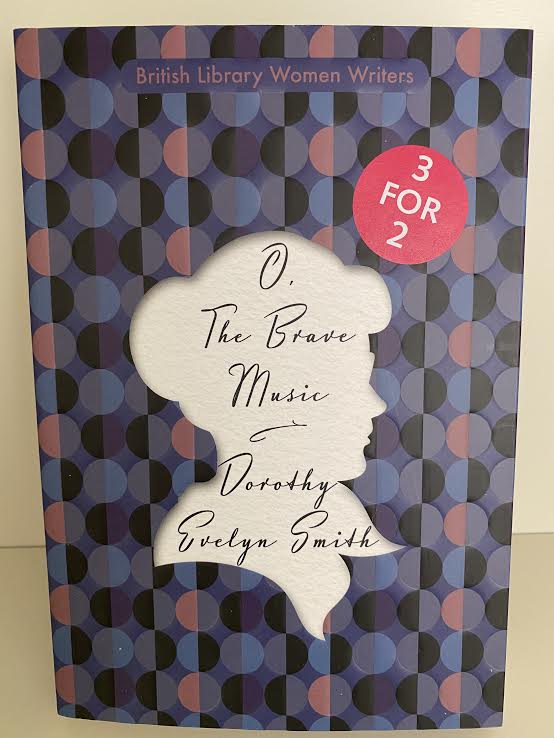
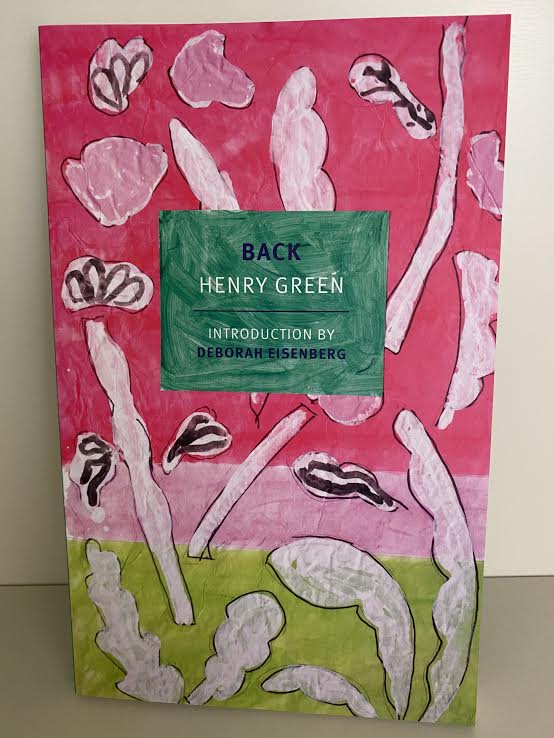
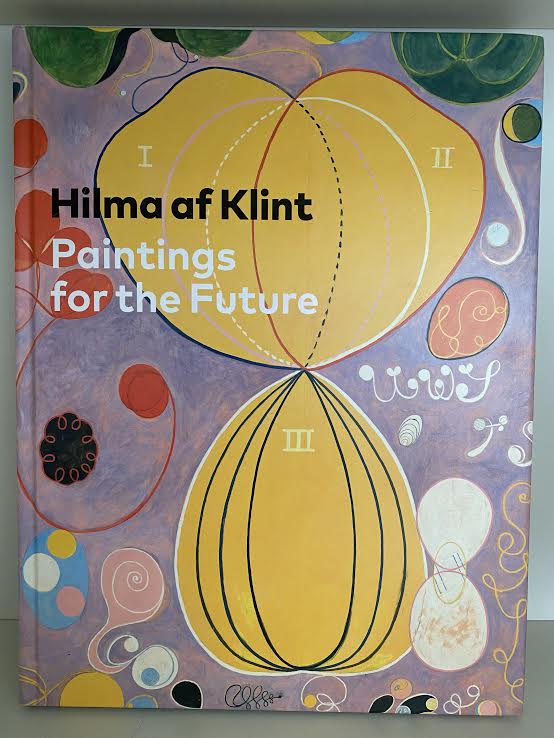
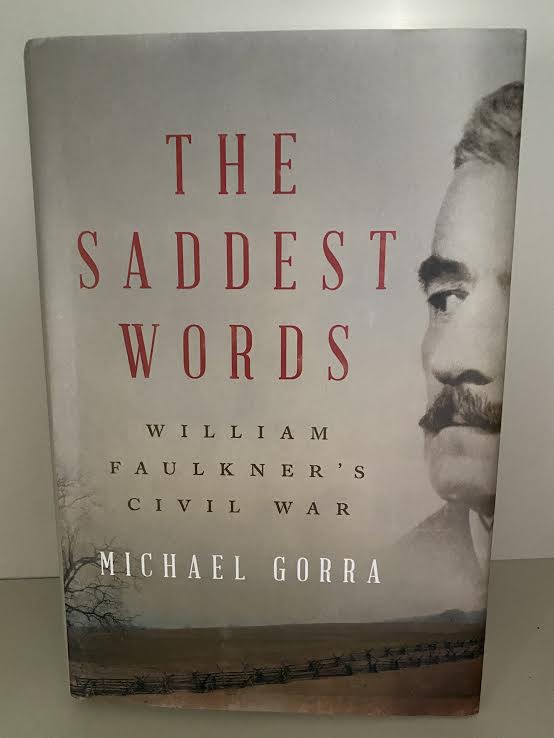
My books aren’t usually this neatly stacked, but I’m trying to impress my readers!I’ve been meaning to try Lispector for ages; with all this new “at home” time, perhaps this will be the year . . This one is Kaggsy’s fault! After reading her September review of a Berridge novella (kaggsysbookishramblings.wordpress.com), I had to try Berridge for myself. I really meant to post a review but — didn’t quite get around to it! I will say, however, that this slightly lurid cover image is rather misleading; clearly the publisher was marketing the novel as a Gothic romance, which it most certainly is not.Another of my books that I’ve actually read! This was the monthly selection automatically sent out by the NYRB Classics Club, so it really doesn’t count against my total. These two novellas are a great introduction to Ginzburg, whom I had not previously read. I loved both novellas and now must get copies of Ginzburg’s other works as well. Another September review, this time by Ali (heavenali.wordpress.com) led to this acquisition. Penelope Mortimer sounded so interesting this novel became a “must.”This one I blame on Simon (at stuckinabook.com). I’ve been following his reviews of this great new series by the British Library (which he is curating) and just had to try one (ahem; actually three — notice the sticker — how could I refuse an offer like this?)I’m reasonably fond of Henry Green (he’s so original that, at least for me, his work takes some getting used to) and haven’t read this one. When it was available on sale by NYRB Classics, there was only one thing to be done . . .What’s a book binge that doesn’t include some art books? The art world has recently rediscovered Klint, a woman painter who was doing abstracts years and years before the big boys like Pollock. I find it very soothing to sit and look at pictures . . .Another art book. I love landscapes but this book has lots of text and looks quite serious. It also has a limited number of pictures. Whatever wasI thinking? Who reads an art book? Perhaps I’ll just place this one in a casual position on the coffee table, to impress my new neighbors when they drop by . . .I don’t think Faulkner’s very fashionable these days and I’m not sure how many people actually read him. I loved Faulkner’s Absalom, Absalom and the few other novels I’ve sampled but . . . there’s no ignoring the fact they were written by a white southern male of the pre-civil rights era. In my opinion, Faulkner views his culture with a merciless and unflinching eye, although he is quite unable to escape its limitations. I’m eager to dip into this study, to see if Gorra shares my view . . . Last but far from least, these two Gothic novels are a trip down memory lane. They were among the first Gothic romances I ever read, oh so very many years ago, very shortly after I read my first Victoria Holts. I was thrilled to rediscover these books a few weeks ago and will be interested to see how they hold up (so far, Sarsen Place is doing pretty well).Maxi says, “Enough blathering about books, Janakay. Move on to the next item on your Happiness List!” There are times, dear reader, when Maxi is as wise as Confucious (and far more sly).
THIRD HAPPINESS
My third happiness is — gasp! new book shelves! Lots and lots of lovely, empty new shelves, just waiting to be filled when I finally complete my move.
Shelves in the living room . . .Shelves in a bedroom . . .Shelves on one side of the dining room and Shelves on the other! And, of course, besides all the shelves, I still have all my old book cases.
Haven’t we all known the agony of triple stacking our beloved treasures, or even (horrors) boxing them away in one of those plastic slidey things that fit under the bed? Could it be that finally I will have enough space to alphabetize my fiction by authors’ last name and group my art books by artists? Reader, is it possible to have a greater happiness than this?
FOURTH (AND FINAL) HAPPINESS
Although I am definitely not an athletic type (turning the pages in my book, or clicking my kindle is quite enough exercise, thank you very much) I do find it absolutely necessary to touch nature at some level for at least some portion of time. In this respect, I’ve been lucky indeed; both my old home and my new have lots of green space.
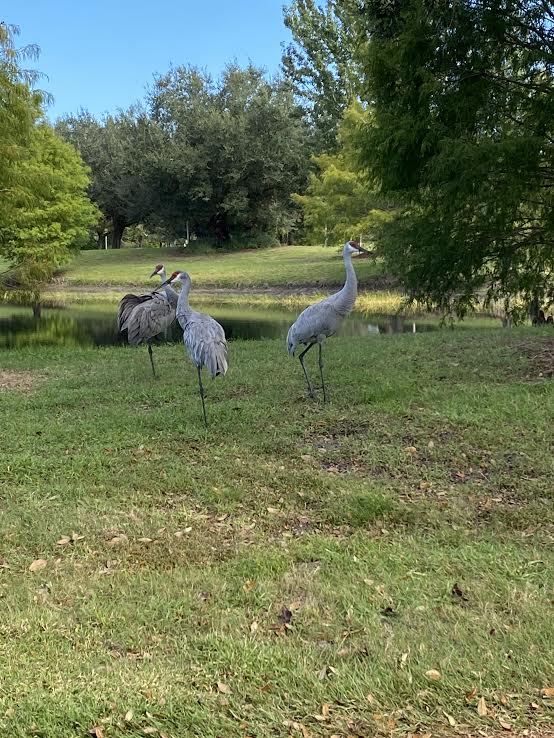
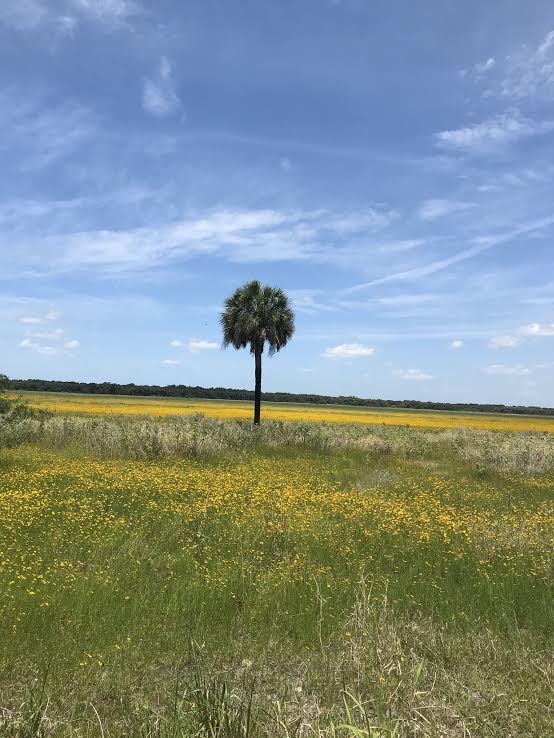
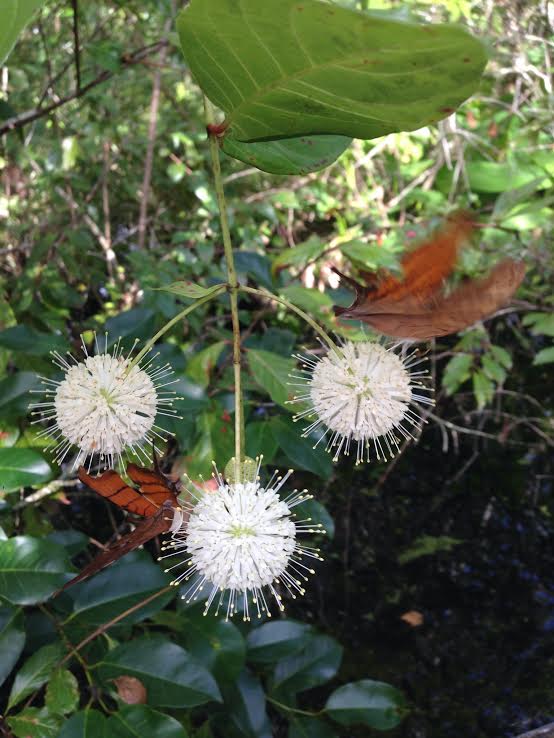
Aren’t these Sandhill Cranes gorgeous, particularly with their red head stripe? There’s nothing to show you the scale, but these are big birds, standing 4 to 5 feet (approximately 152 cm). If you want to see them “live,” plan a trip to North America, where they’re primarily located. This little family group hangs close to my house and seeing them is always a major treat.A classic river scene from a large state park about 20 minutes away from me by car. This photo was taken a few months ago, when it was unbelievably hot. Although I didn’t see any, it’s a very safe bet that this river has alligators! Same state park, different habitat . . . those golden flowers were at their peak when this photo was made earlier in the year (note to self: I really must get a plant book to learn what I’m looking at!)This is an older photo, from an Audubon sanctuary located about 100 miles (160 km) further south from my house. The weird spikey things are flowers and the orange things are butterflies. Aren’t they both marvelous?
Well, that’s it for my Happiness List. What’s on yours, dear reader? What’s keeping you afloat, so to speak, during these dark times?
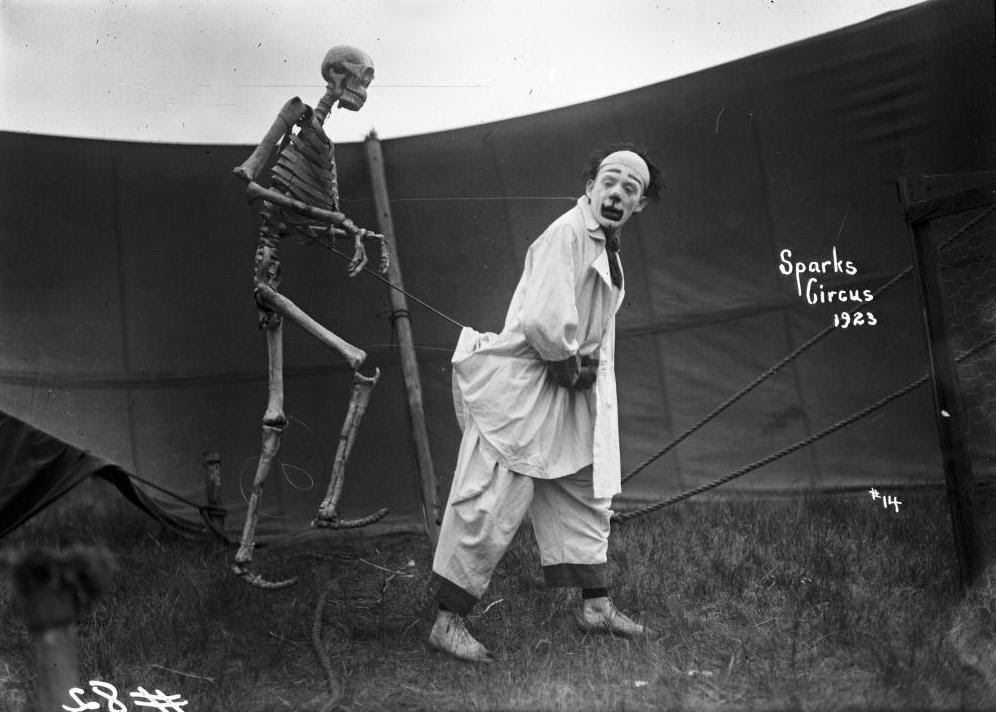
How do you like this rather macabre scene? It’s the work of Frederic W. Glasier, whose extraordinary photos of early 20th century circus performers have recently undergone something of a re-discovery.
Are you, dear reader, a fan of Halloween? It’s a holiday I remember very fondly from my childhood. Decked out in a cardboard witch’s hat (costumes were much less elaborate back in the day), I’d join one of the packs of neighborhood kids and spend a few glorious hours going door to door, free of adult supervision, with a candy bag getting heavier at each stop. The nighttime wandering was followed by the wonderful, if competitive, ritual of examining and comparing our somewhat grubby spoils and making trades. Did the kid next door get more chocolate than I did? Could I persuade one of my little buddies to swap his M&Ms for my green jelly beans (generally the answer was “no”)? Ah, the memories! A lifetime away from the candy haul, I retain a vestigial fondness for this holiday. So, on Halloween night my lights are always on, the candy bowl by the door filled with primo goodies (no green jelly beans at my house) and the bell is always answered, even when the little goblins and space invaders interrupt a chapter in whatever exciting new book I happen to be reading. In short, Janakay has always honored the season!
This year, however, I am totally not into it. Partly it’s my personal circumstances, which have included a long distance move from this:
Can’t you just imagine a forest witch stepping out from those trees at twilight, on this very witchy night of the year?
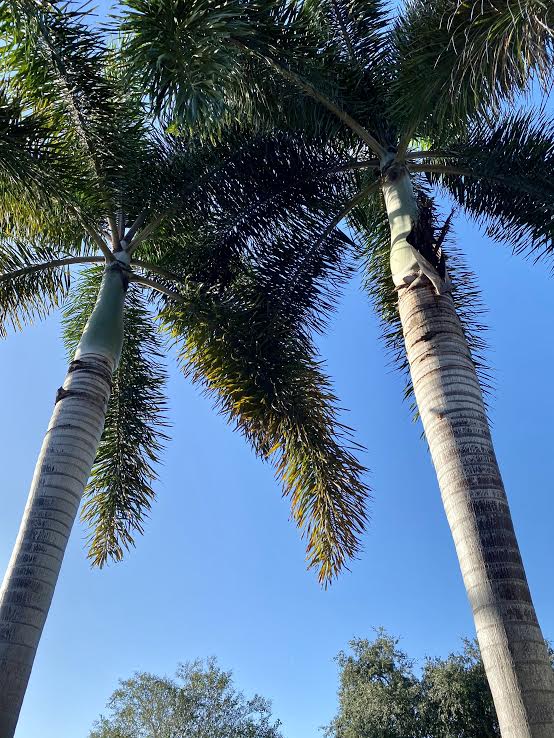
to this:
Despite the menacing angle of Mr. Janakay’s photo, I can’t quite see a hobgoblin emerging from behind one of these palm trees unless it’s wearing a big smile and offering a mimosa! Halloween just doesn’t seem to fit this climate . . .
Primarily, however, the sparkle and playfulness I’ve always associated with Halloween are totally overshadowed this year by the horrors of an ugly and divisive election, civil unrest created by social injustice and a pandemic that has already killed hundreds of thousands. Who can attend to imaginary terrors, when the real things are so frighteningly close at hand?
A news photo of demonstrators; the masks are visible symbols of the terrible disease that’s claimed so many lives (Jose Carlos Fajardo/Bay Area News Group)
One of many polling places near my new residence, thankfully minus the motorcades decorated with banners and flags that seem omnipresent these days (the unfamiliar names you see on some of the signs belong to candidates for such entities as county commission and the mosquito control board, which also appear to be rather hotly contested this election cycle)
But in the midst of chaos and civic unrest, we readers always have our books, don’t we? As I noted last year, I’ve always been fascinated by the fact that we humans love to scare ourselves, as well as by our individual differences in what we each find personally terrifying. I’ve always tended, for example, to favor tales of the occult and supernatural rather than the thriller/slasher brand of horror; more Shirley Jackson and less Freddy Krueger, if that makes sense. And, while I don’t read huge quantities of horror fiction, I have accumulated over the years a clutch of “weird tales,” to use a 1930s term. Although most of my books are still packed and awaiting a home on their new shelves, a quick rummage through what’s available disclosed:
A small but fairly representative sample of my horror fiction, which demonstrates just how versatile the horror genre can be. It includes classics (Sheridan Le Fanu’s Best Ghost Stories and M.R. James); fantasy/sci-fi (Tanith Lee’s Dreams of Dark and Light); conventional mystery with an edge of the occult (Douglas Browne’s What Beckoning Ghost); popular mass market (the great and relatively unknown T.E.D. Klein) and the literary (Margo Livesey’s Eva Moves the Furniture & Hillary Mantel’s wonderful but under-appreciated Beyond Black).
Since I’ve been too enervated and apathetic this year to observe my little ritual of including something creepy and dark in my October reading, I thought I’d share some “horrible” reading from earlier in the year. These are three very different works, read at widely spaced intervals; while I enjoyed all three, I did so in varying degrees. In ascending order of appreciation, I’ll begin with:
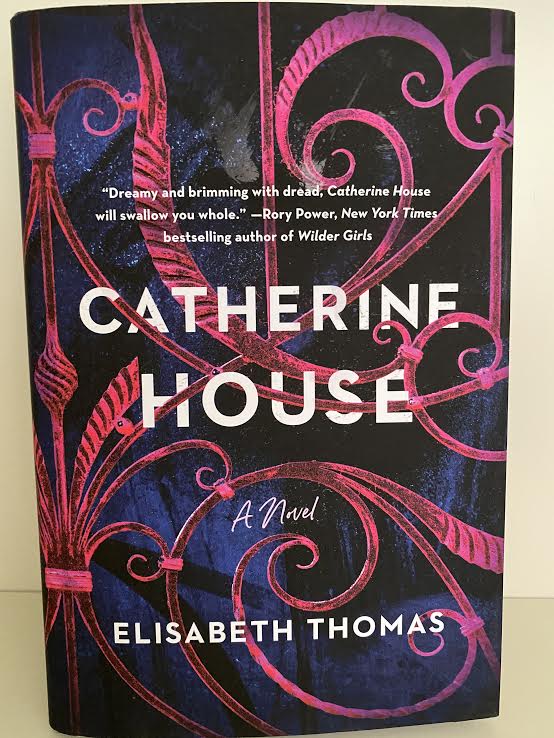
Have you ever, dear reader, moved approximately four thousand books, seven rooms of furniture, a significant other and three very unhappy cats in the middle of a pandemic? Having (barely) survived the experience, being “swallow[ed] . . . whole” by a horror novel was a piece of cake. I spent a week in May soothing myself in Thomas’ debut novel, which follows the adventures of alienated teen Ines Murillo as she navigates her way through the elite corridors of Catherine House, not a college, exactly, although accredited as such; more (2-3)
a community of minds. A crucible of experimental, reformist liberal arts study. Research-and-development institute for the most radical new materials sciences. A postsecondary school more selective than any Ivy League, and so terrifically endowed that tuition was free to any student lucky enough to be accepted. A tiny, pioneering, fanatically private place that by some miracle of chemistry produced some of the world’s best minds; prizewinning authors, artists and inventors, diplomats, senators, Supreme Court justices, two presidents of the United States. A school and an estate: a complex confection of architecture and design, a house — a magnificent house — miles off the highway, in black woods, behind a long iron gate.
In exchange for all this beneficence, students surrender their cell phones, forgo contact with the outside world (including their families) and spend three years secluded on Catherine’s grounds. Does it surprise you, dear reader, to learn that dark deeds are afoot and that Ines, who spends most of her days drinking and — well, engaged in intimate encounters — may be destined for a dark fate? Unfortunately these things were pretty obvious less than halfway through the novel, but Thomas can write and has a real gift for creating an imaginative and disturbing world that’s inhabited by fairly interesting characters (although Ines was admittedly a little tedious at times). If you forget the over the top comparisons to Donna Tart’s Secret History or Ishiguro’s Never Let Me Go (some reviewers never know when to stop, do they?), love novels heavy on atmosphere and don’t mind if you can guess the plot twists, Catherine House is a very enjoyable way to spend a day or two (it clocks in at around 300 pages) and would make a great Halloween read.
A step up from Catherine House, in terms of originality and impact, is
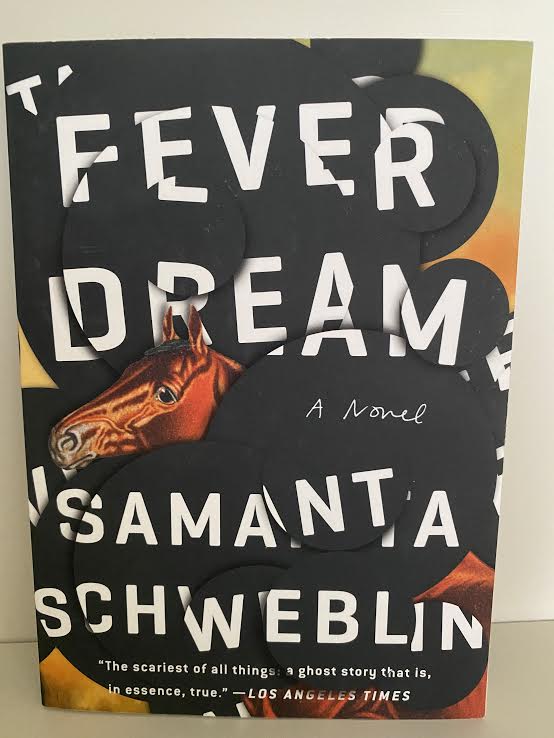
I became interested in Schweblin after reading several very enthusiastic reviews of Little Eyes, her latest novel translated from Spanish into English; I wanted to try Schweblin’s work but didn’t feel up to tackling a full-length novel (her short story collection Mouthful of Birds was off limits because I can’t handle anything involving graphic violence to animals). More a novella than a novel proper (it has 150 pages of very, very large type), Fever Dreams seemed the most accessible introduction to Schweblin’s work. (I actually read this in August, for Spanish Literature month, but never got around to writing a review).
It’s fortunate that Fever Dreams is so brief, because it’s almost impossible to put down once you begin reading it, with its combination of doom, horror and mystery. It’s a tightly structured work, told mostly in conversational questions and answers between Amanda, a young woman who lies dying in a remote, rural hospital, and David, the mysterious child who is not Amanda’s son and whose questions, editings and probings create an almost unbearable level of suspense for both Amanda and the reader. David, you see, is interested in nothing beyond the “worms” or “something very much like worms, and the exact moment” when they first “touch your body.” When Amanda’s account deviates into non-essentials, David reminds her that “there is very little time;” when Amanda doubts the accuracy and reality of her memories, David assures her that her nightmare is indeed real. For all its brevity, Fever Dreams is technically quite complex, as it explains the Amanda and David story arc, set in the present, by means of a dialogue between Amanda and Carla, David’s mother, set in the past. Part environmental disaster, part folk horror and all nightmare, Fever Dreams is an incredible accomplishment. I wasn’t surprised to discover that Granta had recently named Schweblin as one of its top young Spanish language writers or that her subsequent novel was long-listed for the 2020 Man Booker International Prize.
The third (and scariest) of my three scary reads is “The Fly Paper,” a short story by Elizabeth Taylor. Yes, that Elizabeth Taylor, the nice British lady whose reputation has undergone something of a Renaissance in recent times. In the years since I’ve first encountered Taylor (I’ve read almost all of her novels and have begun working on her short stories) my own opinion of her work has shifted significantly, from condescension to true admiration. The surface of Taylor’s deceptively cozy, middle class world can conceal some pretty dark stuff, which is nowhere more evident than in “Fly Paper.” The story concerns Sylvia, a plain and sullen child of eleven with “greasy hair fastened back by a pink plastic slide.” The unmusical Sylvia lives with her grandmother, who won’t let her eat sweets and insists on a weekly music lesson, a torment for the child who’s bullied by her exasperated teacher. Sylvia has received all the usual warnings against speaking to strangers, so she’s duly alarmed when, on her weekly bus ride to her music lesson, a strange man strikes up a conversation and tries to buy her an ice. Her fears are assuaged, however, by a motherly woman who intervenes and invites her to tea. About midway through the story, my flash of where Taylor might be taking me almost literally made me ill and I had to stop reading for a bit. Perhaps I was over reacting, perhaps I was having a bad day, perhaps Taylor was simply a brilliant writer who knew, instinctively or otherwise, that horror is heightened when it’s combined, oh so simply, with the perfectly observed quotidian details of an ordinary day.
“The Fly Paper” was reprinted in this collection of Taylor’s stories published by NYRB Classics, which includes an introduction by Margaret Drabble.
Well, folks, that’s it for this Halloween! It’s time to take a page from Maxi’s book and call it a night.
Maxi says, “A pox on all your electoral factions. Let me sleep.”














 "You Might as Well Read"