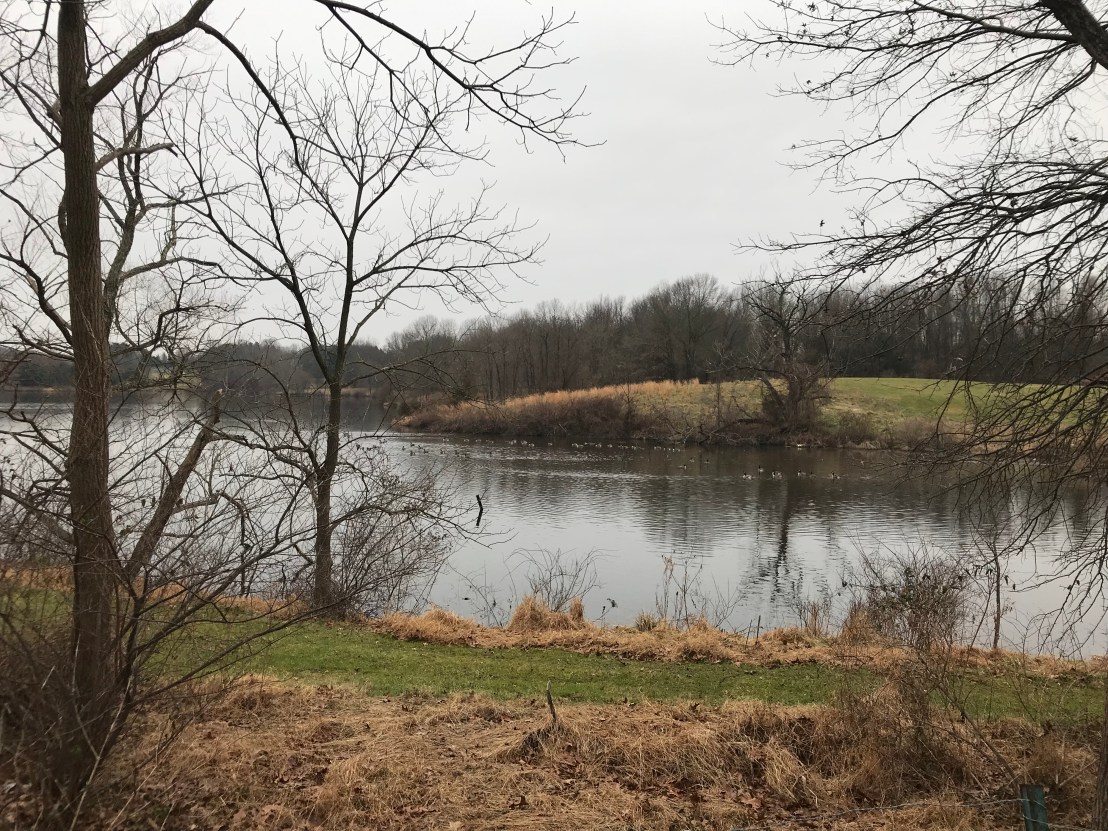
Do you get all introspective on New Year’s Eve or are you a “go out with the crowds and party” type? Or, like most of us, a little of both? Since I’m home working on this post, I guess my choice for this year at least is obvious! Even in my more extroverted periods, however, I’ve always tried to make the end of the year a time for an informal taking stock, for reflecting and for remembering, even if it’s only for a few minutes here and there. Since I’m incapable of sustained thought for more than a few minutes at a time, I stretch this out over a fairly long period, mentally marking out a few weeks, usually mid-December through early January, depending on how busy I am, to make an effort to remember and reflect here and there. You can do this any time of year, of course, but it works best for me at the calendar’s end, the time of darkness and hope, of ends and beginnings. As you can see from the photo of my New Year’s Eve outing, I love including nature in this process. When one’s in a certain mood, there’s nothing to match the brooding and poetic melancholy of a winter’s day.
Since this is a book blog, I’ll confine my end of the year reflections to books. I just finished looking at my “books read” list for 2018; when I become a bit more technologically adept (and have more time) I’ll add it to the blog. I know we all say numbers don’t matter, but then — don’t we all count how many books we’ve read in a particular year? In 2018 I completed about 51 books (I say “about” because I skimmed two very long books and compromised by counting them as one; similarly I squashed two lengthy, related novellas together for a single “count” and I’m about five pages from finishing my last book for 2018). This is fewer than I usually read; also my list this year is much lighter in content and less challenging than in certain years past. I’m a pretty ecletic reader, although these days I read far fewer non-fiction books and 19th century novels; my list includes literary fiction, a classic or two, historical fiction, mystery/thrillers and lots of fantasy & sci-fi (I grew up reading sci-fi & fantasy paperbacks poached from my dad’s collection and loved Asimov and Heinlein as much as I did classical mythology).
I took a bit of a trip down memory lane in 2018, re-reading several books that I first encountered in my teens and twenties, primarily to see how I’d react to them now. These included Richard Powell’s Whom the Gods Would Destroy (a re-telling of the Tojan War; the book is now out of print but available in electronic format) and Judith Rossner’s His Little Women (Anyone remember Judith Rossner? In this particular novel she “updated” Alcott’s Little Women to modern day Hollywood; Rossner’s little women are the daughters of an overbearing Hollywood producer); many years ago I thoroughly enjoyed both works. A third re-read was Shirley Jackson’s We Have Always Lived at the Castle, which I hadn’t much liked when I encountered it in my twenties, immediately after devouring Jackson’s The Haunting of Hill House. My 2018 verdict on these reads of yesteryear? If you’re a Trojan War buff with a thing for Cassandra, you might check out Powell. Make time for Jackson; if Castle isn’t her masterpiece it’s close and skip Rossner unless you’re a serious masochist (at the risk of losing your good opinion, on my re-read I actually did enjoy the first 40 percent of the novel but found everything after Jo –oops! I meant “Nell” — grows up to be a pretty tough slog).
My 2018 list also included two memoirs, and one autobiography, genres that I have successfully avoided until now. My reaction to these works was mixed. Paul Kalanithi’s When Breath Becomes Air was everything it was cracked up to be — a moving, unsentimental look at how a brilliant, driven personality dealt with something that couldn’t be dealt with (Kalanithi died from cancer at age 37, just as he was completing his residency in neurosurgery). J.D. Vance’s Hillbilly Elegy was — well — I’d have to write a separate post to explain my complicated reaction to J.D.’s hillbilly to tech mogul odyssey. I’ll let it go for now by saying there was much in it I admired and identified with and much that I found intensely troubling. My autobiographical read was Benvenuto Cellini’s My Life, which honesty compels me to disclose was required reading for a course in Renaissance art. Although I found it tough going at times, I’m very glad I persevered and would highly recommend it for anyone interested in the Renaissance, the artistic process or colorful personalities (Cellini was a great artist who was also a self-confessed murderer of at least three people).
Although I felt my 2018 reading list was a bit blah, the year did contain some surprises and unexpected pleasures. These did not always coincide with critical acclaim. Two new authors who I thought did live up to their hype were Tommy Orange and Lisa Halliday. I wouldn’t normally have read Orange’s There, There (it struck me as a bit too grim) but at some point I just surrendered to the buzz and pieced it in between classes; his tale of urban Indians, set in Oakland, and written with great skill, blew me away. It also gave me a renewed sense of a certain side of American history which I’m all too prone to forget. Orange is now on my radar, which means I’ll definitely read his second book whenever that should appear. My reaction to Halliday’s Asymmetry was a bit more measured. She’s an impressive talent and Asymmetry’s cleverly done; the “Madness” section centering on a young Iraqi-American detained by immigration officials at Heathrow was chilling, but my enjoyment of the whole was less than my admiration of its parts. Daisy Johnson was another emerging light this year, with her debut novel Everything Under. I found it an odd and interesting book, beautifully written; the complex time shifts were skillfully handled and the characters’ complicated relationships rendered quite believable, no mean feat for such a fantastical story. Although I was less wowed by her novel than were the critics it’s definitely worth reading, especially if you’re interested in stories with an underpinning in Greek mythology. My 2018 reaction to Michael Ondaatje, a long acknowledged literary lion, was unreservedly positive. To date I haven’t read much of his work (I missed The English Patient) but that may change after Warlight, which I absolutely adored. As far as I’m concerned Warlight had it all: wonderful writing, strong atmosphere (I’m a sucker for atmosphere & setting), a good plot and interesting characters. Another veteran writer, Alan Hollinghurst, turned out a good if not great read in The Sparsholt Affair — I was definitely surprised when it didn’t make the Booker long list and thought that perhaps it should have.
On a less lofty plane, perhaps, I found several books in 2018 (not all of them published that year) that were very well written and fun to read but didn’t seem to make any “best of their year” lists. Did anyone read Aja Gabel’s The Ensemble? Since I like novels about tight little groups and how they do, or don’t cope with each other (Donna Tart’s Secret History is a fav of mine) and I also like string quartets, I was destined to love Gabel’s novel about four young classical musicians and how they develop as people and artists over a period of years. Gregory Blake Smith’s The Maze at Windermere, one of my favorite reads of 2018, was a well written and absorbing story that wove back and forwards in time to tell the stories of a number of characters loosely associated with Newport, Rhode Island over a period of two centuries. Think David Mitchell’s Cloud Atlas in an American setting (well — sort of). Daryl Gregory’s Spoonbenders was a light, enjoyable tale of a family of psychics; the plot was tightly woven, if a bit over the top, and the book as a whole funny and absorbing, with a slight underpining of melancholy. For those of a slightly more Gothic turn of mind, I’d highly recommend Sarah Perry’s Melmoth, with its wonderfully atmospheric descriptions of snowy evenings in Prague or the stifling heat of a tropical Manila and its tale of the doomed Melmoth, destined to walk the earth until the day of Judgment.
It wouldn’t be a time of bookish reflection, would it, without noting the books that were abandoned, as well as completed? I’m a firm believer that abandoning a book reflects less on a book’s quality than it does on one’s own readiness to read it. With that standard in mind, 2018 was a year in which I wasn’t ready to read several critically acclaimed novels. Most notable, perhaps, was Meg Wolitzer’s The Female Persuasion, which I stopped reading about three-quarters of the way through (I must admit — I did skip to read the end!) It was my first novel by Wolitzer and in many of the ways lived up to its hype, but for some reason it just didn’t hold my interest. Perhaps it was just too topical, in these days of the me too movement. Why read a novel when you can read the news? Another discarded read was Rachel Kushner’s The Mars Room. About two hours after reading a chunk and thinking “this is really quite good,” I put the novel aside and haven’t returned yet. A third discard was Guy Gunaratne’s In Our Mad and Furious City, much hyped across the pond (a debut novel, long listed for the Booker), less glowingly received by our very own New York Times. Halfway through and in the middle of the action, I just thought “I’ve had enough” and that was that for City. Three good (City) to very good (Mars Room) novels, freely acknowledged as such by me and others, that I will probably never finish. What can I say, except that the Book Gods are fickle?
In closing (and if anyone has lasted this long, I just bet you’re breathing a sigh of relief!), I really must comment on Elizabeth Savage’s Last Night at the Ritz. Aside from its title, which ties in well with my mood of endings and reflection, Last Night also happens to be my last read of 2018 (I’ll finish it after I sign off, along with my very much anticipated glass of champagne!). Long out of print, it was resuscitated as part of Nancy Pearl’s Book Lust Rediscoveries series for Amazon, where it has generally received a series of three star reviews (for those residents of the outer planets who have never purchased from Amazon, a five star review is the highest). Last Night is a wonderful book, for the right reader and the right frame of mind; which is to say it should be avoided by teetotalers (Savage’s characters drink more than Mad Men), those who can’t stomach privileged, upper class protagonists and readers who want no part of a by-gone era whose social mores don’t correspond to our own. The story is told in the first person, by a nameless female narrator who’s back in Boston and having a celebratory night with her college roommate from thirty years before; the two women are joined by the roommate’s husband and the (married) narrator’s ex-lover. Although the time frame is confined to a single evening, Savage uses flashbacks, interior monologues and reminiscenses to very convincingly depict a lifetime of complicated relationships. At the end of the evening, you really understand the title and appreciate that there’s more to the brash, breezy narrator than you first suppose. As an added bonus, both women are fairly erudite readers and the novel is replete with references to books. It’s also a treasure trove of quotable lines. My own favorite? “It is very dangerous to get caught without something to read.”
And on that note — good-night and happy New Year! May you never be caught, in 2019 or ever, without something to read!
 "You Might as Well Read"